On this page
What Are Google Search Ads?
Search campaigns show text-based ads across Google’s search results when a user’s query is eligible for your targeting. Google describes Search campaigns as a way to drive sales, leads or website traffic by reaching people actively searching for specific products and services.
The traditional building blocks remain familiar – campaign, ad groups, keywords, responsive search ads and assets – but modern Search increasingly layers AI-powered matching, bidding and creative optimization on top of those controls.
KEY DISTINCTION
Search captures demand that already exists. It does not automatically make that demand profitable. Profitability depends on what searches you buy, how well the ad qualifies the click, what happens on the landing page, and whether Google receives accurate conversion-quality signals.
Why Google Search Ads Work for Lead Generation
| Search Advantage | Why It Matters for Leads |
|---|---|
| High-intent timing | A prospect can search immediately when the problem or need is active |
| Query-level demand | Search language reveals what the prospect wants |
| Geographic control | Useful for local and regional service businesses |
| Message relevance | Ads can align closely with the searched need |
| Conversion-focused bidding | Bidding can optimize toward conversions or conversion value |
| Measurable funnel | Clicks, forms, calls, qualified leads and sales can be connected when tracking is designed correctly |
Search is especially useful when customers already know how to describe the problem or solution. It can be less effective when the market has little existing search demand, when the offer requires extensive education, or when the economics cannot support the auction cost.
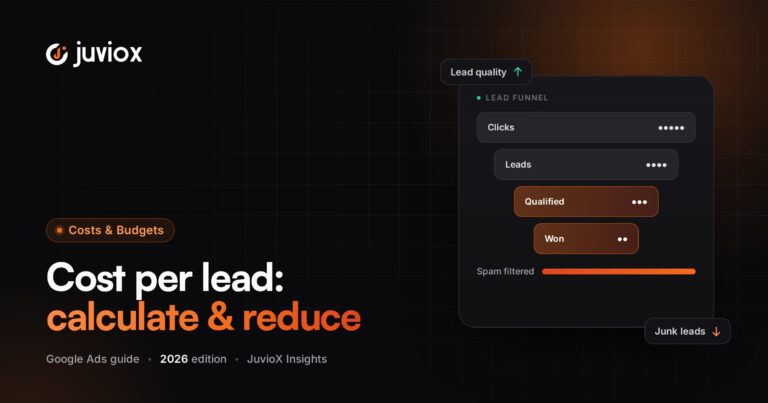
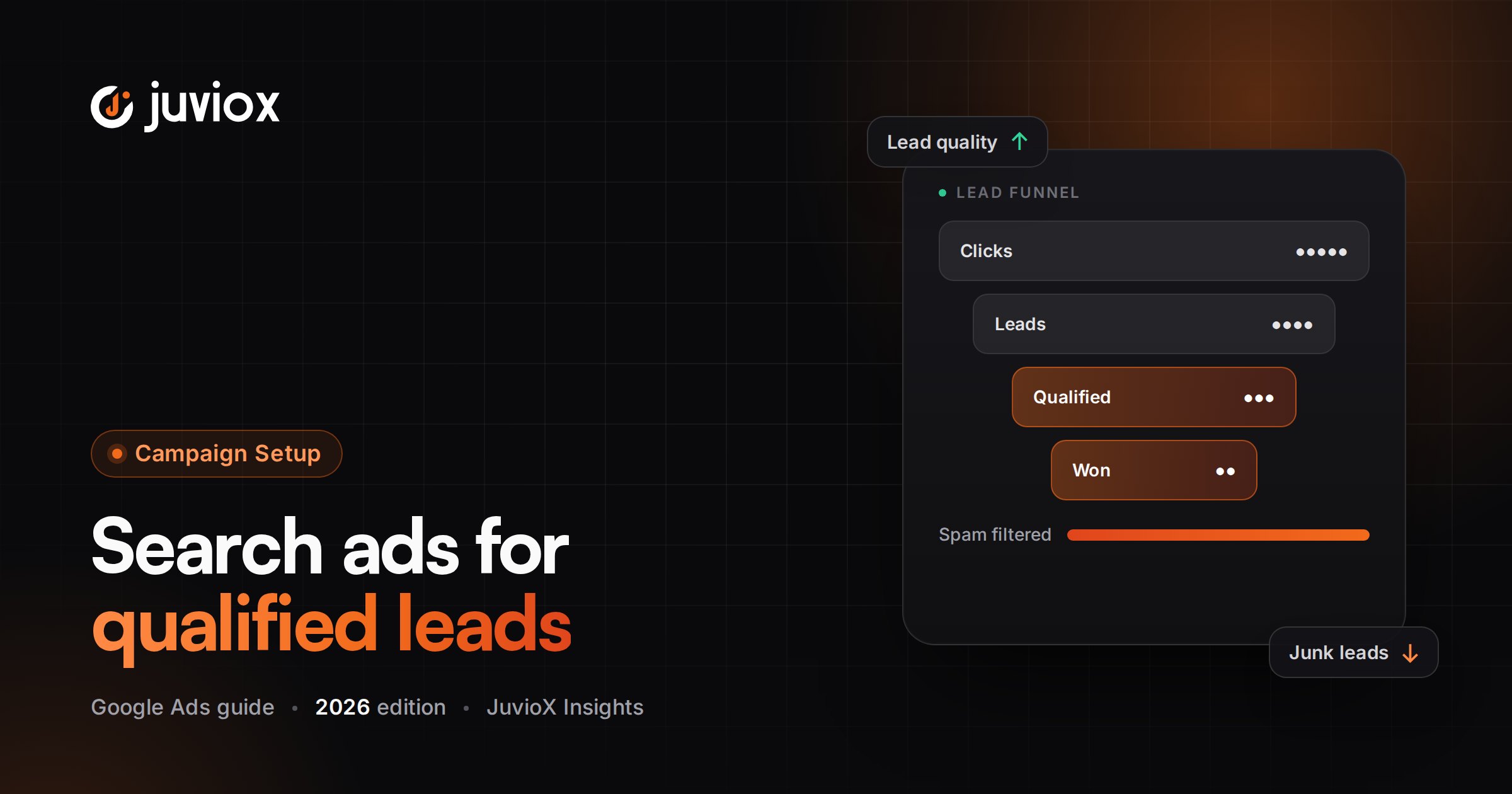
The Qualified-Lead Funnel
Most Google Ads reports stop too early. For lead generation, the measurement chain should continue beyond the form submission.
| Stage | Example Metric | What It Answers |
|---|---|---|
| Search demand | Search term / impression | Are we reaching relevant demand? |
| Ad engagement | CTR / click | Does the message earn the right clicks? |
| Website action | Form / call / booking | Does the page convert traffic? |
| Qualified lead | Qualified lead rate | Are the leads actually relevant? |
| Sales opportunity | Opportunity rate / cost per opportunity | Does sales consider the lead viable? |
| Customer | CAC / revenue / profit | Did advertising create business value? |
JUVIOX PRINCIPLE
Do not optimize a lead-generation campaign to the cheapest form submission if cheap forms produce poor prospects. The strongest campaign teaches Google which conversions represent qualified business outcomes.
Before You Create the Search Campaign
- Define the primary business outcome: call, form, booking, quote request, demo or another lead action.
- Decide what qualifies as a good lead and how that status will be recorded.
- Verify website and phone conversion tracking.
- Identify the landing page for each major search-intent theme.
- Set the geographic service area and exclusions.
- Define an initial budget and acceptable CPL/qualified CPL/CAC.
- Prepare the core keyword themes and initial negative-keyword list.
- Confirm who owns lead follow-up and how quickly leads enter the CRM.
Campaign setup should be the final expression of the business strategy, not the first step.
How to Set Up a Google Search Campaign
Google’s current Search campaign creation flow begins with a goal and requires at least one conversion goal. Search can be created for Sales, Leads or Website traffic, or without goal guidance, but conversion goals still matter for campaign performance optimization.
- Create a new campaign and select the business objective.
- Choose Search as the campaign type.
- Review the conversion goals Google will use for campaign optimization.
- Name the campaign with a consistent naming convention.
- Set location and language based on where the business can actually serve customers.
- Choose the bidding strategy according to the conversion data and business goal.
- Set a budget that can generate enough meaningful traffic to evaluate performance.
- Create tightly themed ad groups around search intent.
- Add keywords/match types and exclusions intentionally.
- Create responsive search ads and relevant assets.
- Map each ad group to the most relevant landing page.
- Review AI Max settings and controls before publishing.
- Verify tracking again before meaningful spend begins.
IMPORTANT 2026 UPDATE
New Search campaigns currently have AI Max selected by default in Google’s setup flow. Treat that as an optimization choice to review – not a setting to accept without understanding its matching, creative and URL behavior.
Choose the Right Conversion Goals Before Bidding
A conversion-focused campaign learns from the goals you tell it to value. If newsletter signups, low-intent micro actions and qualified sales inquiries are all treated as equally important primary conversions, automated bidding can pursue the easiest action rather than the most valuable one.
| Conversion | Typical Role | Lead-Gen Consideration |
|---|---|---|
| Qualified website form | Primary | Strong when form quality is controlled |
| Phone call meeting quality threshold | Primary or carefully configured | Track meaningful calls, not every tap |
| Booked consultation/demo | Primary | Often closer to business value |
| Google-hosted lead form | Primary when intentionally used | Evaluate downstream quality separately |
| Page view / button click | Secondary/diagnostic | Usually too weak for bidding |
| CRM qualified lead / opportunity | Imported/enhanced business signal | Powerful for optimizing toward quality |
QUICK RULE
Primary conversions should represent outcomes you genuinely want the bidding system to maximize. Secondary actions can still be measured without steering bidding.
Campaign Structure: Keep Control Without Fragmenting Data
Search campaigns should be separated when there is a real campaign-level reason – different budget, geography, business objective, conversion economics or strategic control. Within the campaign, ad groups should represent coherent search-intent themes that need distinct messaging or landing pages.
Avoid rebuilding the entire campaign-structure topic here. For the full decision framework, see our Google Ads campaign structure guide.
STRUCTURE RULE
Campaign = control boundary. Ad group = relevance boundary. Do not create extra campaigns or ad groups simply to make the account look granular.
Keywords, Search Intent and Match Types
For lead generation, intent is more important than raw keyword volume. “emergency commercial electrician” and “how does electricity work” may both relate to electrical services, but they represent completely different business opportunities.
| Intent | Example | Typical Lead-Gen Value |
|---|---|---|
| Hire-now / transactional | commercial electrician near me | High |
| Commercial investigation | best commercial electrician company | High to medium |
| Problem/solution | office power keeps tripping | Potentially high if service matches |
| Informational | how circuit breakers work | Usually lower for direct-response campaigns |
| Jobs/training | electrician jobs | Usually exclude for customer-acquisition campaigns |
Use broad, phrase and exact match according to the account’s control requirements and measurement maturity. Modern Google matching increasingly interprets meaning rather than requiring exhaustive variations. For the full methodology, read our keyword research and match types guides.
Responsive Search Ads Should Qualify the Click
A strong Search ad does more than increase CTR. It tells the right prospect, before the click, why the offer is relevant and what action comes next.
| Ad Element | Lead-Generation Job |
|---|---|
| Headline | Mirror high-value intent and communicate the core offer |
| Benefit / differentiator | Explain why the prospect should choose you |
| Qualifier | Clarify service area, audience, minimum requirement or relevant constraint where useful |
| Proof | Reviews, credentials, experience, guarantee or other verified trust signal |
| CTA | Request quote, book consultation, call now, get assessment, etc. |
| Final URL | Send the click to the page that best fulfills the searched intent |
CTR IS NOT THE GOAL
An ad that gets fewer clicks but filters out poor-fit prospects can outperform an ad with a higher CTR if the resulting qualified CPL and customer acquisition cost are better.
Use Assets to Give Prospects More Ways to Convert
Search assets can expand the ad and help prospects take useful actions. Depending on eligibility and business needs, this can include sitelinks, call assets, lead form assets and other asset types.
- Use sitelinks to expose high-value service or proof pages.
- Use call assets when phone calls are a genuine conversion path and call tracking is configured.
- Use lead form assets when reducing form friction fits the lead strategy.
- Use assets to add useful information, not simply to occupy more screen space.
Landing Pages: Where Search Intent Becomes a Lead
The landing page should continue the promise made by the keyword and ad. A generic homepage often forces the visitor to rediscover the information they already searched for.
| Landing-Page Requirement | What Good Looks Like |
|---|---|
| Message match | Headline immediately confirms the searched service/problem |
| Clear offer | Visitor understands what they can request or receive |
| Trust | Relevant proof, reviews, certifications or case evidence |
| Low friction | Form asks only what is useful for conversion/qualification |
| Mobile usability | Fast, readable, easy form/call experience |
| Tracking | Form, call, booking and key downstream events are measured |
CRO CONNECTION
CPC is determined in the ad auction, but profitability is heavily influenced after the click. Improving conversion rate can reduce CPL even when CPC stays the same.
Bidding and Budget Strategy for Lead Generation
Bidding should match the maturity of the measurement system. Conversion-focused Smart Bidding becomes more useful when Google receives enough accurate conversion data and the conversion itself represents business value.
| Situation | Strategic Consideration |
|---|---|
| New campaign / limited data | Avoid forcing unrealistic efficiency targets before the system has evidence |
| Stable conversion tracking | Conversion-focused bidding can use auction-time signals |
| Different lead values | Use value/quality signals where possible instead of treating every lead equally |
| Budget constrained | Prioritize highest-value intent and geography before expanding reach |
| Scaling | Increase reach only while monitoring qualified CPL, opportunity cost and CAC |
Budget decisions should connect expected CPC, conversion rate and acceptable acquisition cost. The cost and budget, CPC and CPL guides cover those formulas in full.
AI Max for Search Campaigns in 2026
AI Max is not a separate campaign type. It is an optimization layer within Search campaigns. Google’s current documentation describes two main feature areas: search term matching and asset optimization.
AI Max can expand matching beyond the existing keyword set, optimize creative text, and use final URL expansion to improve landing-page relevance. New Search campaigns currently have AI Max selected by default during setup.
| AI Max Area | Potential Benefit | Lead-Gen Risk to Manage |
|---|---|---|
| Search term matching | Find additional relevant queries | Expansion can expose weak demand if measurement/controls are poor |
| Text customization | Adapt creative to user intent | Brand/compliance messaging must still be reviewed |
| Final URL expansion | Route users to relevant pages | Website architecture and tracking must be reliable |
| Reporting/controls | Additional visibility and controls are available | Teams still need to evaluate query and lead quality |
BEST USE OF AI
AI should expand a well-measured system, not hide a weak one. Before increasing automation, make sure conversion goals, landing pages, exclusions and CRM feedback accurately describe what a valuable lead looks like.
Lead Form Assets: Website Lead vs Google-Hosted Lead
Google currently allows lead form assets in Search and Performance Max. In Search, responsive search ads can use lead forms, and campaigns can be configured so a headline interaction opens a Google-hosted form in eligible setups.
| Website Form | Google Lead Form |
|---|---|
| More control over page, qualification and brand experience | Lower-friction form directly within the ad experience |
| Can expose detailed proof before submission | Can capture interest before the user visits the site |
| Requires strong mobile landing-page UX | Requires privacy policy and Google lead-form eligibility |
| Lead delivery comes through site/CRM integration | Google supports CSV, email, API/webhook and other lead-delivery options |
Google also offers lead-form optimization choices oriented toward more volume or more qualified leads, and supports custom questions/qualification features in eligible configurations.
DO NOT JUDGE BY CPL ALONE
Google-hosted forms can reduce friction, but the correct comparison is qualified lead rate, opportunity rate and customer acquisition cost – not just form-submission cost.
Conversion Tracking: Measure More Than the Form Submit
For Search lead generation, tracking should connect the ad click to the website conversion and, where possible, the later sales outcome.
- Google Ads conversion tracking for primary lead actions
- Enhanced conversion/first-party lead measurement where appropriate
- Call conversion tracking for meaningful phone leads
- GA4 for independent behavior/reporting context
- CRM status such as qualified lead, opportunity, won/lost
- Revenue or value where the business can reliably assign it
The exact implementation depends on the website, CRM, consent requirements and sales process. The objective is consistent: give the advertising system a truthful picture of business outcomes.
Feed Qualified Lead and CRM Outcomes Back Into Optimization
Lead-generation accounts often fail because Google can see the form submission but cannot see what sales sees afterward.
| Lead A | Lead B |
|---|---|
| Submitted a form | Submitted a form |
| Valid business in target market | Spam / student / wrong location |
| Sales contacted | Never qualified |
| Opportunity created | No opportunity |
| Potential customer value: high | Business value: zero |
If both are counted identically forever, the platform receives an incomplete signal. A mature lead-gen setup connects qualified/offline outcomes back to campaign analysis and, where appropriate, bidding.
OPTIMIZATION HIERARCHY
Prefer Customer/Revenue > Opportunity > Qualified Lead > Raw Lead > Click. The closer your optimization signal gets to business value, the less likely you are to scale cheap but useless conversions.
Search Terms and Negative Keywords: Control the Demand You Buy
After launch, the Search Terms Report becomes one of the most important optimization tools. It shows the real queries behind eligible traffic and helps you decide what to keep, exclude, promote or investigate.
- Exclude clearly irrelevant demand with carefully chosen negative keywords.
- Promote valuable recurring query themes when doing so improves control, messaging or reporting.
- Investigate expensive terms before pausing them – a high CPC can still be profitable.
- Review search quality alongside lead quality, not clicks alone.
- Watch how query mix changes after match-type, bidding or AI Max changes.
For the full workflows, see our negative keywords and search terms report guides.
The JuvioX Search Lead-Generation Optimization Loop
- Verify tracking and primary conversion goals.
- Review spend, clicks, conversions and CPL for directional issues.
- Analyze search terms for relevance and intent.
- Check ad-to-query and landing-page message match.
- Review qualified lead rate and CRM outcomes.
- Identify whether the bottleneck is traffic quality, CPC, conversion rate or sales quality.
- Make one meaningful class of change at a time where possible.
- Monitor enough data to distinguish signal from short-term noise.
- Feed new negatives, new high-value themes and qualification insights back into the campaign.
- Scale only when qualified economics remain acceptable.
DIAGNOSTIC FRAMEWORK
High CPL is not a diagnosis. It can come from expensive clicks, poor search intent, weak ads, a low-converting landing page, broken tracking, low lead quality or an unrealistic target. Find the broken stage before changing bids.
Example 1: Local Service Lead Generation
| Layer | Example |
|---|---|
| Campaign | Search | Emergency Electrician | Core Service Area |
| Intent | Emergency electrician, same-day repair, commercial electrical emergency |
| Conversion | Qualified phone call + website request |
| Ad | Availability, service area, verified differentiator, call/request CTA |
| Landing page | Emergency service page, trust proof, service area, call/form |
| Optimization | Search terms + call quality + booked jobs |
Example 2: B2B Service / Consulting
| Layer | Example |
|---|---|
| Campaign | Search | High Intent | Consultation |
| Intent | Service category + agency/consultant/provider terms |
| Conversion | Qualified consultation request |
| Ad | Business outcome, specialization, proof, consultation CTA |
| Landing page | Dedicated service page with case proof and qualification form |
| Optimization | Qualified lead -> opportunity -> closed revenue |
Example 3: High-Ticket Home Service
| Layer | Example |
|---|---|
| Campaign | Search | Installation / Replacement |
| Intent | Replacement, installer, quote, cost + service intent |
| Conversion | Quote request / booked assessment |
| Ad | Offer, financing/availability if verified, location, CTA |
| Landing page | Service-specific page with proof and quote path |
| Optimization | Lead quality + appointment rate + sale value |
Common Google Search Ads Lead-Generation Mistakes
| Mistake | Why It Hurts | Better Approach |
|---|---|---|
| Optimizing only for clicks | Clicks do not equal leads or revenue | Optimize through qualified business outcomes |
| Counting every micro action as primary | Bidding can chase easy low-value events | Use primary goals deliberately |
| One generic landing page for every intent | Weak message match and conversion rate | Map major intent to relevant pages |
| Broad expansion with weak tracking | Automation learns from poor signals | Fix measurement before scaling reach |
| No search-term review | Irrelevant demand can persist | Review queries and negatives continuously |
| Judging success by raw CPL | Cheap leads can be low quality | Track qualified CPL/opportunity/CAC |
| Over-segmenting campaigns | Fragments budget and learning | Separate only meaningful control boundaries |
| Ignoring lead response process | Good leads can be lost after submission | Connect marketing with CRM/sales follow-up |
| Changing many variables at once | Hard to know what caused performance movement | Use disciplined optimization/testing |
Google Search Campaign Launch Checklist
- Primary conversion goals verified and deduplicated
- Lead qualification definition documented
- Location and language settings reviewed
- Campaign budget and acquisition target are realistic
- Ad groups map to coherent search intent
- Keyword and match-type strategy documented
- Initial negative-keyword list added
- Responsive search ads communicate offer, proof and CTA
- Relevant assets added
- Landing pages match the search intent and work on mobile
- Form/call/booking tracking tested
- CRM lead delivery tested
- AI Max settings reviewed rather than accepted blindly
- Lead form asset strategy decided
- Search-term review cadence assigned
- Qualified lead/opportunity reporting plan defined
Final Takeaway: Optimize Search Ads for Customers, Not Form Fills
A high-performing Search campaign is a connected lead-generation system. Search intent determines who enters. The ad qualifies the click. The landing page converts the prospect. Tracking records the action. The CRM determines whether the lead is real. Sales turns qualified demand into revenue. Google Ads should learn from as much of that chain as your measurement architecture can reliably provide.
That is how Search moves from a traffic channel to a measurable growth engine.
GOOGLE ADS MANAGEMENT
Build Search Campaigns Around Qualified Growth
JuvioX connects Search strategy, conversion tracking, landing-page performance and lead-quality data so campaigns optimize toward real business outcomes – not just more clicks or cheaper form submissions.
FAQ
Frequently asked questions
What are Google Search Ads?
They are ads that can appear on Google search results when a user's search is eligible for your Search campaign targeting and the ad wins the auction.
Are Google Search Ads good for lead generation?
They can be excellent when customers actively search for the product/service and the campaign connects that demand to a strong offer, landing page, tracking and follow-up process.
How do I create a Google Search campaign?
Create a new Google Ads campaign, choose an objective and Search campaign type, review conversion goals, configure settings/bidding/budget, create ad groups, keywords and responsive search ads, then verify tracking before launch.
What is a good conversion rate for Google Search Ads?
There is no universal number. Conversion rate varies by industry, intent, offer, device, geography and what counts as a conversion. Judge it alongside qualified CPL and customer economics.
Should I use Broad, Phrase or Exact match for lead generation?
Use the mix that fits your control requirements, Smart Bidding strategy, data quality and market. Broad can access more contextual matching, while phrase/exact can provide tighter eligibility constraints.
What is AI Max for Search?
AI Max is an optimization layer within Search campaigns that includes enhanced search term matching and asset optimization features. It is not a separate campaign type.
Is AI Max automatically enabled?
As of August 2026, Google's setup documentation says new Search campaigns have AI Max selected by default. Advertisers should still review its individual settings and controls.
Can Google Search Ads collect leads without a landing page?
Eligible Search campaigns can use Google-hosted lead form assets. However, whether that is better than a website form should be judged by qualified lead and sales outcomes.
How do I reduce CPL in Google Search Ads?
Diagnose the cause first: CPC, search intent, ad relevance, landing-page conversion rate, tracking or lead quality. Then improve the broken stage rather than simply lowering bids.
How often should I optimize a Search campaign?
Monitor frequently enough to catch tracking or spend problems, but make strategic decisions based on sufficient data. Search terms and lead quality should be reviewed on a consistent operating cadence.
What should I track besides form submissions?
Where possible, track qualified leads, booked appointments, sales opportunities, customers, revenue/value and meaningful phone calls.
Should I use Google Search Ads or Performance Max for leads?
They serve different strategic roles. Search provides strong query-led control over existing demand; Performance Max can expand across Google inventory. The right mix depends on goals, data, creative assets and measurement quality.
8 sources & references
- Google Ads Help - Create a Search campaign
- Google Ads Help - About AI Max for Search campaigns
- Google Ads Help - How AI Max for Search campaigns works
- Google Ads Help - Set up AI Max for Search campaigns
- Google Ads Help - About lead form assets
- Google Ads Help - Create lead form assets
- Google Ads Help - How to use lead forms in responsive search ads and campaigns
- Google Ads Help - Best practices for generating high-quality leads