- Data-Driven Google Ads
Google Ads Campaigns Built to Drive Profitable Growth
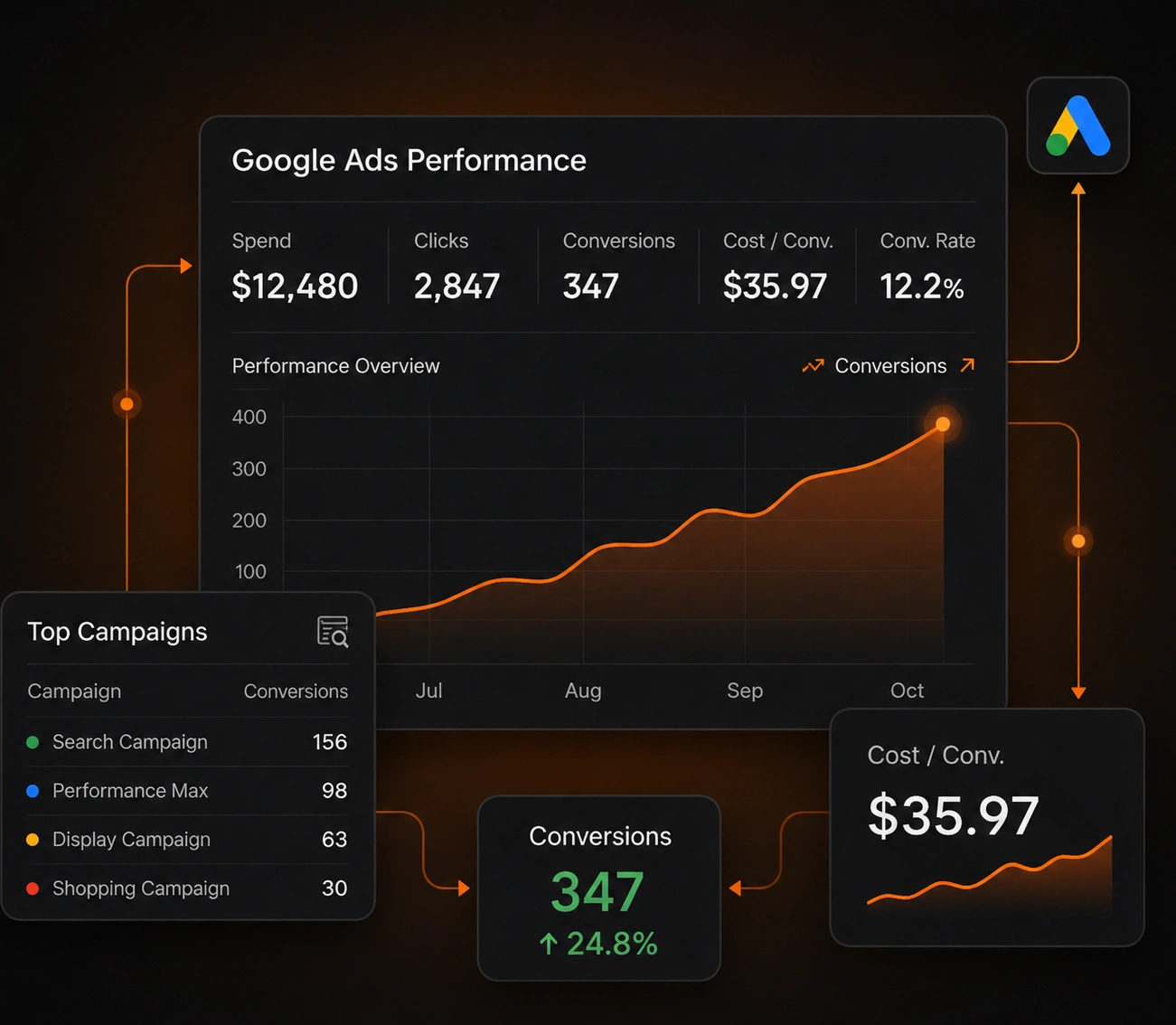
JuvioX combines Google Ads strategy, campaign management, landing-page alignment and accurate conversion tracking to help businesses generate qualified leads, increase sales and scale profitable growth.
Search • Performance Max • Shopping • YouTube • Remarketing • Conversion Tracking


5+
Years of Experience
200+
Projects Delivered
$100M+
Ad Spend Managed
Global
International Clients
Data-Driven
Reliable Measurement
Is Your Google Ads Budget Working as Hard as It Should?
Running Google Ads isn’t just about getting clicks. Without the right strategy, accurate conversion tracking, high-converting landing pages, and continuous optimization, campaigns can quickly become expensive without delivering meaningful business growth.
01 - High Cost Per Lead
You’re spending more to acquire each lead without seeing a corresponding improvement in lead quality or revenue.

02 - Poor Conversion Tracking
Incomplete or inaccurate tracking makes it difficult to understand which campaigns, keywords, and ads are actually generating business.
03 - Low-Quality Leads
Advertising spend continues to increase while revenue and qualified conversions fail to keep pace
04 - Low Return on Ad Spend
Advertising spend continues to increase while revenue and qualified conversions fail to keep pace.
05 - Limited Campaign Optimization
Campaigns are running without enough testing, search-term analysis, bidding refinement, or performance optimization.

06 - Weak Landing Pages
Qualified traffic reaches pages that are slow, unclear, or poorly optimized to turn visitors into leads or customers.
The Right Google Ads Solution for Every Stage of Customer Intent
From capturing existing demand to creating new demand and converting paid traffic, we select and manage the Google Ads solutions that fit your goals and customer journey.
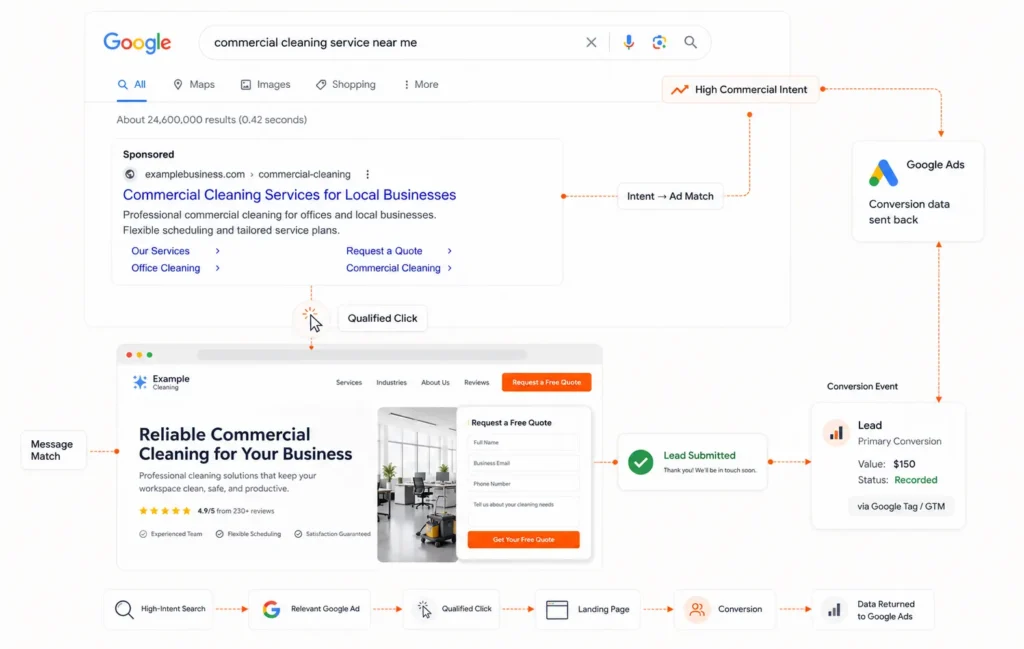
Capture Demand at the Moment Customers Are Searching
Reach potential customers at the moment they’re actively searching for your products or services. We build Search campaigns around commercial intent, relevance, and measurable business outcomes.
- Search Campaigns
- Keyword & Search-Term Strategy
- Responsive Search Ads
- Negative Keyword Management
- Bidding & Budget Optimization
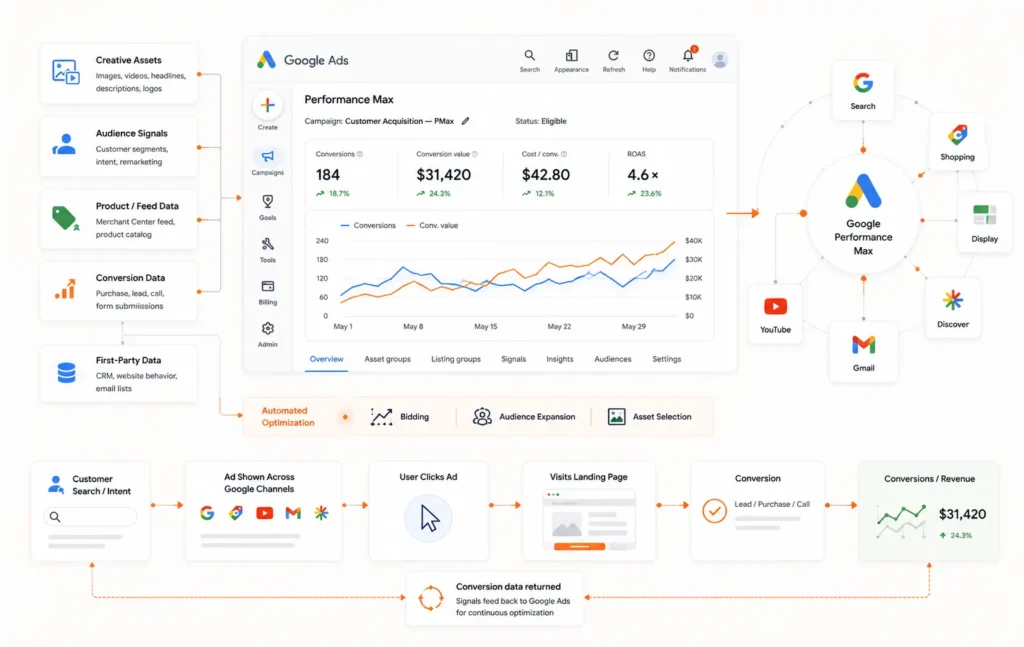
Expand Performance Across Google’s Advertising Ecosystem
Reach potential customers across Google’s inventory with Performance Max campaigns structured around your business goals, audience signals, creative assets, products, and reliable conversion data.
- Performance Max Campaigns
- Asset Group Structure
- Audience Signals
- Creative Asset Strategy
- Conversion Value Optimization
Turn Product Searches Into Ecommerce Revenue
Put the right products in front of shoppers with strong purchase intent. We connect Shopping campaigns, Merchant Center, product feeds, and conversion data to drive more valuable ecommerce performance.
- Google Shopping Campaigns
- Merchant Center Setup
- Product Feed Optimization
- Product Segmentation
- ROAS-Focused Optimization

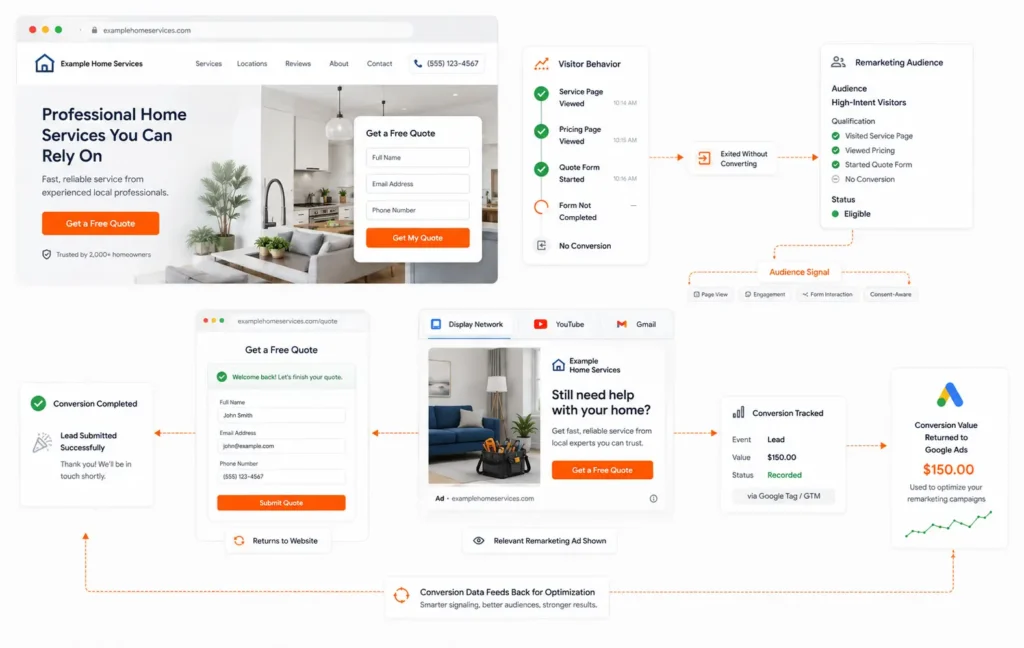
Re-Engage Prospects Who Didn’t Convert the First Tim
Reconnect with people who have already interacted with your website, products, or business. We build remarketing audiences around meaningful user behavior and guide high-intent prospects back toward conversion.
- Website Remarketing
- Dynamic Remarketing
- Customer Match
- Audience Segmentation
- Conversion-Focused Retargeting
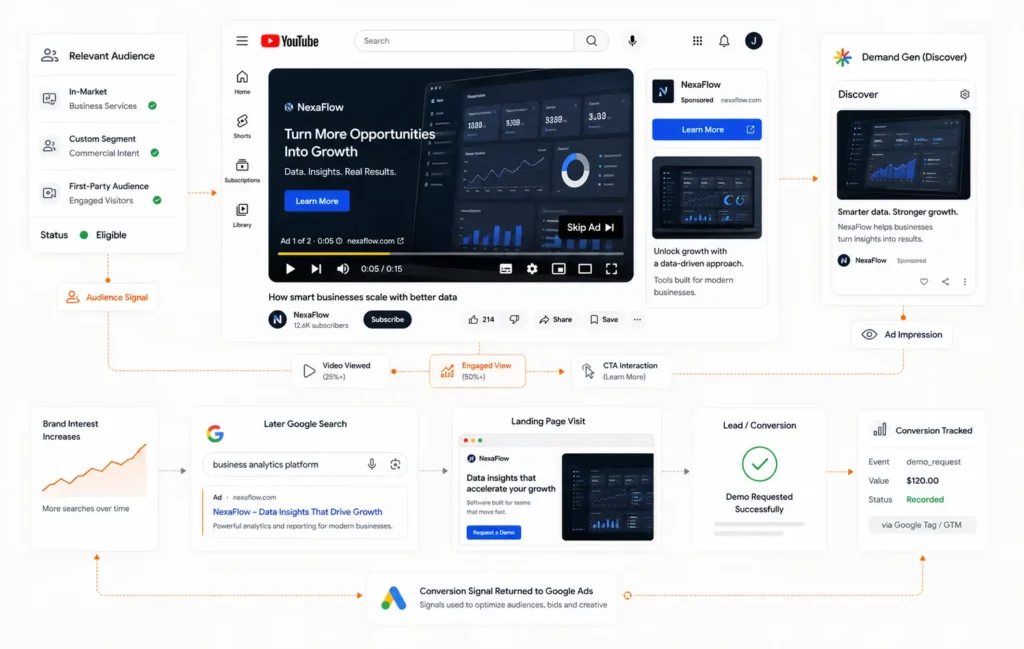
Create Demand Beyond Search
Reach relevant audiences before they actively search with visual and video campaigns designed to build awareness, consideration, and future demand across Google’s ecosystem.
- YouTube Campaigns
- Demand Gen Campaigns
- Audience & Intent Targeting
- Creative Testing
- Conversion Measurement
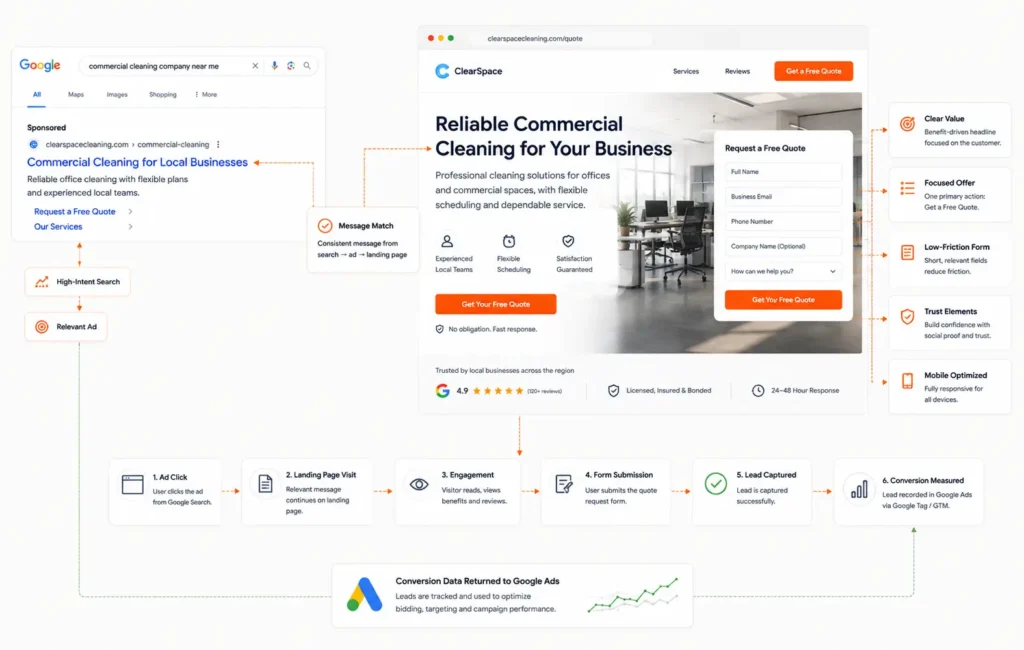
Turn More Paid Traffic Into Qualified Conversions
The campaign doesn’t end at the click. We create and optimize campaign-specific landing experiences that align with search intent, communicate the offer clearly, reduce friction, and guide qualified visitors toward conversion.
- Campaign-Specific Landing Pages
- Ad-to-Page Message Match
- Conversion-Focused UX
- Forms & CTA Optimization
- Mobile Conversion Experience
The Performance Levers We Continuously Improve
Strong Google Ads performance comes from improving the system as a whole—from search intent and campaign structure to measurement and the post-click experience.
Build the Right Campaign Structure
We organize campaigns around your business goals, services or products, customer intent, locations, budgets, and conversion objectives, creating a cleaner foundation for optimization and growth.
Reach the Searches That Matter
We analyze keywords, match types, search terms, negative keywords, and user intent to reduce irrelevant traffic and focus your budget on searches with stronger business potential.
Turn Search Intent Into Qualified Clicks
We create and optimize relevant ads, headlines, descriptions, assets, offers, and messaging that connect what people are searching for with what your business provides.
Spend Where It Creates More Value
We manage bidding strategies, campaign budgets, targeting, and spend allocation based on conversion data, campaign maturity, business priorities, and performance.
Know What Actually Drives Results
We validate conversion tracking and measurement so campaign decisions are based on reliable data, meaningful conversions, and real business value.
Turn More Ad Clicks Into Customers
We review message match, page relevance, mobile usability, speed, trust signals, calls to action, forms, and conversion friction to improve the experience after the click.
A Connected Google Ads System From Demand to Business Outcomes
We connect demand, consideration, conversion, and measurement into one system—using real performance data to continuously improve business outcomes.
Reach the Right Potential Customers
Capture relevant demand and reach audiences with genuine potential to become customers, focusing spend where commercial opportunity is strongest.
Focus
- Existing market demand
- New audience discovery
- Commercial relevance
- Qualified reach
Turn Interest Into Consideration
Connect customer intent with relevant messaging, offers, and landing experiences that help prospects understand why your business is the right choice.
Focus
- Intent-to-message alignment
- Relevant offers
- Clear value proposition
- Consistent ad-to-page journey
Turn Qualified Interest Into Outcomes
Create a lower-friction path from consideration to meaningful actions such as qualified leads, calls, bookings, purchases, or revenue.
Focus
- Conversion journey
- Lead or purchase actions
- Reduced conversion friction
- Business-value outcomes
Use Outcomes to Improve That Happens
Connect meaningful conversion data back to advertising decisions so optimization is informed by what actually creates value for the business.
Focus
- Conversion quality
- Revenue and lead value
- Performance feedback
- Continuous learning
Google Ads Management Built on Clarity, Data & Collaboration
Clear decisions, honest reporting, reliable data, and a collaborative way of working.
See What Better Google Ads Performance Looks Like
Real examples of how stronger strategy, measurement, and optimization translated into improved advertising outcomes.
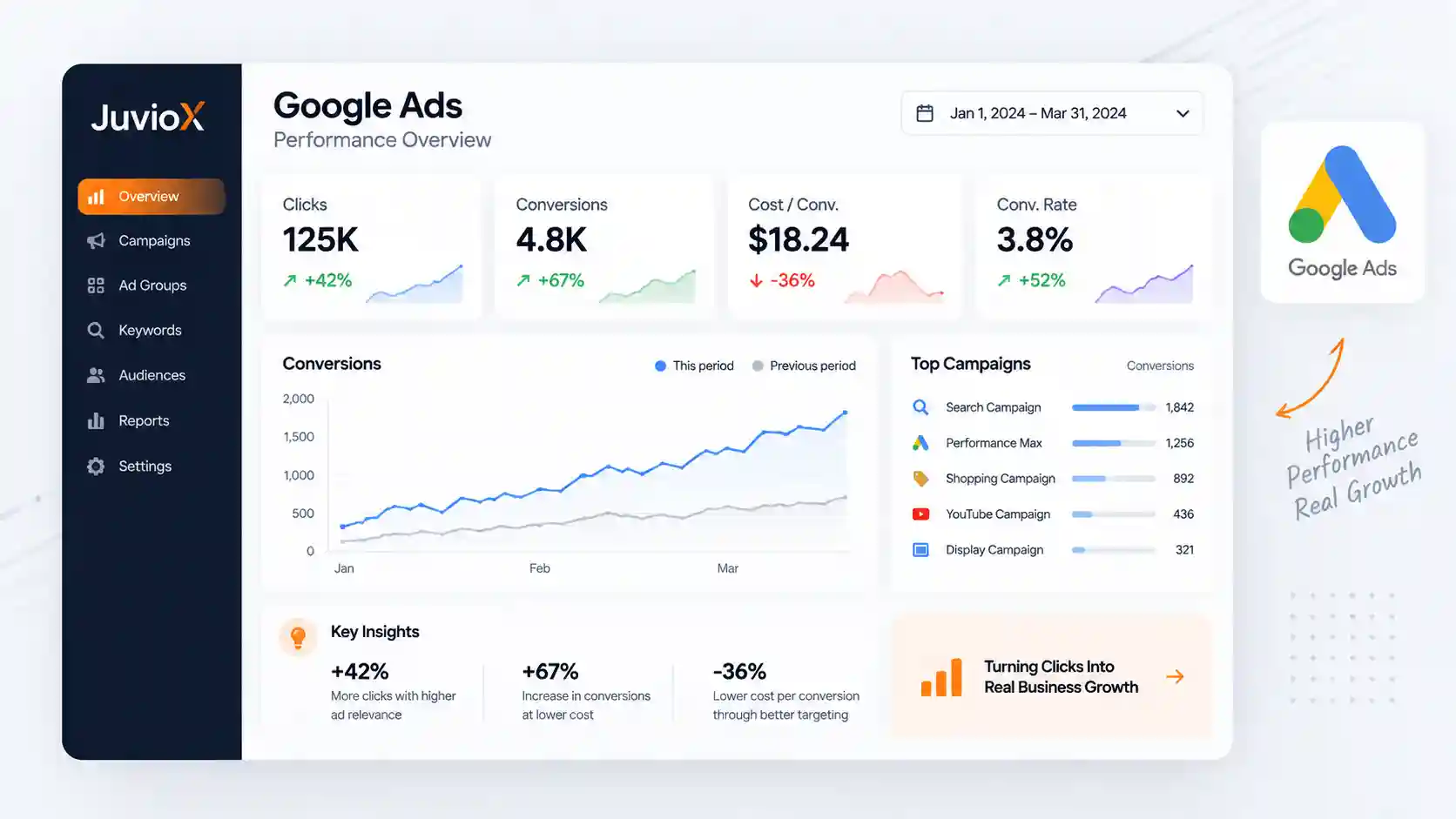
Scaling Customer Acquisition Efficiency and ROAS for SaaS Platform
+48%
+48%
+48%
Scaling Customer Acquisition Efficiency and ROAS for SaaS Platform
+48%
+48%
+48%
Scaling Customer Acquisition Efficiency and ROAS for SaaS Platform
+48%
+48%
+48%
Ready To Improve Your Google Ads Performance?
Let’s Find What’s Limiting
Your Google Ads Performance.
Tell us about your business, goals, and current Google Ads challenges. We’ll review your situation and identify where performance may be getting lost—and where the strongest opportunities exist.
✓ Google Ads Performance Review
We’ll assess your current campaign setup, targeting, search intent, conversion tracking, and overall account direction.
✓ Wasted Spend & Opportunities
We’ll identify areas where budget may be going toward low-value traffic, inefficient campaigns, or weak conversion paths.
✓ Conversion & Tracking Gaps
We’ll look for measurement issues, landing-page friction, and missing conversion signals that could be limiting optimization.
✓ Clear Next Steps
You’ll get practical direction on what should be fixed, improved, or prioritized to move your Google Ads performance forward.
Common Questions About Google Ads
Straightforward answers about Google Ads strategy, timelines, implementation, pricing, measurement, local search and the changing search landscape.
What is Google Ads and how does it work?
Google Ads is Google's advertising platform that allows businesses to reach potential customers across Google Search, Shopping, YouTube, Display and other Google properties. Advertisers can target users based on search intent, audiences and other signals, then pay according to the campaign and bidding model being used.
How much does Google Ads cost?
Google Ads does not have one fixed cost. Your advertising cost depends on factors such as industry competition, keywords, location, audience, campaign type, bidding strategy and conversion goals. The right budget should be based on your economics and the amount of qualified demand available, not an arbitrary monthly number.
How much should I spend on Google Ads per month?
Your Google Ads budget should reflect your market, average CPC, conversion rate, customer value and growth goals. A useful budget should generate enough meaningful conversion data to evaluate performance and make informed optimization decisions.
What does JuvioX’s SEO service include?
The scope depends on what is limiting your organic performance. It may include technical SEO, keyword and search-intent research, content strategy, on-page optimization, internal linking, authority development, local SEO, website improvements, analytics and measurement, and optimization for emerging AI-powered search experiences.
How much do SEO services cost?
SEO pricing depends on your website, market, competition, goals and the amount of work required. A small local business and a large website competing nationally require very different strategies. JuvioX evaluates the current situation and growth opportunities before recommending a scope rather than forcing every business into the same predefined package.
Do you guarantee first-page Google rankings?
No. No SEO provider can responsibly guarantee a specific Google ranking because search results are influenced by algorithms, competitors and factors outside an agency’s control. We focus on improving the factors we can influence—technical quality, relevance, content, authority, user experience and measurement—to build sustainable organic growth.
Can JuvioX work with our existing website?
Yes. A new website is not automatically required for SEO. We can audit your existing site and identify technical, structural, content, UX and conversion issues affecting performance. When the existing website can support your growth objectives, we improve it rather than recommending an unnecessary rebuild.
Do we need ongoing SEO or is a one-time audit enough?
A one-time SEO audit can identify problems and opportunities, but sustainable organic growth usually requires ongoing work. Competitors, search behavior, content, websites and search engines continue to evolve. Ongoing SEO allows the strategy to be implemented, measured and continuously reprioritized using actual performance data.
What is a technical SEO audit?
A one-time SEO audit can identify problems and opportunities, but sustainable organic growth usually requires ongoing work. Competitors, search behavior, content, websites and search engines continue to evolve. Ongoing SEO allows the strategy to be implemented, measured and continuously reprioritized using actual performance data.
What technical SEO issues can affect rankings?
Common issues include blocked crawling, incorrect indexation, duplicate pages, broken internal links, redirect problems, poor site architecture, incorrect canonical tags, slow performance, mobile usability issues and improperly implemented structured data. The priority should depend on actual impact rather than simply fixing every warning reported by an SEO tool.
What is on-page SEO?
On-page SEO improves individual pages so their purpose, relevance and content are clearer to both users and search engines. It includes titles, headings, content structure, internal links, metadata, images, topical relevance and search-intent alignment. Effective on-page SEO should improve usefulness and clarity rather than simply adding keywords.
How do you approach keyword research and search intent?
We look beyond search volume alone. Keyword research should identify what potential customers search for, why they search for it and where that search fits within their buying journey. We evaluate intent, relevance, competition, existing visibility, content gaps and business value before deciding which opportunities deserve priority.
How can I improve Google Ads performance?
Start by evaluating search intent, targeting, campaign structure, search terms, ad messaging, conversion tracking and landing-page performance. Optimization should prioritize profitable business outcomes rather than improving individual platform metrics in isolation.
How can I reduce my Google Ads cost per lead?
Reducing Google Ads CPL can involve removing low-value traffic, improving targeting, refining search terms, strengthening ads, improving conversion rates and reallocating budget toward better-performing opportunities. A lower CPL is only valuable when lead quality remains strong.
What is Google Ads Quality Score?
Quality Score is a diagnostic metric shown at the keyword level in Google Ads. It uses expected click-through rate, ad relevance and landing-page experience to help advertisers understand how their search experience compares with other advertisers.
How can I improve Google Ads Quality Score?
Review the individual Quality Score components rather than optimizing the number alone. Improving search-intent alignment, ad relevance and landing-page experience can address underlying weaknesses while supporting better overall campaign performance.
What are negative keywords in Google Ads?
Negative keywords help prevent ads from appearing for unwanted searches. Reviewing search terms and adding appropriate negative keywords can reduce irrelevant traffic and help concentrate budget on searches that are more relevant to your business.
What is conversion tracking in Google Ads?
Google Ads conversion tracking measures valuable actions after users interact with your advertising, such as purchases, qualified leads, calls or bookings. Reliable tracking helps advertisers understand which campaigns and interactions are contributing to business outcomes.
Why is accurate Google Ads conversion tracking important?
Without reliable conversion tracking, bidding algorithms and campaign decisions may be based on incomplete or misleading information. Accurate measurement helps evaluate CPA, ROAS, lead generation and the actual business value produced by advertising.
What are enhanced conversions in Google Ads?
Enhanced conversions can improve conversion measurement by using consented first-party customer data in a privacy-conscious way. The data is hashed before being sent to Google and can help recover conversions that might otherwise be difficult to observe.
What is difference between Google Ads and GA4 data?
Google Ads and GA4 can report different conversion numbers because they serve different purposes and may use different attribution, reporting and processing methods. Small differences are not automatically tracking errors, so the measurement setup should be reviewed before comparing numbers directly.
Why is my Google Ads CPA increasing?
CPA can rise because of stronger competition, higher CPCs, changing demand, weaker conversion rates, targeting changes, poor traffic quality or landing-page issues. Diagnose the underlying cause before changing bids or budgets.
How often should Google Ads campaigns be optimized?
Google Ads accounts should be monitored regularly, but optimization frequency depends on traffic volume, budget and conversion data. Making major changes too frequently can be counterproductive. Changes should be based on meaningful data rather than constant adjustments.
Why should I hire JuvioX for Google Ads management?
JuvioX approaches Google Ads as part of the wider customer acquisition system. Campaign strategy is connected with accurate conversion tracking, analytics, landing-page experience, CRO and business performance so decisions can focus on qualified leads, sales, CPA, ROAS and sustainable growth.