Your ROAS looks good, but your bank account doesn’t
Ad platforms report revenue. After product costs, shipping, returns and fees, the profit isn’t there.
Ecommerce · United States
Google Shopping, Performance Max, Meta Ads and email built for Shopify and WooCommerce stores. We track every order back to the ad and set targets from your margins, so you grow profit, not just revenue.
What’s included
Quick answer
An ecommerce marketing agency helps online stores sell more at a profit. That usually means Google Shopping and Performance Max for people searching for your products, Meta Ads to reach new buyers, email and SMS to bring customers back, and SEO for your product and collection pages. A good agency also tracks every order back to its source and sets targets from your margins, so your budget follows profit, not platform-reported revenue.
Sound familiar?
Most store owners who call us have tried an agency or a freelancer before. If any of these are familiar, you’re in the right place.
Ad platforms report revenue. After product costs, shipping, returns and fees, the profit isn’t there.
Each platform takes credit for the same order, so nobody knows what’s really working.
Most send the same message to every store, with screenshots you can’t check.
Retainers and add-ons came first, while tracking, the product feed and the checkout were still broken.
Customers who were already coming back get counted as new sales, and your real growth is smaller than it looks.
What we do
We build the marketing your sales actually come from, and connect every channel to the same order data.
A clean product feed with clear titles, prices and stock, campaigns split by margin and best sellers, and brand searches kept separate so new sales are counted honestly.
New creative tested every week, prospecting to people who don’t know you yet, and retargeting for visitors and carts that didn’t check out.
Welcome, abandoned cart, browse and post-purchase flows that bring shoppers back without paying for the click again.
Collection and product pages written for what shoppers search, product structured data and faster pages, so you earn sales without a cost per click.
Server-side tracking and the Meta Conversions API, with every order matched to your store’s own numbers.
Clear product pages, trust signals and a shorter checkout, so more of the traffic you pay for becomes orders.
Google & Meta Ads
Online stores need two kinds of advertising. Google Shopping and Performance Max catch people already searching for your products. Meta Ads find buyers who don’t know you yet. Treating them the same way either starves growth or wastes budget, so each gets its own job, its own targets and its own reporting.
Keywords
Every store’s keywords are different, but the waste looks the same. These are the patterns we use on every account.
We don’t block price searches like “cheap [product]” by default: for many stores they convert well. And your own brand name is bid on separately, so it never hides inside Performance Max results.
Benchmarks
Clicks for online stores are cheaper than for service businesses, but margins are thinner, so your budget has to be planned around profit per order, not ROAS alone.
Median cost per click and conversion rate on Google search ads, US, Apr 2025 to Mar 2026.
| Store category | Avg. click cost | Conv. rate |
|---|---|---|
| Home & home improvement | $8.33 | 8.05% |
| Health & fitness | $6.17 | 6.94% |
| Beauty & personal care | $4.62 | 10.35% |
| Apparel, fashion & jewelry | $4.44 | 4.50% |
| Shopping, collectibles & gifts | $4.14 | 4.01% |
| Animals & pets | $4.06 | 16.22% |
| Furniture | $3.97 | 2.99% |
| Sports & recreation | $2.77 | 7.69% |
Source: LocaliQ and WordStream 2026 Google Ads Benchmarks, 13,000+ US search campaigns. Conversion rate counts every tracked action, not only purchases.
Source: LocaliQ 2026 Search Advertising Benchmarks, US, Apr 2025 to Mar 2026.
Your numbers will differ.
A 2.25× ROAS looks healthy on a dashboard, but at a 55% margin it only just pays for itself. Repeat purchases and email turn it into real profit. That’s why we set targets from your margins, not from a ROAS number.
Try your own numbers in the budget calculator| Store stage | Monthly revenue | Monthly ad spend |
|---|---|---|
| Starting | Under $30,000 | $1,500–$3,000 |
| Growing | $30,000–$250,000 | $3,000–$15,000 |
| Established | Over $250,000 | $15,000+ |
Ad spend only, before management fees. The right budget comes from your margins and stock; these ranges are our starting guidance.
Tracking
Ad platforms happily report sales that overlap, or that would have happened anyway. We track every order through to profit, so the ads learn from real revenue.
Server-side tracking and the Meta Conversions API send each order to GA4, Google Ads and Meta, even when browsers block cookies.
Platform sales are matched with Shopify or WooCommerce orders and refunds, so you see which numbers to trust.
Product costs, shipping and fees turn revenue into profit per campaign and per product.
Value-based bidding and margin-based targets push budget toward the products and campaigns that actually make money.
Before you hire
Ask any agency these five questions before you sign. The answers tell you more than their sales deck.
If you leave, you should keep every account, audience and flow.
Profit and new customers, checked against your store’s orders, beats platform-reported ROAS.
A flat fee keeps the agency focused on your results. A percentage of ad spend rewards them for spending more.
Tracking, the product feed and the checkout come first. An agency that jumps straight to scaling is guessing.
Long lock-ins protect the agency, not you.
JuvioX is a Google Partner. Google confirms we meet its requirements for account performance, ad spend managed and certified Google Ads specialists.
Google Partner Verify on GoogleResults
Real accounts, real numbers from online stores and booking businesses.
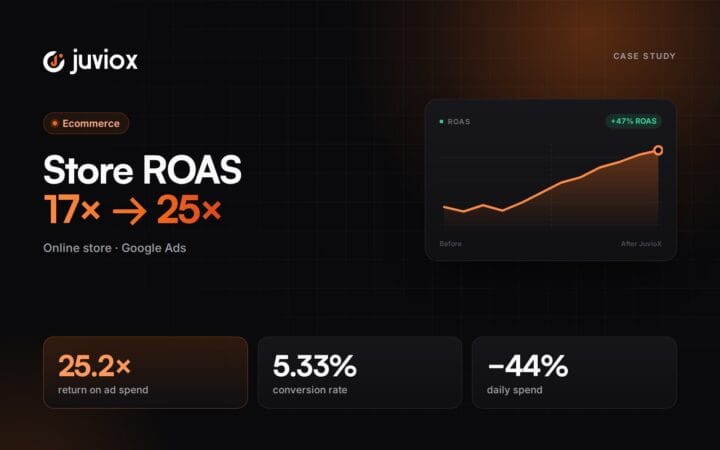
Ecommerce
In the 10 days after we restructured its campaigns in September 2025, a US online store’s ROAS rose from 17.1× to 25.2× and conversion rate to…
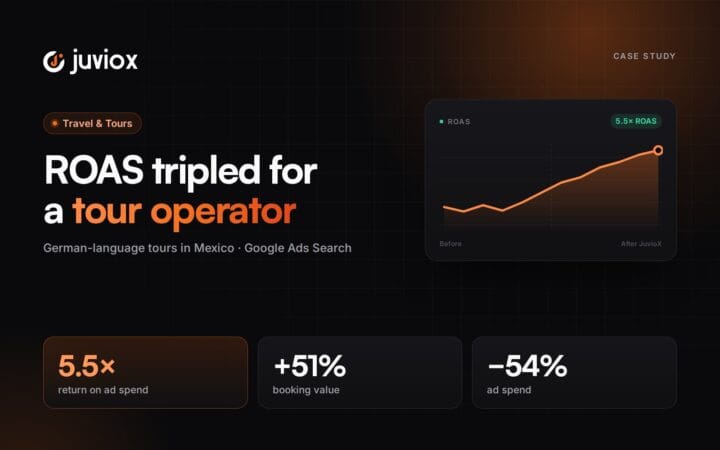
Travel & Tours
ROAS from 166% to 547% in one month: more booking value from ads with less than half the spend.
Client feedback
Insights
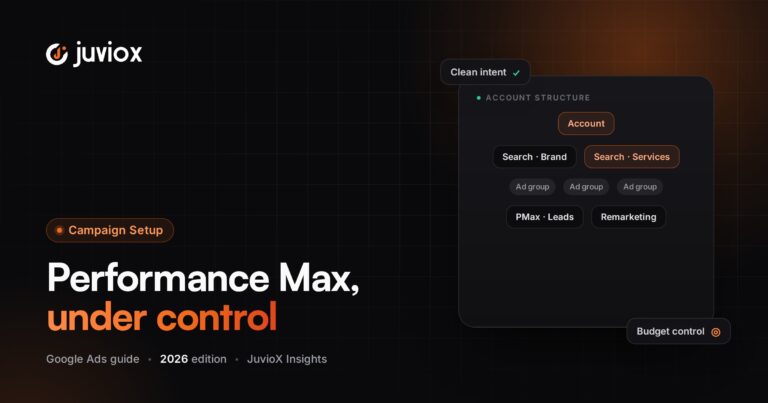
Performance Max is Google Ads at its most automated - but “automated” does not mean “hands…
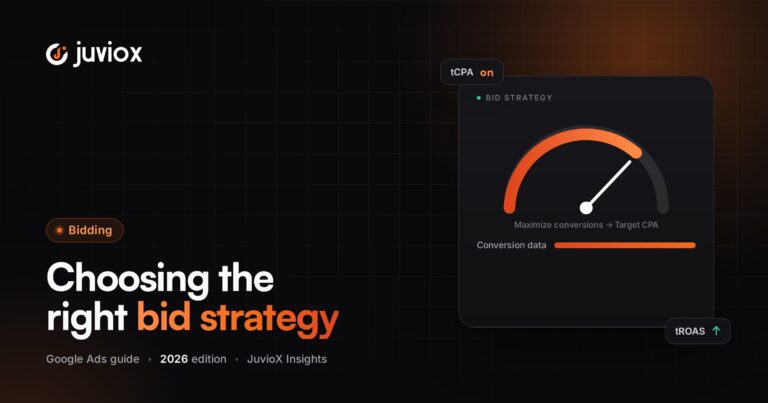
Choosing a Google Ads bid strategy is not simply choosing how much you are willing to…

A conversion tells you that an outcome happened. Attribution determines which advertising interactions receive credit for…
FAQ
Many growing stores spend $1,500–$15,000 a month on ads, plus a management fee. The right amount depends on your margins, average order value and stock. Start with enough budget for your best-selling products to get steady sales, then scale what stays profitable.
It depends on your margin. Your break-even ROAS is 1 divided by your gross margin, so a store with a 50% margin breaks even at 2× and a store with a 25% margin at 4×. Anything above break-even is profit, before repeat purchases.
Start with Google Shopping if people already search for what you sell. Start with Meta Ads if your product is new or visual and needs to be discovered. Most growing stores end up running both, with email underneath.
Usually yes, with a clean product feed, correct conversion values and your brand searches kept separate. Without those, Performance Max often takes credit for customers who were already coming back.
Each platform uses its own attribution window and often counts the same order. Privacy settings also hide some conversions. We use your store’s orders as the source of truth and set up server-side tracking so the platforms get more complete data.
Yes. Welcome, abandoned cart and post-purchase flows bring shoppers back without paying for another click, and they usually lift the profit from every ad dollar.
Yes, especially for collection pages and products people search by name or type. Better titles, descriptions, product structured data and speed usually show results in 3–9 months, and those sales carry no cost per click.
Shopping and Performance Max campaigns usually bring sales within days, but they need a few weeks to learn, so judge results after about 90 days. SEO takes longer, usually 3–9 months.
Last updated: September 2026
Keep exploring
Free audit
A specialist reviews your Google Ads, Merchant Center feed, Meta Ads and purchase tracking, then sends a prioritized fix list within one business day. No obligation.