On this page
What Is Cost Per Lead (CPL) in Google Ads?
Cost per lead is the amount of advertising spend required to generate a tracked lead. In a Google Ads lead-generation campaign, a “lead” might be a submitted contact form, booked consultation, phone call, quote request, application, Google-hosted lead form, or another action the business has intentionally defined as a lead conversion.
FORMULA
Google Ads CPL = Google Ads spend ÷ number of tracked leads
If you spend $5,000 and record 50 leads, the raw CPL is $100. The calculation is easy. Deciding whether $100 is good is the difficult part.
How to Calculate Google Ads CPL Correctly
Use spend and leads from the same scope and period. Do not divide total account spend by only one campaign’s leads, mix different date windows, or count micro-conversions as if they were genuine enquiries.
| Example | Spend | Leads | Calculated CPL |
|---|---|---|---|
| Campaign A | $3,000 | 30 | $100 |
| Campaign B | $3,000 | 60 | $50 |
| Account total | $6,000 | 90 | $66.67 |
Campaign B appears more efficient. But if only 6 of its 60 leads are qualified while 18 of Campaign A’s 30 leads are qualified, the picture changes dramatically.
| Example | Raw CPL | Qualified Leads | Cost per Qualified Lead |
|---|---|---|---|
| Campaign A | $100 | 18 | $166.67 |
| Campaign B | $50 | 6 | $500 |
JUVIOX RULE
Never optimize CPL in isolation when the business can measure downstream quality. The cheapest raw lead can be the most expensive qualified opportunity.
CPL vs CPA vs CAC: What Should You Measure?
| Metric | Simple Definition | Best Use |
|---|---|---|
| CPL | Ad spend ÷ leads | Top-of-funnel lead efficiency |
| Cost per qualified lead | Ad spend ÷ qualified leads | Lead quality and marketing efficiency |
| CPA / cost per conversion | Spend ÷ selected conversion actions | Platform-level conversion efficiency |
| Cost per opportunity | Spend ÷ sales opportunities | B2B and higher-consideration sales |
| CAC | Acquisition cost ÷ new customers | True customer acquisition economics |
Google Ads reports cost per conversion based on the conversion actions included in your reporting and goals. For a lead-generation business, that number can approximate CPL when the selected conversion action is a genuine lead. But it can become misleading if the campaign is optimizing toward multiple actions with very different business values.
What Is a Good Google Ads Cost Per Lead?
There is no universal “good CPL.” A $25 lead can be unprofitable for one business and a $500 lead can be excellent for another. The correct ceiling comes from sales economics.
BETTER BENCHMARK
A good CPL is one that allows the business to acquire enough qualified customers at an acceptable CAC and margin while maintaining the desired growth rate.
Work Backward From Customer Economics
Suppose a business can profitably spend up to $1,000 in advertising to acquire one new customer. If 20% of raw leads become customers, the break-even raw CPL implied by that simplified model is $200. If only 5% become customers, it falls to $50.
| Allowable CAC | Lead-to-Customer Rate | Implied Maximum Raw CPL* |
|---|---|---|
| $1,000 | 20% | $200 |
| $1,000 | 10% | $100 |
| $1,000 | 5% | $50 |
| $2,500 | 10% | $250 |
*Simplified planning model before considering other acquisition costs, overhead, sales costs, refunds, margin constraints, and desired profit.
Why Is My Google Ads Cost Per Lead So High?
High CPL is usually the output of one or more upstream problems. Treating it as a single bidding problem often leads to the wrong fix.
- Expensive clicks caused by competitive or overly broad auction participation.
- Low landing-page conversion rate.
- Search terms with weak or mixed commercial intent.
- Ads that attract clicks but set the wrong expectation.
- Poor geographic, device, schedule, audience or network fit.
- A form or booking flow with unnecessary friction.
- Weak offer, pricing, trust, differentiation or message match.
- Conversion tracking that misses real leads or counts the wrong actions.
- Low lead quality that makes the raw CPL look better than the sales economics.
- Budget or bid targets that constrain the campaign in the wrong places.
The JuvioX CPL Diagnostic Framework
Instead of asking only “How do we lower CPL?”, diagnose the full equation in order:
| Layer | Question | Key Metrics / Evidence |
|---|---|---|
| 1. Auction cost | Are we paying too much for the traffic we choose to enter? | CPC, search terms, impression share, auction insights, query intent |
| 2. Click quality | Are the right people clicking? | CTR in context, search terms, location, device, audience, lead source |
| 3. Conversion experience | Do qualified visitors convert? | Landing-page CVR, form completion, calls, booking completion, UX |
| 4. Measurement | Are leads counted accurately? | Primary conversions, duplicates, enhanced conversions, attribution, consent |
| 5. Lead quality | Do submissions match the ICP? | Qualified rate, spam rate, sales acceptance, lead score |
| 6. Sales outcome | Do leads become pipeline and customers? | Opportunity rate, close rate, revenue, CAC, LTV / margin |
DIAGNOSTIC PRINCIPLE
CPL = CPC ÷ conversion rate in a simplified click-to-lead model. You can therefore reduce CPL by lowering the cost of relevant traffic, increasing the conversion rate of that traffic, or both—but neither matters if lead quality collapses.
How to Reduce Google Ads Cost Per Lead
1. Fix Conversion Tracking Before Optimizing Bids
If Google Ads is learning from duplicate forms, page views, button clicks, spam submissions, or low-value actions, automated bidding can optimize toward the wrong behavior. Confirm which actions are Primary, verify successful submissions, deduplicate events, and test every important conversion path.
2. Separate Raw Leads From Qualified Leads
Where the sales process continues in a CRM, import meaningful downstream outcomes such as qualified lead, sales opportunity, or closed customer. This changes optimization from “find more form fills” toward “find more valuable outcomes.”
3. Improve Search-Term Quality
Review actual search terms, not only keywords. Add negatives where appropriate, tighten ambiguous themes, isolate different intents, and ensure the campaign is not paying for research queries that rarely become customers.
4. Improve Ad-to-Landing-Page Message Match
The query, ad promise, landing-page headline, offer and CTA should feel like one continuous journey. Misalignment can produce clicks without conversions.
5. Increase Landing-Page Conversion Rate
- Clarify the offer above the fold.
- Make the primary CTA obvious.
- Reduce unnecessary form fields while retaining fields that protect lead quality.
- Improve mobile UX and page speed.
- Add relevant proof, reviews, credentials and case-study evidence.
- Address price, process, eligibility and common objections when they matter.
- Test landing pages by intent rather than sending every campaign to one generic page.
6. Use Geography, Schedule and Device Data Intelligently
Find segments with materially different lead quality or economics. Avoid cutting segments based on tiny samples; use enough data to distinguish noise from a repeatable pattern.
7. Improve the Offer, Not Just the Ads
A campaign cannot permanently compensate for an offer that is unclear, undifferentiated, overpriced for the perceived value, or poorly matched to the searcher’s problem.
8. Control Budget Fragmentation
Spreading a limited budget across too many campaigns, locations or themes can leave each segment with too little data. Consolidate where it improves learning without mixing fundamentally different economics or intent.
9. Optimize Toward Value, Not Vanity
When possible, evaluate qualified CPL, opportunity cost, CAC and revenue alongside raw CPL. A campaign that generates fewer but better leads can be the better growth engine.
How Lead Quality Changes the CPL Equation
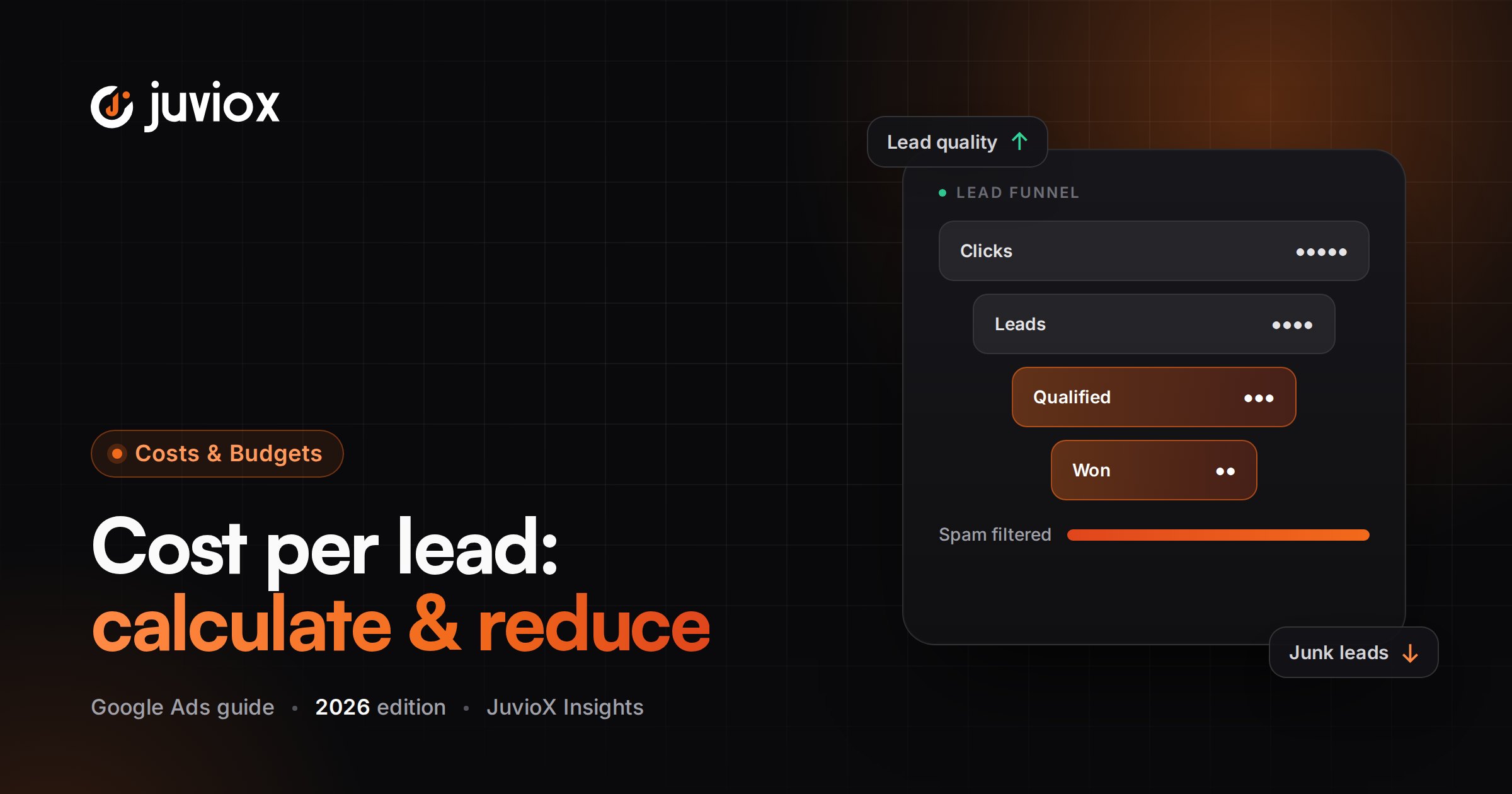
Lead generation has two optimization systems: the advertising system that creates enquiries and the sales system that determines whether those enquiries have value. If the two systems do not share data, Google Ads sees only the front half of the funnel.
| Stage | Example Volume | Stage Cost on $10,000 Spend |
|---|---|---|
| Raw leads | 100 | $100 CPL |
| Qualified leads | 40 | $250 per qualified lead |
| Sales opportunities | 20 | $500 per opportunity |
| Customers | 5 | $2,000 CAC |
Now imagine another campaign produces 150 raw leads at a $66.67 CPL but only 3 customers. The raw CPL is lower, yet CAC rises to $3,333. This is why JuvioX recommends proof-first reporting from click through CRM outcome wherever the stack allows it.
Target CPA and Automated Bidding for Lead Generation
Google’s Target CPA bidding aims to generate as many conversions as possible at the average cost per action you set. Individual conversions can cost more or less than the target, and an unrealistically low target can reduce eligible traffic and total conversion volume.
In 2026 Google is also changing how some Smart Bidding strategies are labeled. Google states that “Maximize conversions with a Target CPA” is transitioning to the “Target CPA” label, without changing the underlying bidding behavior.
TARGET CPA CAUTION
Do not set a Target CPA simply because it is the CPL you wish you had. Use real conversion data, business economics, volume, conversion lag and lead quality. A target that is too aggressive can trade volume for an attractive-looking target.
Google Ads Lead Forms: Lower Friction, But Measure Quality
Google lead form assets allow people to submit information directly from an ad. Google currently supports lead forms with Search and Performance Max campaigns and provides delivery options such as CSV, email notifications, webhooks, API-based delivery and integrations.
In 2026 Google added/expanded lead-quality controls including qualifying responses and phone-number verification in supported Search lead-form workflows. These features can help filter invalid or low-intent submissions before they reach sales.
OPTIMIZATION TRADE-OFF
Reducing form friction can increase lead volume, but volume alone is not the goal. Compare website-form leads and Google-hosted lead-form leads by qualification rate, sales acceptance, opportunity rate and CAC—not only raw CPL.
Conversion Tracking and Enhanced Conversions for Leads
For businesses that close leads after the website interaction, downstream conversion data is critical. Google describes enhanced conversions for leads as an upgraded offline-conversion approach that uses hashed first-party customer data to improve attribution and bidding accuracy.
A material 2026 platform change: Google unified enhanced conversions for web and leads into a single setting, and Google’s current documentation directs offline/enhanced-conversion uploads toward Data Manager / Data Manager API as its migration evolves. Implementation should therefore be checked against current Google documentation before deployment.
JUVIOX MEASUREMENT STANDARD
For serious lead generation, connect the ad click to the CRM outcome whenever technically and legally appropriate: lead → qualified lead → opportunity → customer. Raw form submissions should not be the end of measurement if better business data exists.
Google Ads CPL Examples for Different Lead-Generation Models
These are illustrative models—not industry benchmarks. Their purpose is to show why the same raw CPL can mean different things.
| Business Model | Raw CPL | Qualified Rate | Qualified CPL | Close Rate From Qualified Lead | Approx. Ad CAC |
|---|---|---|---|---|---|
| Local service | $80 | 60% | $133 | 30% | $444 |
| B2B service | $200 | 50% | $400 | 20% | $2,000 |
| High-ticket consulting | $350 | 70% | $500 | 25% | $2,000 |
| Low-quality volume campaign | $50 | 10% | $500 | 10% | $5,000 |
The last row is the key lesson: the lowest raw CPL in the table produces the highest acquisition cost because qualification and close rates are poor.
What About Google Local Services Ads Cost Per Lead?
Many people researching Google Ads cost are really asking about Local Services Ads and pay-per-lead pricing. This deserves separate treatment because Local Services Ads are not simply standard Search campaigns with a different CPC. Their charging, eligibility, lead handling and market behavior differ.
When a Higher CPL Is Actually Better
- The leads have a much higher qualification rate.
- The campaign attracts larger contracts or higher-margin customers.
- The close rate is materially stronger.
- Sales cycles are shorter or sales effort is lower.
- Refund, cancellation or no-show rates are lower.
- The campaign reaches a strategically important market with better lifetime value.
BUSINESS RULE
Optimize for profitable growth, not for the smallest number in the CPL column.
Common Google Ads CPL Optimization Mistakes
| Mistake | Why It Fails | Better Approach |
|---|---|---|
| Chasing the lowest CPL | Can reward low-quality volume | Track qualified CPL and CAC |
| Changing bids before checking tracking | Optimizes around bad signals | Validate conversion actions first |
| Using industry averages as a target | Ignores your margin and close rate | Build a target from business economics |
| Counting every form interaction as a lead | Inflates conversions | Track successful, meaningful submissions |
| Ignoring search terms | Keyword settings do not reveal every query | Review actual query intent regularly |
| Over-reducing form friction | Can increase spam/poor fit | Balance conversion rate with qualification |
| Setting Target CPA too low | Can suppress useful volume | Use realistic targets and sufficient evidence |
| Judging campaigns only inside Google Ads | Misses sales outcomes | Connect CRM/offline outcomes where possible |
Google Ads CPL Optimization Checklist
- Define exactly what counts as a lead.
- Confirm Primary vs Secondary conversion actions.
- Test forms, calls, bookings and deduplication.
- Calculate raw CPL and qualified CPL separately.
- Calculate opportunity cost and CAC where data exists.
- Review search terms and negatives.
- Segment materially different intent.
- Audit landing-page message match and mobile UX.
- Review lead quality with sales, not only marketing.
- Use CRM/offline conversion data where appropriate.
- Enable and validate enhanced conversion measurement where appropriate.
- Set bidding targets from economics and real performance, not wishful targets.
- Scale only after tracking and lead quality are trustworthy.
Final Takeaway: Lower the Cost of Acquiring Customers, Not Just Leads
Google Ads CPL is useful, but it is only one layer of the acquisition system. A mature lead-generation program connects traffic cost, conversion rate, lead quality, sales outcomes and customer economics. That is how you know whether a “cheap” lead is genuinely efficient.
If CPL is high, diagnose the system in order: auction cost, click quality, conversion experience, measurement, lead quality and sales outcome. Then optimize the weakest layer without sacrificing the parts that already produce profitable customers.
GOOGLE ADS MANAGEMENT
Stop Optimizing for Cheap Leads. Start Optimizing for Better Customers.
JuvioX connects Google Ads, conversion tracking, landing-page CRO and downstream lead data so campaign decisions are based on qualified opportunities, revenue and measurable growth.
FAQ
Frequently asked questions
What is CPL in Google Ads?
CPL is the advertising spend required to generate one tracked lead. Divide Google Ads spend by the number of leads recorded for the same scope and period.
How do you calculate cost per lead in Google Ads?
Divide campaign or account spend by the number of genuine lead conversions. For deeper analysis, also calculate cost per qualified lead and customer acquisition cost.
What is a good Google Ads cost per lead?
There is no universal good CPL. It depends on lead-to-customer rate, customer value, margin, sales costs and the acquisition cost the business can sustain.
Why is my Google Ads CPL so high?
Common causes include expensive traffic, weak search intent, low landing-page conversion rate, poor offer/message match, tracking errors, budget fragmentation and low lead quality.
How can I reduce CPL in Google Ads?
Start by validating tracking, then improve query intent, ad-to-page relevance, landing-page conversion rate, targeting, lead qualification and bidding. Measure downstream quality so CPL reductions do not sacrifice customers.
Is cost per conversion the same as cost per lead?
Sometimes, but not always. Cost per conversion reflects the conversion actions being counted. If the counted action is a genuine lead, it may approximate CPL. If multiple or lower-value actions are included, it may not.
Should I use Target CPA for lead generation?
It can be effective when conversion tracking and goals are reliable. Set the target from real economics and performance; an overly low target can reduce conversion volume.
Can Google Ads optimize for qualified leads instead of form submissions?
Yes, businesses can feed downstream lead outcomes back into Google Ads using supported first-party/offline conversion workflows. The exact implementation depends on the CRM and measurement stack.
Do Google lead form ads reduce CPL?
They can reduce friction and may increase lead volume, but the correct comparison includes qualification rate and CAC. A lower raw CPL is not useful if lead quality declines.
Is Google Local Services Ads CPL the same as Google Search Ads CPL?
No. Local Services Ads use a different lead-generation and charging model. They should be evaluated separately from standard Google Ads Search campaign CPL.
7 sources & references
- Google Ads Help — About Target CPA bidding
- Google Ads Help — About lead form assets
- Google Ads Help — Create lead form assets
- Google Ads Help — Best practices for lead form assets
- Google Ads Help — About qualifying responses in lead forms
- Google Ads Help — About enhanced conversions for leads
- Google Ads Help — Updates to enhanced conversions settings