On this page
How Google Ads Pricing Works
Google Ads is primarily an auction-based advertising platform. There is no universal price list that says every business pays the same amount for a click, lead, or sale. When an eligible search or other ad opportunity occurs, Google determines which ads can show and in what order based on the campaign’s settings, bids, relevance, quality signals, competition, and other auction-time factors.
That means two advertisers targeting similar customers can pay very different amounts. A legal-services advertiser in a competitive city may face far more expensive clicks than a niche ecommerce brand, while two advertisers in the same market can still produce different economics because one converts visitors more efficiently.
JUVIOX NOTE
The right question is not simply “How much does Google Ads cost?” The better question is “How much can we afford to pay to acquire a qualified lead or customer while still hitting our margin and growth targets?”
What Do You Actually Pay for in Google Ads?
The charging model depends on the campaign type and objective. Search campaigns commonly use cost-per-click economics, meaning cost is closely tied to clicks. Other campaign types and bidding strategies may optimize toward conversions, conversion value, views, impressions, or other outcomes. Your campaign budget controls how much Google can spend; your bidding strategy influences how aggressively the system competes for eligible opportunities.
| Metric | What It Tells You | Why It Matters |
|---|---|---|
| CPC (cost per click) | Average amount paid for a click | Useful for traffic economics, but not enough to judge profitability |
| CPA / cost per conversion | Spend divided by tracked conversions | Better for lead generation when conversion tracking is reliable |
| ROAS | Tracked conversion value divided by ad spend | Useful for ecommerce and revenue-value optimization |
| Cost per qualified lead | Spend divided by leads that meet qualification criteria | More useful than raw form-fill CPA for many service businesses |
| CAC | Total acquisition cost per new customer | Connects advertising spend to actual customer acquisition |
How Much Does Google Ads Cost Per Month?
There is no single required monthly spend that fits every advertiser. You choose a campaign budget based on your goals and what you are comfortable spending. Google defines the average daily budget as the average amount you set for a campaign per day over the course of a month.
For most campaigns using an average daily budget, Google states that the daily spending limit can be up to 2× the average daily budget, while the monthly spending limit is generally 30.4× the average daily budget. Daily spend can therefore fluctuate as Google responds to higher- and lower-opportunity days, while billing remains subject to the applicable spending limits.
| Average Daily Budget | Approx. Monthly Spending Limit (×30.4) | Possible Daily Spending Limit for Most Campaigns (up to ×2) |
|---|---|---|
| $10 | $304 | $20 |
| $25 | $760 | $50 |
| $50 | $1,520 | $100 |
| $100 | $3,040 | $200 |
| $250 | $7,600 | $500 |
| $500 | $15,200 | $1,000 |
QUICK RULE
To translate a monthly budget into an average daily budget, divide the monthly amount by 30.4. Example: $3,040 ÷ 30.4 = $100 average daily budget.
Is There a Minimum Google Ads Budget?
The practical minimum is not a universal dollar amount. A budget is only useful if it can generate enough relevant auction participation, clicks, and conversions for the campaign to learn and for you to make decisions. A very small budget can technically run, but it may produce data too slowly in an expensive market.
Your minimum viable budget should therefore be based on expected click costs, conversion rate, target CPA, sales economics, and the amount of data needed to evaluate performance—not on an arbitrary number copied from another business.
What Affects Google Ads Cost Per Click?
Google Ads CPC can vary substantially. The biggest practical cost drivers include:
- Industry and commercial value: markets with high customer lifetime value often support higher acquisition costs.
- Keyword and query intent: high-intent searches close to a purchase or enquiry can attract stronger competition.
- Location: auction pressure can change by country, city, radius, and local market.
- Device, time, audience and context: auction conditions are not identical for every user or moment.
- Bidding strategy and targets: aggressive targets or looser efficiency constraints can change how the system enters auctions.
- Ad relevance and expected user experience: stronger relevance can improve competitiveness, although lower CPC is never guaranteed.
- Landing-page experience and conversion rate: these do not merely affect click cost; they determine how much revenue or lead value you get from the traffic you already paid for.
- Competitor behavior and seasonality: CPCs can move as demand and advertiser activity change.
IMPORTANT
Keyword Planner “top of page bid” ranges are planning estimates, not a promise of the CPC you will actually pay. Keyword Planner often shows very wide bid ranges for cost-related terms, which is exactly why budgeting should use your own market, account data, conversion rate and economics.
How to Calculate a Realistic Google Ads Budget
A useful Google Ads budget starts with business economics and works backward. Instead of asking what competitors spend, define what a lead or customer is worth and how many outcomes you need.
Method 1: Budget From a Target CPA
For lead generation, a simple planning model is:
FORMULA
Monthly ad budget = target number of conversions × acceptable cost per conversion
Example: if you want 40 qualified leads per month and you can profitably pay $75 per qualified lead, the planning budget is approximately $3,000 per month. This is a forecast, not a guarantee: actual volume depends on search demand, competition, conversion rate, tracking quality, and campaign execution.
Method 2: Budget From CPC and Conversion Rate
FORMULA
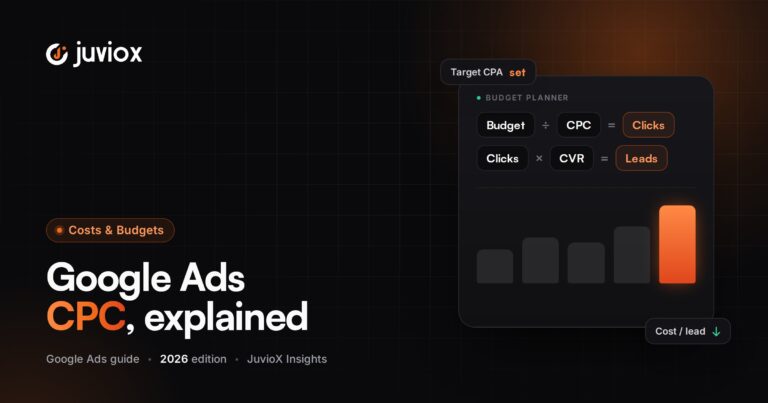
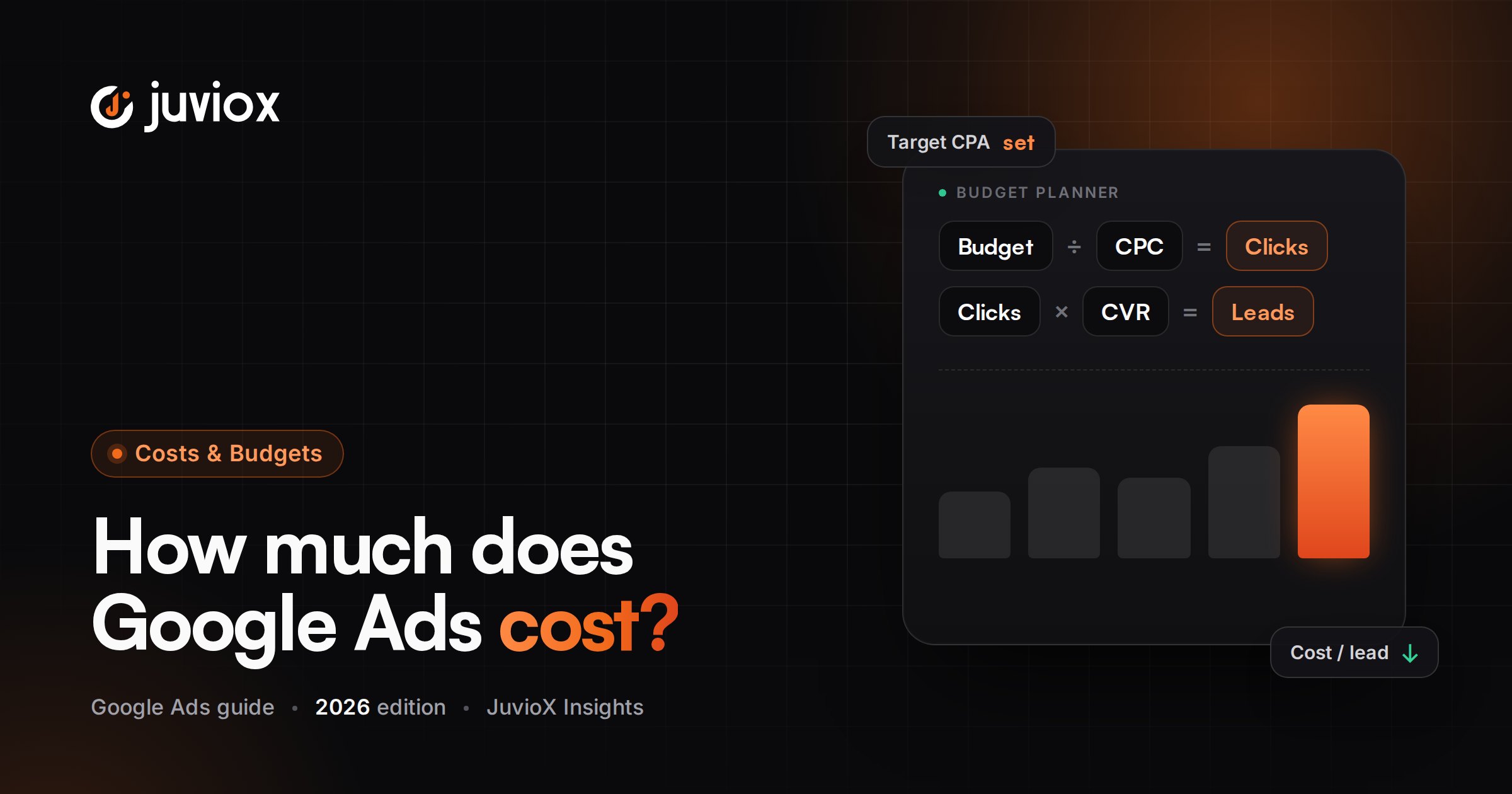
Estimated clicks = monthly budget ÷ expected CPC. Estimated conversions = estimated clicks × conversion rate.
Suppose your planning CPC is $5 and your landing page converts 8% of paid clicks. A $3,000 budget would buy roughly 600 clicks at that assumed CPC; at an 8% conversion rate, that would imply about 48 conversions. Real performance will vary, so use ranges rather than treating the estimate as a guaranteed outcome.
Method 3: Budget From Revenue and Allowable CAC
For ecommerce or businesses with clear customer economics, work from gross profit, contribution margin, repeat purchase behavior, and allowable customer acquisition cost. A campaign that generates a $100 sale at $60 ad cost may look strong or weak depending on product margin, refunds, fulfillment costs, repeat revenue, and the business’s growth strategy.
A Simple Google Ads Budget Calculator
| Input | Example | How to Use It |
|---|---|---|
| Monthly conversion goal | 40 qualified leads | Set the outcome required from paid search |
| Target CPA | $75 | Maximum/target acquisition cost consistent with economics |
| Base monthly budget | $3,000 | 40 × $75 |
| Planning CPC | $5 | Use Keyword Planner + real account data when available |
| Estimated clicks | 600 | $3,000 ÷ $5 |
| Assumed conversion rate | 8% | Use historical paid-traffic conversion rate where possible |
| Estimated conversions | 48 | 600 × 8% |
JUVIOX NOTE
Build the forecast as a range—conservative, expected and aggressive—not a single perfect number. CPC, conversion rate and lead quality all move.
Google Ads Budget Examples
The examples below illustrate budgeting logic, not universal recommendations. The right budget depends on the market and the economics of the specific business.
| Scenario | Planning Logic | What to Watch |
|---|---|---|
| Local service business | Start from qualified-lead target × acceptable qualified-lead CPA | Call quality, booked jobs, location coverage, search terms |
| B2B lead generation | Use pipeline value, close rate and allowable cost per sales-qualified opportunity | Lead qualification, CRM stages, offline conversions |
| Ecommerce | Use margin-aware target ROAS or allowable CAC | Revenue, gross margin, new vs returning customers, product mix |
| High-ticket professional service | Higher CPC may be acceptable if close rate and customer value support it | Qualified enquiries, sales acceptance, closed revenue |
| Seasonal promotion | Use a defined flight budget and expected demand window | Pacing, inventory, promotion dates, conversion lag |
How Much Should a Small Business Spend on Google Ads?
A small business should not choose a budget because another small business spends the same amount. A better starting point is the smallest budget that can generate enough high-intent traffic and conversion data to evaluate the campaign within a useful timeframe.
Before choosing the number, answer five questions:
- What is one new customer worth in revenue and gross profit?
- What percentage of leads become qualified opportunities?
- What percentage of qualified opportunities become customers?
- What cost per customer can the business sustain?
- How much relevant search demand exists in the target market?
PRACTICAL PRINCIPLE
If your budget can only buy a handful of clicks in a market where clicks are expensive, the problem is not necessarily Google Ads—it may be that the test is underfunded for the amount of evidence you expect to collect.
Why a Cheap Click Is Not Always a Good Click
Optimizing for the lowest CPC can be misleading. A $2 click that rarely becomes a customer can be more expensive than a $12 click from a high-intent query that consistently produces qualified leads.
| Traffic Set | CPC | 100 Clicks Cost | Conversion Rate | Conversions | CPA |
|---|---|---|---|---|---|
| Lower-cost traffic | $2 | $200 | 1% | 1 | $200 |
| Higher-intent traffic | $8 | $800 | 10% | 10 | $80 |
In this simplified example, the higher CPC produces a much lower CPA. This is why JuvioX evaluates search intent, conversion quality and business outcomes rather than treating CPC as the final KPI.
How to Know Whether Your Google Ads Budget Is Profitable
Spend becomes meaningful only when it is connected to outcomes. The measurement model should follow the customer journey from ad click to conversion and, where possible, from lead to qualified opportunity, sale and revenue.
- Lead generation: track qualified leads, sales-qualified leads, booked appointments, closed customers and revenue where the CRM allows it.
- Ecommerce: track purchases, revenue, refunds where relevant, product margin and new-customer economics.
- Calls: distinguish meaningful calls from short or irrelevant calls where possible.
- Forms: verify successful submissions rather than counting button clicks as leads.
- Offline sales: import or connect downstream conversion outcomes when the sales cycle continues outside the website.
MEASUREMENT RULE
Do not scale a campaign simply because Google Ads reports more conversions. First confirm that the conversion actions are accurate, deduplicated, meaningful and aligned with the business goal.
How to Reduce Google Ads Costs Without Reducing Growth
Cost reduction should come from removing waste and improving conversion efficiency—not from blindly lowering bids or budgets.
1. Tighten Search Intent
Review search terms, negative keywords, match-type behavior and campaign segmentation. Spend should concentrate on queries that have a credible path to revenue.
2. Improve Conversion Tracking
Accurate primary conversions, enhanced conversions where appropriate, and clean deduplication give bidding systems better signals and give your team better decision data.
3. Improve Landing-Page Conversion Rate
If the same paid traffic converts at a higher rate, your effective cost per lead or sale can fall even when CPC stays unchanged.
4. Separate Brand, Non-Brand and Different Intent Levels
Mixing very different traffic can hide where budget is actually producing incremental value.
5. Use Geographic and Scheduling Data Carefully
Reduce exposure where the business cannot serve customers profitably, but avoid overreacting to small datasets.
6. Feed Better Business Outcomes Back Into Optimization
For lead generation, CRM and offline conversion data can help distinguish raw leads from valuable outcomes. For ecommerce, conversion value and margin-aware analysis can improve budget decisions.
Common Google Ads Budgeting Mistakes
| Mistake | Why It Causes Problems | Better Approach |
|---|---|---|
| Choosing a budget before defining economics | Spend has no profitability guardrail | Start with customer value, margin, close rate and allowable CPA/CAC |
| Using CPC as the main success metric | Cheap traffic can still be low quality | Judge CPA, qualified lead cost, revenue and profit |
| Spreading a small budget across too many campaigns | Each campaign may receive too little data | Prioritize the highest-value demand first |
| Changing budgets too frequently | Performance becomes harder to interpret and pacing changes | Make deliberate changes and evaluate sufficient data |
| Treating all conversions as equal | Low-value actions can distort optimization | Use meaningful primary conversions and value/quality signals |
| Ignoring landing pages | Paid traffic is wasted after the click | Improve message match, speed, UX, trust and conversion friction |
| Scaling before tracking is validated | More spend amplifies measurement errors | Audit conversion tracking before major scaling |
Google Ads Cost and Budget Checklist
- Define the primary business outcome: qualified lead, sale, revenue, booking, or another measurable result.
- Calculate an acceptable CPA or CAC from real business economics.
- Research keyword demand and planning CPC ranges for the target locations.
- Estimate traffic and conversions using conservative, expected and aggressive scenarios.
- Set the campaign’s average daily budget from the approved monthly amount.
- Remember that most average-daily-budget campaigns can spend above the average on an individual day, subject to Google’s spending-limit rules.
- Validate conversion tracking before evaluating or scaling performance.
- Review search terms, lead quality, revenue and profitability—not only clicks.
- Improve landing pages and CRO alongside campaign optimization.
- Reforecast as real CPC, conversion rate, close rate and customer value data becomes available.
QUICK RULE
Budget tells Google how much it may spend. Profitability tells you how much it should be allowed to spend.
Final Takeaway: Set Your Google Ads Budget From Business Economics
Google Ads pricing is variable by design. The platform lets advertisers choose their budgets, but that flexibility makes planning more important—not less. A strong budget is grounded in customer value, conversion rate, acceptable acquisition cost, real search demand and accurate measurement.
Start with the economics, forecast a realistic range, validate tracking, and then use actual performance data to decide where to cut, maintain or scale spend. The goal is not to buy the cheapest clicks. The goal is to acquire valuable customers at a cost the business can sustain.
GOOGLE ADS MANAGEMENT
Build a Google Ads Budget Around Real Growth
JuvioX connects campaign strategy, conversion tracking, landing-page performance and business data so budget decisions are based on qualified leads, revenue and measurable growth—not clicks alone.
FAQ
Frequently asked questions
How much does Google Ads cost?
There is no fixed universal price. Cost depends on auction competition, targeting, bids, campaign type, relevance, market conditions and how much traffic you choose to buy. Your budget controls spend; your business economics determine whether that spend is worthwhile.
How much does Google Ads cost per month?
You choose the budget. For campaigns using an average daily budget, Google generally calculates the monthly spending limit as 30.4 times the average daily budget, subject to its current budget rules.
Is there a minimum spend for Google Ads?
There is no single practical minimum that works for every advertiser. The useful minimum depends on CPC, search volume, conversion rate and how much data you need to evaluate performance.
How much should I spend on Google Ads per day?
Work backward from a monthly budget that is supported by your target CPA/CAC and conversion goals, then divide that monthly amount by 30.4 for an average daily budget.
Can Google Ads spend more than my daily budget?
For most campaigns using an average daily budget, Google says daily billed spend can reach up to two times the average daily budget on higher-opportunity days, while the monthly spending limit is generally 30.4 times the average daily budget.
What is a good cost per click for Google Ads?
A good CPC is one that contributes to profitable customer acquisition. A higher CPC can be acceptable if the traffic converts at a stronger rate or produces higher-value customers.
Why is Google Ads so expensive in some industries?
Industries with high customer values, strong commercial intent and many advertisers can sustain more aggressive bids. Geography, seasonality and query intent can also increase auction pressure.
How can I estimate Google Ads cost before launching?
Use Keyword Planner or existing account data to create CPC ranges, estimate available traffic, apply realistic conversion-rate assumptions, and model expected CPA/CAC. Use a range rather than one exact forecast.
Should I use a daily budget or a campaign total budget?
Average daily budgets are suitable for ongoing campaigns with flexible pacing. Google also supports campaign total budgets for eligible fixed-duration campaigns, where you set a total amount for the campaign period. Availability and rules depend on campaign type.
Should I increase my Google Ads budget when a campaign is profitable?
Potentially, but first confirm conversion accuracy, lead or revenue quality, marginal performance, impression opportunity and operational capacity. Scaling should be based on incremental profitable growth, not only a strong account-level average.