On this page
What Is CPC in Google Ads?
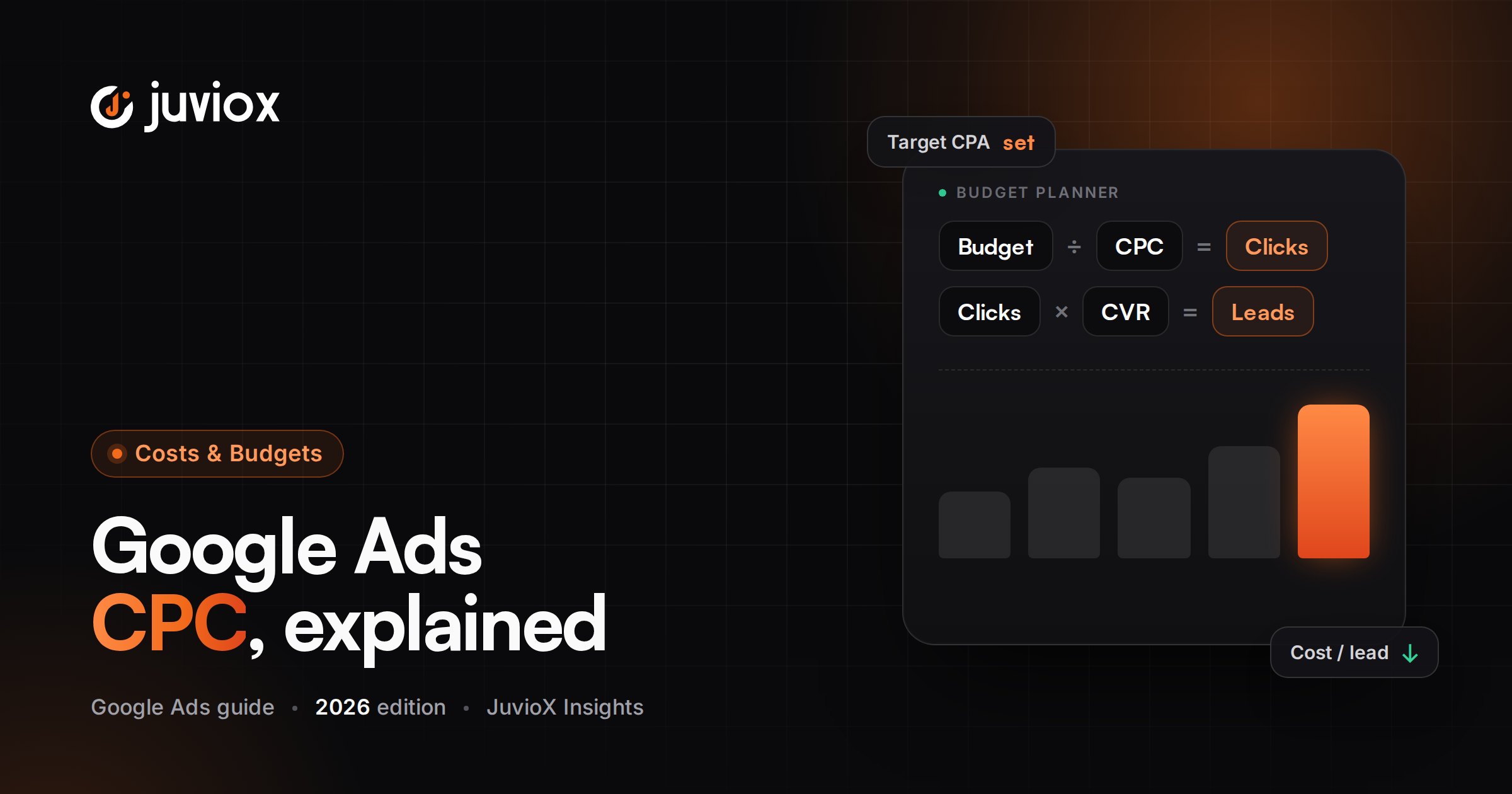
CPC stands for cost per click. In Google Ads, it describes the amount associated with a click on your advertisement. Average CPC is calculated by dividing the total cost of clicks by the total number of clicks.
FORMULA
Average CPC = total click cost ÷ total clicks
If a campaign spends $1,000 and receives 200 clicks, its average CPC is $5. That number tells you the average traffic cost, but it does not tell you whether the campaign generated profitable leads or sales.
JUVIOX NOTE
CPC is a traffic-efficiency metric, not a business-outcome metric. Always evaluate it alongside conversion rate, CPA/CAC, lead quality, revenue and ROAS where applicable.
How Does Google Ads Calculate Your Actual CPC?
Google defines actual CPC as the final amount you are charged for a click. It is often lower than your maximum CPC bid because, in an auction, you generally pay only what is minimally required to clear the applicable Ad Rank thresholds and beat the Ad Rank of the competitor immediately below you. Exceptions can apply depending on bidding settings and auction conditions.
Ad Rank is determined at auction time. Google lists factors including your bid, the quality of your ads and landing page, Ad Rank thresholds, auction competitiveness, the context of the search, and the expected impact of assets and other ad formats. This is why the same keyword does not have one permanent CPC.
IMPORTANT
Google Ads is not a fixed-price keyword marketplace. CPC can change from one auction to the next because the competitors, user context, ad quality, thresholds and bids can change.
Average CPC vs Actual CPC vs Max CPC
| Term | Meaning | How to Use It |
|---|---|---|
| Actual CPC | The final amount charged for an individual click | Understand what a specific click cost |
| Average CPC | Total click cost divided by total clicks | Evaluate average traffic cost over a period |
| Max CPC bid | The maximum CPC you set under applicable manual bidding settings | Controls how much you are generally willing to bid for a click |
| Keyword Planner CPC/bid estimates | Planning estimates based on historical data and forecast inputs | Research and scenario planning—not a guaranteed future CPC |
What Is a Good CPC in Google Ads?
There is no universal “good” CPC. A good CPC is one that allows you to acquire valuable conversions at an acceptable cost. The correct threshold depends on your conversion rate, customer value, gross margin, lead-to-sale rate and business model.
For example, a $20 CPC can be excellent for a high-value service if the traffic converts into profitable customers. A $1 CPC can be poor if the clicks are irrelevant and never convert.
QUICK RULE
Do not optimize toward the lowest CPC. Optimize toward the best economics from qualified traffic.
Why CPC Benchmarks Need Context
Advertisers frequently search for an “average CPC Google Ads” or a “Google Ads CPC benchmark.” Benchmarks can provide directional context, but they should not become a target by themselves. CPC varies by industry, country, query intent, device, season, match behavior, ad quality, competition and bidding strategy. Your own account data is more actionable once sufficient clean data exists.
What Affects Google Ads CPC?
| Factor | How It Can Affect CPC | What to Review |
|---|---|---|
| Auction competition | More or stronger competitors can increase the price needed to win valuable positions | Auction Insights, impression share, market changes |
| Search intent | Commercial and high-value queries can attract stronger bids | Search terms and conversion quality |
| Bid / bidding strategy | Your bid or automated bidding constraints affect auction participation | Strategy settings, targets and budget |
| Ad quality | Higher-quality ads can improve competitiveness and generally support better performance | Expected CTR, ad relevance, landing-page experience |
| Landing-page experience | A relevant, useful destination supports ad quality and conversion efficiency | Message match, usability, speed, content |
| Location and device | Auction thresholds and competitor pressure can vary by context | Geographic and device reports |
| Ad position opportunity | Thresholds are typically higher for ads above search results | Top/absolute-top metrics and economics |
| Seasonality | Demand and advertiser competition can move during high-value periods | Time-series CPC and conversion data |
Quality Score and CPC: What the Relationship Really Means
Quality Score is a 1–10 diagnostic tool at the keyword level. Google explicitly says Quality Score itself is not an input in the ad auction and should not be treated as a KPI. Its three components—expected CTR, ad relevance and landing-page experience—help diagnose areas where the user experience may be weaker than competing ads.
At auction time, Google uses real-time quality evaluations among the factors that determine Ad Rank. Better ad quality generally supports better performance, including stronger positions and lower cost, but there is no guaranteed formula such as “raise Quality Score by one point and CPC falls by X%.”
JUVIOX NOTE
Use Quality Score to find the weak component. Do not optimize the 1–10 number in isolation.
Why Is My Google Ads CPC So High?
High CPC is not automatically a campaign problem. It becomes a problem when the price of traffic is too high relative to the value and conversion rate of that traffic. Diagnose the cause before changing bids.
1. You Are Competing for Expensive Search Intent
Keywords close to a high-value purchase or enquiry can support aggressive advertiser bids. If those clicks produce strong customers, the high CPC may still be economically rational.
2. Your Keyword Themes Are Too Broad
Broad or mixed intent can place your ads into auctions that do not match the offer closely enough. Review actual search terms, not just the keyword list.
3. Ad Relevance or Expected CTR Is Weak
If the ad does not closely match the user’s intent or fails to earn clicks when eligible, your quality diagnostics may show opportunities to improve copy, grouping and relevance.
4. Landing-Page Experience Is Weak
A landing page that does not deliver what the ad promised can hurt user experience and conversion rate. Google recommends close alignment between keywords, ad messaging and the destination page.
5. You Are Chasing Top Positions Without Checking Incremental Value
Higher positions can require higher thresholds and may cost more. The business question is whether the incremental visibility produces enough additional conversion value to justify the cost.
6. Your Market Changed
Competitor activity, seasonality and demand can change CPC even when you made no major account changes. Compare CPC trends with Auction Insights, search volume, conversion rate and impression-share metrics.
How to Estimate Google Ads CPC Before Launching
Google Keyword Planner can help you research keywords, view search-volume estimates, inspect cost estimates and build forecasts. Google states that forecasts use historical search data and consider factors such as bid, budget, seasonality and historical ad quality. Forecasts are planning tools—not guarantees.
- Choose the exact target locations and language settings relevant to the campaign.
- Build a focused keyword set around the service or product.
- Review Keyword Planner cost and bid ranges as directional inputs.
- Use the Forecast view to model clicks, cost and average CPC at different spend levels.
- Create conservative, expected and aggressive CPC scenarios.
- After launch, replace assumptions with real account CPC, conversion and lead-quality data.
How to Calculate CPC and Its Impact on CPA
FORMULA
Average CPC = spend ÷ clicks
PLANNING RELATIONSHIP
Estimated CPA ≈ average CPC ÷ conversion rate
If average CPC is $5 and 10% of clicks convert, the simplified CPA is about $50. If CPC rises to $7 but conversion rate improves to 20%, the simplified CPA becomes about $35. This illustrates why CPC should never be optimized independently from conversion rate.
| Scenario | Avg. CPC | Clicks from $1,000 | Conversion Rate | Conversions | Approx. CPA |
|---|---|---|---|---|---|
| A — cheaper traffic | $3 | 333 | 3% | 10 | $100 |
| B — stronger intent | $6 | 167 | 10% | 17 | $59 |
| C — expensive but weak | $10 | 100 | 3% | 3 | $333 |
How to Lower CPC in Google Ads Without Hurting Performance
The goal is not to force CPC down at any cost. The goal is to remove inefficient auction participation and improve the relevance and value produced by each click.
1. Improve Search-Term Quality
Review the Search terms report regularly. Add appropriate negative keywords, identify irrelevant themes, and separate materially different intent when it needs different ads or landing pages.
2. Make Ads More Relevant to Search Intent
Google recommends matching ad language more directly to user searches and grouping keywords into tighter themes when one ad cannot address very different intents well.
3. Improve Expected CTR Without Clickbait
Strengthen the offer, differentiation and call to action while accurately representing the landing page. Higher CTR is useful only when the clicks remain qualified.
4. Improve Landing-Page Experience
Make the destination closely match the keyword and ad promise. Improve usefulness, navigation, speed, trust, mobile experience and conversion friction. A better landing page can also improve conversion rate, making the same CPC more profitable.
5. Reassess Bids and Automated-Bidding Targets
If the campaign is paying too aggressively for marginal traffic, review bid strategy, targets and conversion signals. Avoid making bidding changes before verifying that primary conversion tracking is accurate.
6. Segment by Real Business Value
Different locations, services, products and customer types can tolerate different CPCs. Allocate spend based on qualified-lead value, margin or revenue—not a single account-wide CPC target.
7. Improve Conversion Tracking and Offline Feedback
For lead generation, feeding qualified or closed outcomes back into measurement can reveal that some expensive clicks are valuable while some cheap clicks are waste. This prevents CPC optimization from rewarding low-quality traffic.
8. Test Landing Pages and CRO
A higher conversion rate increases the CPC you can afford at the same CPA. Sometimes the strongest “CPC optimization” happens after the click.
QUICK RULE
Before lowering bids, ask: Is CPC actually the problem, or is poor search intent, conversion rate, tracking or lead quality making the CPC look expensive?
CPC by Campaign Type: Search, Shopping, Display and YouTube
Do not compare CPC across campaign types as if the clicks are equivalent. User intent and the way campaigns serve differ substantially.
| Campaign Type | CPC Interpretation | Primary Context |
|---|---|---|
| Search | Often tied to explicit query intent | Search terms, CPA, qualified leads, revenue |
| Shopping / Performance Max inventory | Product intent and feed/asset context matter | ROAS, margin, product performance, conversion value |
| Display | Clicks may be cheaper but intent can be very different | Incrementality, assisted outcomes, audience quality |
| YouTube | Video campaigns may optimize around views, reach or conversions rather than CPC alone | View/conversion strategy, audience, lift and downstream actions |
Manual CPC vs Automated Bidding
Manual CPC gives the advertiser direct control over maximum CPC bids. Automated bidding strategies use Google’s systems to set bids toward a defined objective, such as clicks, conversions or conversion value, depending on the strategy. In an automated strategy, trying to micromanage CPC can conflict with the campaign’s actual objective.
DECISION RULE
If the objective is profitable conversions, judge the bidding strategy primarily on conversion economics—not whether every individual click is cheap.
Common Google Ads CPC Optimization Mistakes
| Mistake | Why It Fails | Better Approach |
|---|---|---|
| Pausing every high-CPC keyword | High CPC can still produce the best customers | Compare CPA/CAC, quality and revenue |
| Chasing the lowest CPC | Cheap traffic can have weak intent | Optimize for qualified outcomes |
| Treating Quality Score as an auction score | Google says the 1–10 score is diagnostic, not an auction input | Diagnose its three components |
| Using Keyword Planner bid ranges as actual CPC | Planner values are estimates | Use them for planning, then use live data |
| Lowering bids before fixing tracking | Bad signals make optimization unreliable | Validate primary conversions first |
| Ignoring landing-page conversion rate | Traffic cost is only half of acquisition efficiency | Improve CRO and message match |
| Comparing CPC across campaign types blindly | Different inventory carries different intent | Evaluate each type against its role and business KPI |
Google Ads CPC Optimization Checklist
- Confirm that conversion tracking is accurate and primary actions are meaningful.
- Review average CPC by campaign, ad group, keyword/search theme, device and location where statistically useful.
- Inspect actual search terms for irrelevant or low-value traffic.
- Review expected CTR, ad relevance and landing-page experience diagnostics.
- Compare CPC changes with conversion rate and CPA/CAC changes.
- Check Auction Insights and market/seasonal changes before assuming an internal problem.
- Improve ad-to-keyword-to-landing-page message match.
- Use negative keywords and tighter intent segmentation where appropriate.
- Review bidding strategy and targets against the campaign objective.
- Evaluate lead quality, closed revenue or product margin—not just platform conversions.
- Run CRO tests when conversion rate is limiting allowable CPC.
- Document changes so CPC movements can be interpreted correctly.
Final Takeaway: CPC Is a Cost Signal, Not the Goal
Google Ads CPC matters because it determines how much traffic your budget can buy, but it should never be managed in isolation. The strongest campaigns connect CPC with search intent, conversion rate, qualified-lead quality, customer acquisition cost and revenue. Diagnose why CPC is high, remove waste, improve relevance and landing-page experience, and then decide whether a click is expensive based on what that click is worth to the business.
GOOGLE ADS MANAGEMENT
Pay for Better Clicks — Not Just Cheaper Clicks
JuvioX connects keyword intent, campaign structure, conversion tracking, landing-page performance and business data so Google Ads optimization is based on qualified leads and revenue—not CPC alone.
FAQ
Frequently asked questions
What is CPC in Google Ads?
CPC means cost per click. Average CPC is total click cost divided by the number of clicks. Actual CPC is the final amount charged for an individual click.
How much does Google Ads cost per click?
There is no fixed price per click. CPC varies by auction competition, search intent, bids, quality, location, device, user context and other auction-time factors.
What is a good CPC for Google Ads?
A good CPC is one that supports profitable acquisition. Judge it against conversion rate, CPA/CAC, lead quality, customer value, margin and revenue rather than a universal benchmark.
Why is my Google Ads CPC so high?
Common causes include expensive commercial intent, stronger competition, aggressive bidding, weak relevance or landing-page experience, top-position pressure, seasonality, or a market where customers are simply valuable.
How can I lower CPC in Google Ads?
Improve search-term quality, relevance, expected CTR and landing-page experience; remove waste; review bidding; segment by value; and improve conversion rate. Do not lower CPC at the expense of qualified traffic.
Does Quality Score affect CPC?
Quality Score itself is a diagnostic score and Google says it is not an input in the ad auction. However, auction-time quality factors such as expected CTR, ad relevance and landing-page experience are used in Ad Rank calculations, and better ad quality generally supports better performance and lower cost.
What is the difference between max CPC and actual CPC?
Max CPC is generally the most you are willing to bid for a click under applicable manual bidding settings. Actual CPC is what you are finally charged and is often lower.
Can Google Keyword Planner predict my CPC?
Keyword Planner provides estimates and forecasts based on historical data and planning inputs. It is useful for scenario planning but cannot guarantee the CPC you will pay in live auctions.
Should I pause a keyword because its CPC is high?
Not automatically. Check conversion rate, CPA/CAC, lead quality, revenue and strategic value. A high-CPC keyword can be one of the most profitable keywords in the account.
Is lower CPC always better?
No. Lower CPC is beneficial only if traffic quality and business outcomes remain strong. The cheapest click can be the most expensive one if it never becomes a customer.
7 sources & references
- Google Ads Help — Actual cost-per-click (CPC)
- Google Ads Help — About Ad Rank
- Google Ads Help — About Quality Score for Search campaigns
- Google Ads Help — 5 ways to use Quality Score to improve performance
- Google Ads Help — About ad quality
- Google Ads Help — About Keyword Planner forecasts
- Google Ads Help — Use Keyword Planner