On this page
The Google Ads Account Hierarchy
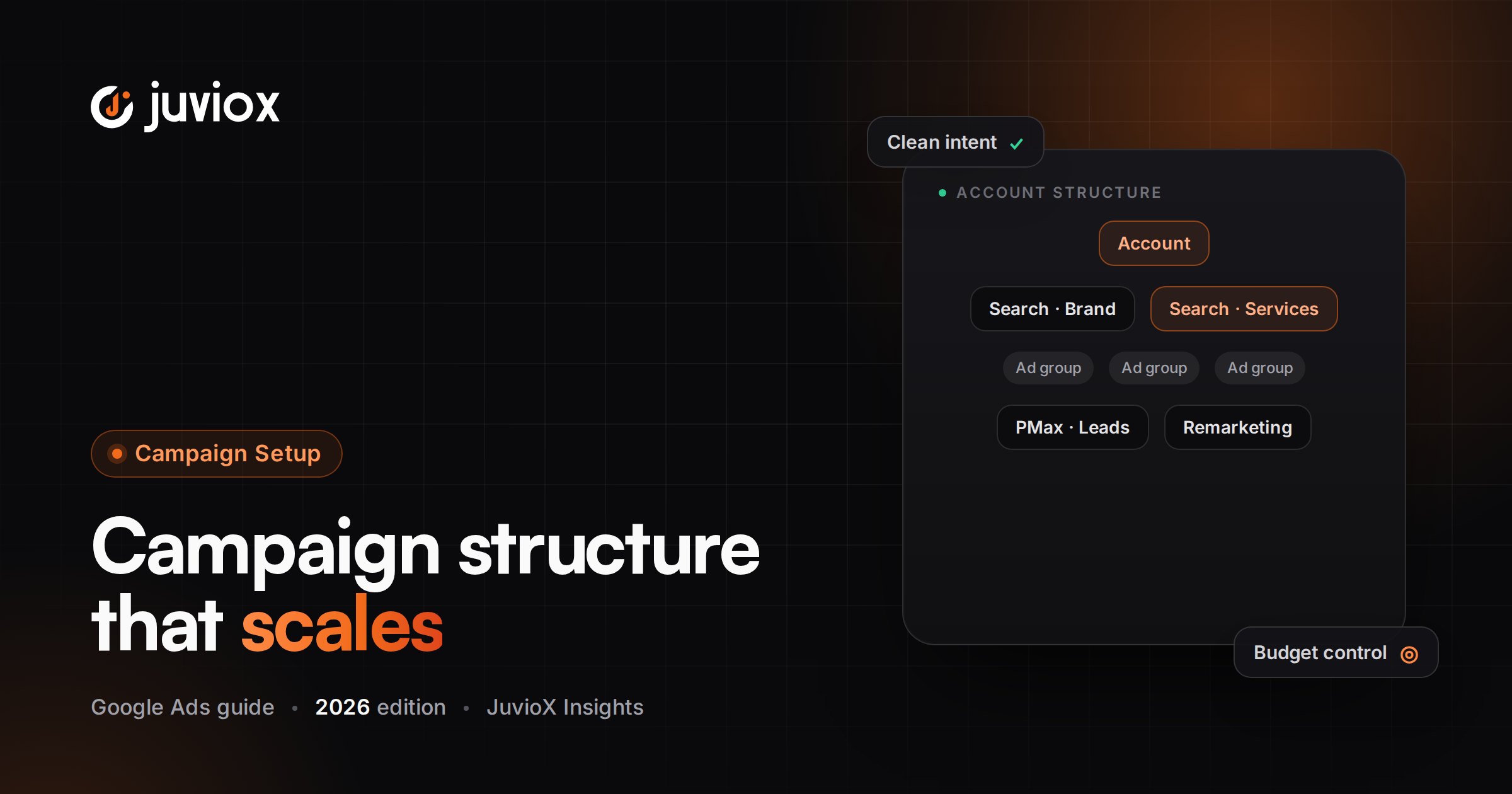
Google Ads uses three core organizational layers: account, campaign, and ad group. The account contains billing and access. Campaigns hold budgets and major settings. Ad groups contain similar ads and targeting—keywords in keyword-based Search campaigns, or other targeting methods depending on campaign type.
| Level | Primary Job | Typical Decisions |
|---|---|---|
| Account | Business-level access, billing and shared resources | Users, billing, account-wide measurement/resources |
| Campaign | Budget and major delivery/optimization controls | Objective, budget, bidding, geography, networks, conversion goals and campaign type |
| Ad group | Organize closely related intent and messaging | Keyword/theme, ads, landing-page relevance and certain targeting |
| Ad / assets | Communicate the offer | Headlines, descriptions, images/video where applicable, final URL and assets |
JUVIOX PRINCIPLE
Structure should follow control boundaries. If two groups need different budgets, locations, conversion goals, bidding economics or fundamentally different campaign types, they may need separate campaigns. If they share those controls but need different messaging or landing pages, they may only need separate ad groups.
The Core Principle: Separate Only What Needs Separate Control
Over-segmentation used to be common in PPC accounts. Advertisers created campaigns by device, match type, tiny keyword groups, or every product variation. That can fragment conversion data and make automated bidding learn from smaller pools of evidence.
Google’s current account-structure guidance explicitly recommends simpler, consolidated, tightly themed structures for AI-powered Search. It advises moving away from single-keyword ad groups, bringing match types together within themed ad groups, and segmenting campaigns around business objectives rather than unnecessary technical splits.
DECISION RULE
Campaign = control boundary. Ad group = relevance boundary. Keyword/search theme = demand signal. Landing page = conversion destination. Do not create a new layer unless it changes one of those jobs.
When Should You Create a Separate Campaign?
Create a separate campaign when you need materially different campaign-level control—not merely because two keyword lists look different.
| Reason to Separate | Example | Why Campaign-Level Separation Helps |
|---|---|---|
| Different budget | Brand protection vs non-brand acquisition | Each can receive its own spend allocation |
| Different business objective | Lead generation vs ecommerce sales | Optimization and conversion goals differ |
| Different geography | USA vs UK | Budgets, economics, language or offers may differ |
| Different product/service economics | High-margin service vs low-margin service | Target CPA/ROAS can be managed differently |
| Different campaign type | Search vs Performance Max | They use different delivery and creative systems |
| Different conversion strategy | New-customer acquisition vs existing demand | Separate goals/values may justify separate optimization |
| Different seasonality or promotion | Evergreen vs Black Friday | Independent pacing and start/end strategy |
Do not automatically split campaigns just to separate devices, match types, every city, or every small product category. If the budget, objective and optimization target are the same, consolidation may produce a cleaner learning environment.
How to Structure a Google Search Campaign
For Search, start from the business goal and the landing-page architecture. Google recommends specific, themed ad groups so keywords, ads and landing pages remain relevant.
- Choose the business objective and the primary conversion goal.
- Define the campaign’s budget, bidding strategy, locations, language and network settings.
- Group demand into a small number of meaningful themes.
- Build an ad group for each theme that needs distinct messaging or a distinct landing page.
- Add closely related keywords/match types rather than duplicating the same theme across many micro ad groups.
- Create strong responsive search ads that connect the search intent to the landing page.
- Add relevant assets and negative-keyword controls.
- Launch only after conversion tracking and primary conversion actions are verified.
EXAMPLE
A digital marketing agency should not put “Google Ads management,” “SEO services,” and “website design” in one ad group just because all three are agency services. They represent different intent, different ad messaging and different landing pages. They may share a campaign only if the campaign-level budget and optimization objective genuinely should be shared.
How to Structure Ad Groups
An ad group should represent one coherent search-intent or product/service theme. Google describes ad groups as collections of ads with similar targets and recommends organizing them around common themes, products or goals.
| Weak Ad Group | Better Structure |
|---|---|
| Marketing services: Google Ads + SEO + web design keywords | Separate themed ad groups for Google Ads, SEO and web design |
| Emergency plumber + bathroom renovation | Separate urgent repair intent from planned renovation intent |
| All shoes | Running shoes / hiking shoes / formal shoes when each has distinct pages and messaging |
| One ad group per keyword | Combine closely related keywords that share intent, creative and landing page |
The test is not whether keywords are spelled similarly. Ask whether the same ad promise and the same landing page can satisfy the searches well. If yes, they can often live together. If not, split the theme.
How Many Ad Groups Should You Have Per Campaign?
There is no universal ideal number. The correct number is the number of meaningful themes that share the campaign’s budget, bidding and business objective while still requiring distinct messaging or landing pages.
A campaign with four strong themes may need four ad groups. A larger catalog may need more. Creating 30 ad groups simply because a checklist says so is not a best practice.
BETTER QUESTION
Instead of “How many ad groups per campaign?”, ask: “How many distinct relevance themes need their own ads and landing-page alignment while sharing the same campaign-level controls?”
How Many Keywords Should You Have Per Ad Group?
Again, there is no magic count. Google’s account-organization documentation gives an example recommendation of smaller, tightly themed lists around 20–30 terms, but modern structure should prioritize semantic and commercial coherence over hitting a number.
An ad group with eight highly related keywords can be excellent. An ad group with 25 closely related variants can also be appropriate. The problem starts when the list contains different intents that require different offers, ads, or landing pages.
AVOID THE OLD TRAP
Do not create a single-keyword ad group merely because you have one high-value keyword. Google’s current AI-oriented guidance specifically recommends moving SKAG-style structures into themed ad groups.
Match Types and Modern Consolidation
Match type should not automatically determine account structure. Duplicating the same theme into separate Exact, Phrase and Broad campaigns or ad groups can add complexity without creating a meaningful business boundary.
Google’s current AI account-structure guidance recommends bringing match types together in themed ad groups and, in its AI-focused approach, simplifying toward broad match with Smart Bidding where appropriate. That does not mean every advertiser should blindly switch everything to broad match. It means structure should be built around intent and business goals rather than match-type duplication.
JUVIOX IMPLEMENTATION VIEW
Use broader automation only when conversion tracking is trustworthy, primary conversions represent real business outcomes, negative controls are maintained, and the account has enough data to judge search quality. Structure and measurement have to work together.
Landing Pages Are Part of Campaign Structure
Account structure is not finished when the keywords and ads are organized. The landing page determines whether the relevance created inside Google Ads continues after the click.
| Search Intent | Ad Message | Best Destination |
|---|---|---|
| google ads management agency | Google Ads management focused on profitable growth | Dedicated Google Ads service page |
| google ads audit | Find tracking, structure and spend leaks | Google Ads audit landing page |
| google ads cost | Educational cost/budget guidance | Google Ads cost guide |
| emergency electrician near me | Immediate emergency service and response | Emergency electrician location/service page |
If two keyword themes need fundamentally different pages to convert well, that is a strong signal they should not be forced into the same ad group.
How to Structure Performance Max Campaigns
Performance Max does not use Search-style ad groups. It uses asset groups: collections of creative assets centered on a theme or audience. Google recommends organizing asset groups around similar themes, categories, website sections or audiences.
For retail campaigns connected to Merchant Center, listing groups determine which products are included. Google specifically recommends avoiding overlapping product sets when duplicating asset groups; distinct product groups make reporting and creative alignment cleaner.
| PMax Layer | Use It For |
|---|---|
| Campaign | Shared budget, goals, bidding and high-level strategy |
| Asset group | Theme/category/audience-aligned creative grouping |
| Listing group | Control which Merchant Center products are included |
| Search themes | Optional signals that help communicate relevant search concepts |
| Audience signals | Optional guidance to accelerate learning; not a hard audience restriction |
IMPORTANT
Do not copy Search-campaign logic directly into Performance Max. An asset group is not simply an ad group with a different name. Structure it around coherent creative/product themes while keeping campaign-level economics in mind.
How to Structure Google Shopping Campaigns
Shopping structure should begin with the product feed and business economics. Product categories, brands, margins, price bands, best sellers, seasonality and inventory can all influence how much segmentation is useful.
The correct structure depends on whether you use Standard Shopping or Performance Max with a Merchant Center feed. In Performance Max, listing groups and asset groups are the core segmentation tools. Avoid creating complexity that does not lead to a different budget, target, creative strategy or product decision.
COMMERCE PRINCIPLE
Segment products when the segmentation changes how you bid, budget, promote, measure or merchandise them—not simply because the feed contains many categories.
Lead Generation vs Ecommerce: Structure Should Follow Economics
| Lead Generation | Ecommerce |
|---|---|
| Campaigns can separate services with different lead values or sales processes | Campaigns can separate product groups with materially different margin/ROAS goals |
| Ad groups organize search intent and service themes | Asset/listing groups organize product/creative themes in PMax |
| CRM/offline conversion quality is critical | Revenue, margin, new-customer value and product economics are critical |
| Location segmentation may matter when service areas differ | Inventory, shipping regions and feed quality may drive structure |
| Primary KPI may be qualified CPL, opportunity cost or CAC | Primary KPI may be ROAS, profit, contribution margin or CAC |
Google Ads Campaign Structure Examples
Example 1: Local Service Business
| Campaign | Ad Groups / Themes |
|---|---|
| Search | Emergency Services | Core Area | Emergency repair; same-day service; 24/7 service |
| Search | Planned Services | Core Area | Installation; replacement; maintenance |
| Brand Search | Brand-name demand |
Example 2: B2B SaaS
| Campaign | Ad Groups / Themes |
|---|---|
| Search | High Intent | Demo | Software category; solution; competitor-alternative intent |
| Search | Problem/Solution | Pain-point themes with dedicated solution pages |
| Brand | Brand + product terms |
| Performance Max / Demand expansion | Creative groups aligned to priority solutions, if justified by strategy/data |
Example 3: Ecommerce
| Campaign | Structure |
|---|---|
| PMax | Core Products | Asset/listing groups by coherent product categories or economics |
| PMax or Shopping | Priority / high-margin | Separate only if budget/ROAS strategy needs independent control |
| Search | Brand | Brand demand where strategically useful |
| Search | High-intent non-brand | Selected category/product demand where Search adds control/value |
A Structure Decision Tree
- Do these products/services need a different campaign type? If yes, separate campaigns.
- Do they need different budgets, geographies, conversion goals or materially different efficiency targets? If yes, consider separate campaigns.
- If campaign controls can be shared, do the searches require different ad promises or landing pages? If yes, separate ad groups/themes.
- If the same message and destination work, consolidate closely related keywords rather than creating micro ad groups.
- For Performance Max, ask whether different product/creative themes justify separate asset groups or listing groups—not Search-style ad groups.
- After launch, use search-term quality, conversion quality and business outcomes to refine the structure.
Common Google Ads Structure Mistakes
| Mistake | Why It Hurts | Better Approach |
|---|---|---|
| Single-keyword ad groups everywhere | Fragments themes and management; conflicts with modern AI-oriented consolidation | Use tightly themed ad groups |
| Campaign per match type | Duplicates structure without a real business boundary | Group match types around intent; segment only when control requires it |
| Too many campaigns sharing tiny budgets | Fragments conversion data and learning | Consolidate campaigns with the same goal/economics |
| One giant ad group | Weak message and landing-page relevance | Split distinct intent themes |
| Mixing different lead values under one target | Automation may optimize toward easier but lower-value conversions | Separate economics or feed values/quality back into bidding |
| Copying Search structure into PMax | Ignores asset/listing-group mechanics | Use PMax-native themes and product grouping |
| Restructuring everything at once | Makes performance changes difficult to diagnose | Migrate deliberately and protect measurement continuity |
| Structuring before tracking is reliable | Automation learns from bad outcomes | Validate primary conversions first |
How to Restructure an Existing Google Ads Account Safely
Google warns that reorganizing existing campaigns and ad groups can remove accumulated history from the newly created entities and may affect performance. Do not rebuild a live account simply because a diagram looks cleaner.
- Audit the existing structure and identify actual control/relevance problems.
- Confirm conversion tracking and business-goal definitions before changing campaign architecture.
- Map old campaigns/ad groups to the proposed structure.
- Prioritize duplicate, non-serving, SKAG-style or unnecessarily segmented areas.
- Consolidate in stages where risk is meaningful.
- Preserve negative-keyword strategy, landing-page mapping and critical settings.
- Annotate changes and monitor conversion volume, search terms, CPA/ROAS and lead quality.
- Avoid judging a structural change from one or two days of noisy data.
JUVIOX NOTE
A prettier account is not automatically a better account. Restructure only when the new architecture improves control, relevance, data density, measurement, or operational clarity.
Google Ads Campaign Structure Audit Checklist
- Campaigns are separated by genuine budget, goal, geography, economics or campaign-type requirements.
- Campaign names are consistent and understandable without opening every campaign.
- Ad groups represent coherent themes rather than isolated keyword variations.
- Keywords within each Search ad group can use the same core message and landing page.
- Match-type duplication is intentional rather than inherited from an old structure.
- Brand and non-brand strategy is deliberate.
- Primary conversion goals are accurate at the level used for bidding.
- Low-value and high-value lead types are not blindly treated as identical.
- Landing pages align with the ad-group/search intent.
- Performance Max asset groups have coherent creative/product themes.
- Retail listing groups do not overlap without a strategic reason.
- Budgets are not fragmented across unnecessary campaigns.
- Search terms and negative keywords are reviewed after launch.
- The structure can be explained in business language—not only PPC jargon.
Final Takeaway: Build Around Business Control, Relevance and Data
The strongest Google Ads account structure in 2026 is neither ultra-granular nor blindly consolidated. It separates what genuinely needs independent control and combines what benefits from shared learning.
Use campaigns for meaningful budget, objective, geography and economic boundaries. Use ad groups for coherent Search intent and messaging. Use landing pages to continue that relevance after the click. In Performance Max, use asset and listing groups according to the way the campaign actually works. Then let accurate conversion and business data—not account aesthetics—tell you whether the structure is succeeding.
GOOGLE ADS MANAGEMENT
Is Your Google Ads Account Structured to Scale?
JuvioX audits campaign architecture, search intent, conversion tracking, landing pages and business data together—so structure supports qualified leads, revenue and scalable optimization rather than unnecessary complexity.
FAQ
Frequently asked questions
What is the Google Ads account hierarchy?
Google Ads is organized primarily into account, campaign and ad-group layers. Campaigns contain budgets and major settings; ad groups organize similar ads and targeting.
What is the best Google Ads campaign structure?
There is no single universal layout. The best structure separates genuine campaign-level control while consolidating themes that share the same business goal, economics and settings.
How many ad groups should I have per campaign?
There is no fixed ideal. Create as many as needed to represent distinct relevance themes that share the campaign’s budget and optimization controls.
How many keywords should be in one ad group?
Use a tightly themed set rather than chasing a fixed number. Google documentation gives 20–30 terms as one organizational example, but intent, message and landing-page coherence matter more than the count.
Should I use single-keyword ad groups (SKAGs)?
Not as a default. Google’s current AI-oriented structure guidance recommends moving SKAG-style structures into themed ad groups.
Should Exact, Phrase and Broad match be in separate campaigns?
Not automatically. Match type alone is usually not a sufficient reason for campaign separation. Segment when a real budget, goal, bidding or control requirement exists.
Should brand and non-brand campaigns be separate?
Often they are separated because intent, economics, reporting and budget control can differ, but the decision should follow the advertiser’s strategy rather than a universal rule.
How should I structure a Performance Max campaign?
Use campaign-level goals and budget, then organize asset groups around coherent creative/product themes. For Merchant Center campaigns, use listing groups to control product inclusion.
Does campaign structure affect Google Ads performance?
Yes. Structure influences budget allocation, bidding data, relevance, reporting and management. Both excessive fragmentation and excessive consolidation can create problems.
Should I restructure an account that is already performing well?
Only with a clear reason. Structural changes can disrupt data continuity and make performance harder to interpret. Define the expected benefit before rebuilding a live account.
7 sources & references
- Google Ads Help — About your account organization
- Google Ads Help — Organize your account with ad groups
- Google Ads Help — The ABCs of Account Structure
- Google Ads Help — Create a Search campaign
- Google Ads Help — Create an ad group with a responsive search ad
- Google Ads Help — How asset groups work
- Google Ads Help — Ad group and asset group prioritization