On this page
The Three Google Ads Keyword Match Types
| Match Type | Keyword Format | Relative Reach | Core Role |
|---|---|---|---|
| Broad | running shoes | Widest | Reach related searches and give Google the most matching flexibility |
| Phrase | “running shoes” | Middle | Reach searches that include the meaning of the keyword while applying additional matching requirements |
| Exact | [running shoes] | Narrowest | Apply the tightest positive-keyword matching requirements of the three |
IMPORTANT
These are relative levels of reach, not literal string-matching rules. Google states that phrase includes the reach of exact and more, while broad includes the reach of phrase and exact and more.
Broad vs Phrase vs Exact Match: The Quick Decision Table
| Question | Broad | Phrase | Exact |
|---|---|---|---|
| Maximum eligible reach | Strongest | Moderate | Lowest |
| Additional contextual signals for matching | Yes – broad can use additional account/user context | More restricted | More restricted |
| Query predictability | Lowest of the three | Middle | Highest of the three, but still includes close variants/meaning |
| Works naturally with conversion-based Smart Bidding | Yes; Google strongly positions the combination | Yes | Yes |
| Useful when exact search control is mandatory | Usually not first choice | Potentially | Often strongest fit |
| Requires search-term governance | Yes – especially important | Yes | Yes |
| Literal-word-only matching | No | No | No |
How Google Ads Keyword Matching Actually Works Now
Google explains that keyword matching has evolved from syntax toward the meaning conveyed by the search. This reduces the need to build exhaustive lists for every plural, misspelling or wording variation. For broad match, Google can also use additional signals such as landing pages, other keywords in the ad group and previous searches to understand intent.
That means a keyword can match a relevant search even when the search does not contain exactly the same words. The practical job of the advertiser is to define coherent intent themes, choose the appropriate reach/control level, supply strong conversion signals and review what queries actually arrive.
JUVIOX PRINCIPLE
Match type determines eligibility flexibility. Bidding determines what an eligible auction may be worth. Conversion tracking tells the system and the advertiser what success means. Search-term analysis tells you whether the traffic quality matches the business goal.
Close Variants: Why Exact Match Is Not Literal Exact Match
All keyword match types are eligible for close variants, and Google says advertisers cannot opt out. Close variants reduce the need to build separate keywords for slight variations.
- Misspellings, singular/plural forms, stems, abbreviations and accents can be included.
- Exact match close variants can include reordered words with the same meaning and changes to function words when intent is preserved.
- Matching can also reflect the same search intent even when the wording is not identical.
COMMON MISCONCEPTION
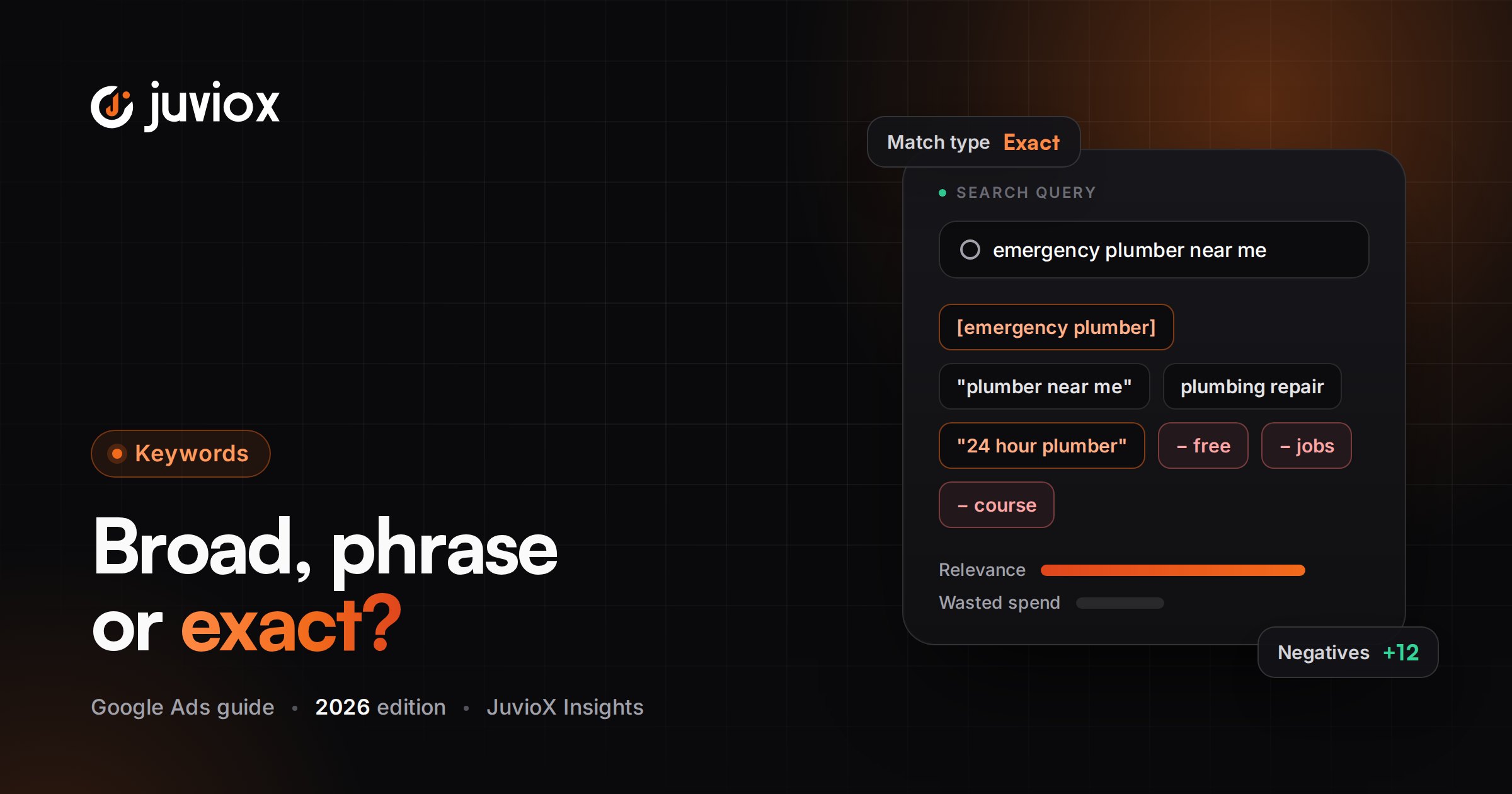
[emergency plumber] does not mean “show only when someone types those exact two words in that exact form.” Exact match is the tightest positive match type, but it still works with close variants and meaning-based matching.
Broad Match Explained
Broad match uses plain keyword text with no quotation marks or brackets. It has the widest reach and is the default match type if no other match type is specified. Google positions broad match as the match type that can use the full set of available contextual signals to understand the intent of the keyword and search.
When Broad Match Can Be Strong
- Conversion tracking represents real business outcomes.
- The campaign uses conversion-based Smart Bidding and has a realistic goal/budget.
- You want to discover incremental relevant demand beyond your explicit keyword list.
- The landing page and ad group give Google a clear theme.
- Search terms and negative keywords are actively governed.
- Lead quality or conversion value can be measured beyond a superficial form submission.
When Broad Match Needs More Caution
- The account optimizes to weak or noisy conversion actions.
- The business operates in a narrow or ambiguous category where irrelevant meanings are common.
- Budget is too constrained to tolerate exploration.
- Regulatory/compliance requirements demand specific query control.
- The campaign uses a non-conversion goal where exact/phrase restrictions are strategically more useful.
BROAD-MATCH RULE
Do not judge broad match by how “close” a query looks to the keyword. Judge it by whether the matched demand produces the business outcomes you are optimizing for.
Phrase Match Explained
Phrase match uses quotation marks, for example “emergency plumber”. It sits between broad and exact in reach. Modern phrase match can show on searches that include the meaning of the keyword, and word order matters when changing the order would change the meaning.
Phrase match is useful when you want more expansion than exact but still want additional matching requirements compared with broad. It can also be useful when an account does not yet have the measurement maturity or strategic tolerance needed for broad expansion.
WHEN TO USE PHRASE MATCH
Use phrase when you want controlled expansion around a well-defined intent theme, especially when the business needs more query predictability than broad while still avoiding an exhaustive exact-match list.
Exact Match Explained
Exact match uses brackets, for example [emergency plumber]. It provides the tightest positive-keyword matching requirements, but it still uses close variants and meaning-based matching. Exact can be valuable when a specific set of searches is strategically important, when budgets are highly constrained, or when regulations/brand requirements demand tighter query eligibility.
Exact match should not be confused with “exact text only,” and it should not automatically be treated as the highest-quality match type. A broad query can be highly valuable; an exact-matched query can still be low value for the business.
Broad Match vs Phrase Match
| Broad Match | Phrase Match |
|---|---|
| Wider eligible reach | More restricted reach |
| Can use additional contextual signals to interpret intent | Must satisfy additional matching requirements |
| Strong fit with conversion-based Smart Bidding when measurement is mature | Useful when more query control is desired |
| Can uncover demand you did not explicitly enumerate | Provides a middle ground between broad expansion and exact control |
| Requires disciplined search-term/negative governance | Still requires search-term review |
Choose broad when the campaign can benefit from broader auction access and strong conversion-based optimization. Choose phrase when you need more restriction or are deliberately controlling how far matching can expand.
Phrase Match vs Exact Match
Phrase match gives more reach; exact applies tighter requirements. If the keyword theme is proven and you want additional demand, phrase can expand coverage. If only a narrower set of search meanings is acceptable, exact may be the better control layer.
DO NOT DUPLICATE BLINDLY
Adding the same term in exact and phrase is not automatically a strategy. Use duplication only when it serves a real testing, reporting, bidding or control purpose; otherwise it can add management complexity without creating new business value.
Broad Match vs Exact Match
This is the widest contrast: broad offers the most reach and signal flexibility, while exact provides the tightest matching requirements. The correct choice depends on the campaign objective, bidding method, measurement quality, budget, ambiguity of the market and tolerance for discovery.
| Situation | Likely Starting Direction |
|---|---|
| Conversion-based Smart Bidding + reliable qualified conversion data | Test broader eligibility, including broad, with safeguards |
| Highly regulated search requirements | Exact/phrase may provide needed restriction |
| Brand-defense / tightly defined navigational intent | Exact and phrase can provide focused control |
| New account with weak tracking | Fix tracking first; do not expect match type to solve measurement |
| Very ambiguous service terminology | Start more controlled, build negatives/data, then test expansion |
| Mature account seeking incremental volume | Broad + Smart Bidding can be a logical experiment |
What Happened to Broad Match Modifier (BMM)?
Broad Match Modifier is no longer a current fourth match type. Google began incorporating BMM behavior into phrase match in 2021. Since July 2021, advertisers cannot create new BMM keywords using the old +keyword notation. Legacy BMM keywords use the updated phrase-match behavior.
This matters because people still search for “broad match modifier” every month. The demand exists, but the correct answer in 2026 is historical clarification – not instructions for creating BMM keywords.
Which Google Ads Match Type Should You Use?
There is no universal “best keyword match type.” Use a decision framework.
- Define the business conversion and make sure it is tracked accurately.
- Identify how ambiguous the keyword theme is.
- Choose the bidding strategy and understand whether it optimizes to conversions/value or another goal.
- Estimate whether the budget can support exploration.
- Decide how much query-level restriction the business actually requires.
- Start with the match type or combination that fits those constraints.
- Use search-term and downstream business-quality data to expand or tighten eligibility.
BETTER QUESTION
Do not ask “Which match type gets the cheapest CPC?” Ask “Which eligibility strategy produces the most valuable incremental conversions at an acceptable acquisition cost?”
Match Types + Smart Bidding
Smart Bidding uses Google AI to set auction-time bids for conversions or conversion value. Google specifically positions broad match as a natural partner for Smart Bidding because broad increases the range of auctions available while bidding can evaluate expected performance at auction time.
As of June 2026, Google is also changing how some Smart Bidding strategies are labeled: “Maximize conversions with a Target CPA” is transitioning to “Target CPA,” and “Maximize conversion value with a Target ROAS” to “Target ROAS.” Google says the underlying bidding behavior is unchanged.
CRITICAL DEPENDENCY
Broad match + Smart Bidding is only as useful as the objective you feed it. If a low-quality form submission is treated as equal to a qualified opportunity, the system can efficiently optimize toward the wrong business outcome.
Match Types With Manual CPC or Non-Conversion Goals
Google notes that exact and phrase can work well in specific cases, including campaigns that do not have conversion-based goals or use conversion-based bidding, and situations where matching to specific searches is mandatory. In these cases, tighter matching can provide useful control.
This is why “Google recommends broad match” should never be simplified into “everyone should use broad match.” The campaign objective and operating constraints still matter.
How Match Type Affects CPC, CPL and Lead Quality
Match type does not assign a fixed CPC. It changes which searches can become eligible, which changes the mix of auctions the campaign can enter. That can affect average CPC, conversion rate, CPL, volume and lead quality – but the direction is not guaranteed.
| Metric | What Match Type Can Change | What You Should Evaluate |
|---|---|---|
| CPC | Auction/query mix | Do not optimize CPC in isolation |
| Conversion rate | Intent mix and landing-page fit | Qualified conversion rate by query/theme |
| CPL / CPA | Traffic cost + conversion quality | Qualified CPL, not only raw lead CPL |
| Volume | Eligible query coverage | Incremental conversions, not impressions alone |
| Lead quality | Search-intent mix | CRM stage, sales acceptance, closed revenue |
How to Structure Match Types Inside Ad Groups
Do not build separate ad groups solely because one keyword is exact and another is phrase. Google’s current AI-oriented account-structure guidance favors themed ad groups and bringing match types together around coherent intent rather than fragmenting the account by match type.
A good ad group should contain keywords that can share the same core ad promise and landing page. Match type is a targeting property inside that theme, not necessarily an organizational boundary.
STRUCTURE PRINCIPLE
Theme first, match type second. Split when business intent, message, landing page, budget or optimization requirements differ – not because brackets look different from quotation marks.
Search Terms and Negative Keywords: The Control Layer
No positive match type removes the need to review search terms. The search terms report shows the actual demand Google matched. Negative keywords let you deliberately exclude unwanted searches.
- Review search terms by spend and conversion volume.
- Check the business quality of conversions, not only platform-reported leads.
- Add irrelevant intent as negative keywords using the appropriate negative match type.
- Identify new high-value themes that deserve stronger ads, landing pages or explicit keywords.
- Compare performance before and after match-type changes over a meaningful period.
OPERATING LOOP
Match type sets reach -> Search terms reveal reality -> Negatives remove waste -> Conversion/CRM data reveals value -> Structure and bidding are refined -> Reach is expanded or tightened.
A Practical Match-Type Testing Framework
| Phase | Action | Decision Signal |
|---|---|---|
| 1. Baseline | Document current match types, search terms, conversions and qualified outcomes | Know what “normal” looks like |
| 2. Hypothesis | Define why broader/tighter matching should improve the campaign | Incremental volume, better control or quality |
| 3. Controlled change | Change a coherent theme/campaign rather than random keywords | Keep measurement interpretable |
| 4. Learning period | Monitor search terms, spend, conversions and downstream quality | Avoid judging from a few clicks |
| 5. Business evaluation | Compare qualified CPA/CAC/revenue, not only CPC | Keep, expand, tighten or revert |
| 6. Governance | Add negatives and improve conversion values/quality signals | Make the next test smarter |
Common Google Ads Match-Type Mistakes
| Mistake | Why It Fails | Better Approach |
|---|---|---|
| Treating exact as literal text-only matching | Close variants and meaning still apply | Understand modern exact behavior |
| Teaching BMM as a current match type | New BMM keywords have been unavailable since 2021 | Explain BMM historically and use current phrase/broad |
| Using broad match before fixing conversion tracking | Automation may optimize to poor signals | Validate meaningful conversions first |
| Assuming broad always means irrelevant traffic | Modern broad uses additional intent/context signals | Judge real search terms and business outcomes |
| Assuming exact always means higher-quality traffic | Tighter matching does not guarantee customer quality | Evaluate conversion/CRM outcomes |
| Splitting campaigns/ad groups by match type by default | Fragments data and management | Organize around business controls and intent themes |
| Ignoring negative keywords | Unwanted queries continue consuming budget | Maintain a search-term/negative process |
| Changing match types based only on CPC | Cheaper clicks can produce worse customers | Use qualified CPA/CAC/revenue |
| Duplicating every keyword in all three match types | Creates complexity without guaranteed incremental value | Add variants only with a defined role |
Google Ads Match-Type Checklist
- Current keywords use only broad, phrase or exact positive match types
- Legacy BMM terms are understood and not recreated as a current strategy
- Conversion tracking is accurate before broad expansion
- Primary conversions represent meaningful business outcomes
- Ad groups are organized by coherent intent themes
- Match-type choice aligns with bidding strategy
- Search terms are reviewed regularly
- Negative keywords are maintained carefully
- Close variants are understood when evaluating exact/phrase traffic
- Performance is judged using qualified CPA/CAC/revenue where possible
- Match-type tests have a written hypothesis
- Campaign structure is not fragmented merely by punctuation
Final Takeaway: Match Type Is a Business-Control Decision
Broad, phrase and exact are not three quality levels. They are three levels of positive-keyword matching flexibility. Exact gives the tightest eligibility requirements. Phrase expands beyond exact. Broad expands further and can use additional contextual signals.
The best strategy is to connect match type with bidding, measurement and business economics. Give Google more reach when your conversion signals and governance can support it. Use tighter matching when control is genuinely required. Then let search terms, qualified conversions, CAC and revenue determine whether the choice is working.
GOOGLE ADS MANAGEMENT
Get More Control Without Limiting Profitable Growth
JuvioX connects keyword strategy, match types, Smart Bidding, conversion tracking, search-term quality and landing pages so Google Ads can expand where it creates business value – and stay controlled where it does not.
FAQ
Frequently asked questions
What are the three Google Ads keyword match types?
Broad match, phrase match and exact match are the three current positive Search keyword match types.
What is broad match in Google Ads?
Broad match is the widest-reach keyword match type. It can reach queries beyond phrase and exact and can use additional contextual signals to interpret intent.
What is phrase match in Google Ads?
Phrase match provides more reach than exact and less than broad, matching searches that include the meaning of the keyword while applying additional matching requirements.
What is exact match in Google Ads?
Exact match applies the tightest positive-keyword matching requirements, but it can still match close variants and searches with the same intent or meaning.
Is exact match really exact?
No. It is the most restrictive current positive match type, but close variants and meaning-based matching mean the search does not have to be an identical character-for-character string.
Which is better: broad match or phrase match?
Neither is universally better. Broad offers more reach and Smart Bidding flexibility; phrase provides additional matching restriction. Choose based on measurement, bidding, ambiguity, budget and business constraints.
Which is better: phrase match or exact match?
Phrase is useful for controlled expansion; exact is useful when tighter search eligibility is strategically required. Evaluate business outcomes rather than assuming one is inherently higher quality.
Should I use broad match with Smart Bidding?
Google strongly positions broad match with conversion-based Smart Bidding, but the combination depends on accurate conversion tracking, meaningful goals, sufficient budget and ongoing search-term governance.
What happened to Broad Match Modifier?
Google stopped allowing new BMM keywords in 2021. Legacy BMM keywords use updated phrase-match behavior, so BMM is not a current fourth match type.
Can I opt out of close variants?
Google states that all keyword match types are eligible for close variants and there is no opt-out.
Should I add the same keyword as broad, phrase and exact?
Not automatically. Add multiple match types only when each has a defined strategic or testing role; otherwise unnecessary duplication can make management harder.
Do match types affect CPC?
They can change the mix of eligible auctions and therefore observed CPC, but no match type has a fixed CPC. Judge acquisition economics and conversion quality, not CPC alone.
Do I still need negative keywords with exact match?
Yes. Search-term review and negative-keyword governance remain useful because matching is meaning-based and close variants apply.
What is the best match type for a new Google Ads campaign?
There is no universal answer. Start from conversion quality, bidding method, budget, search ambiguity and required control. If measurement is weak, fix that before relying on broader automation.
7 sources & references
- Google Ads Help - Google Ads keyword matching
- Google Ads Help - Keyword matching options
- Google Ads Help - Keyword close variants
- Google Ads Help - Your guide to broad match
- Google Ads Help - How to reach the right customers
- Google Ads Help - About changes to phrase match and broad match modifier
- Google Ads Help - Your guide to Smart Bidding