On this page
Why B2B Google Ads Is Different
| B2C / Simple Lead Gen | B2B Reality |
|---|---|
| Conversion may equal sale | Form fill is usually an early-stage signal |
| Short decision cycle | Decision can take weeks/months |
| One buyer | Multiple stakeholders may influence purchase |
| High search volume | Niche B2B demand can be limited |
| Low-friction purchase | Demo, consultation, procurement or sales process |
| Revenue known immediately | Revenue often appears later in CRM |
| CPL can be useful | Qualified CPL, opportunity cost and CAC matter more |
CORE DIFFERENCE
In B2B, the conversion Google Ads sees first is often not the conversion the business ultimately cares about.
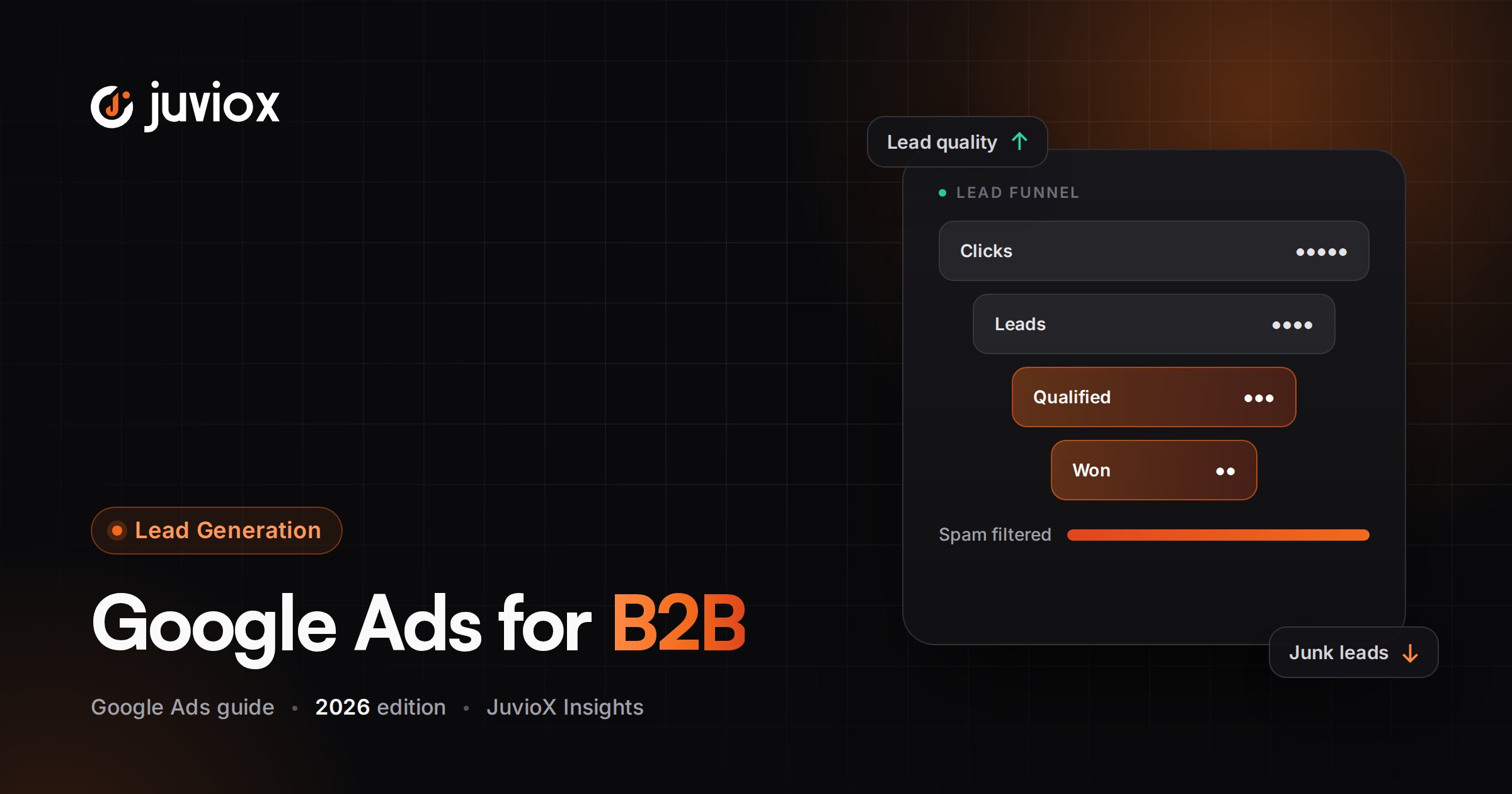
The JuvioX B2B Google Ads Revenue Framework
| Stage | What to Measure | Optimization Question |
|---|---|---|
| Search demand | Queries / intent | Are the right companies/problems searching? |
| Ad click | CTR / CPC | Does the message attract relevant buyers? |
| Lead | CVR / CPL | Can the page create enough inquiries? |
| Qualified Lead | Qualification rate / CPQL | Are those inquiries commercially relevant? |
| Opportunity | Cost per opportunity | Does sales see real buying potential? |
| Customer | CAC / close rate | Are campaigns creating customers? |
| Revenue | Revenue / ROAS / profit | Which demand creates business value? |
NORTH STAR
The best B2B campaign is not necessarily the one with the cheapest CPL. It is the one that produces valuable pipeline and customers at acceptable economics.
When Is Google Ads a Good Fit for B2B?
- Prospects actively search for the problem, service, product category or competitor alternatives.
- The average customer value can support paid acquisition costs.
- The business has a clear offer and conversion path such as demo, consultation, quote or assessment.
- Sales can follow up reliably.
- The website can explain a complex offer credibly.
- CRM or another system can identify what happened after the initial lead.
- There is enough market demand to support the growth target.
DEMAND CAPTURE, NOT DEMAND CREATION ALONE
Search Ads are strongest when relevant demand already exists. If the category is new and buyers do not search for it, B2B growth may require additional demand-generation channels alongside Search.
Search vs Performance Max for B2B
| Search | Performance Max |
|---|---|
| Strong query/keyword control | Cross-channel Google inventory |
| Useful for high-intent niche demand | Can find additional conversion opportunities |
| Search Terms provide direct demand insight | Uses goals, creative, audience/data and landing-page inputs |
| Often ideal starting point for B2B demand capture | Better after measurement/quality signals are trustworthy |
| Can separate brand/non-brand/service themes clearly | Needs strong conversion quality to avoid scaling weak leads |
RECOMMENDED SEQUENCING
For many B2B advertisers, establish trustworthy Search demand and downstream measurement first. Expand automation only when Google is receiving a conversion signal you actually want more of.
B2B Keyword Strategy: Start With Buying Intent
| Intent Layer | Examples | Priority |
|---|---|---|
| Solution/category | enterprise CRM software; commercial solar installer | High |
| Problem | reduce cloud infrastructure cost; automate invoice processing | High/Medium |
| Service | B2B SEO agency; cybersecurity consulting company | High |
| Vendor/comparison | best [category] platform; [vendor] alternative | High |
| Feature/use case | CRM for manufacturing sales teams | High |
| Informational | what is sales automation | Medium/Low depending funnel |
| Jobs/training/free | careers, salary, course, free template | Usually exclude unless relevant |
B2B KEYWORD RULE
A low-volume keyword can be extremely valuable if it represents a high-value buying problem. Do not judge B2B keywords only by search volume.
Build Keywords Around ICP + Problem + Solution + Stage
A useful B2B keyword map combines who the buyer is, what problem they have, what solution they seek and how close they are to a commercial decision.
| Dimension | Examples |
|---|---|
| ICP | SaaS company, manufacturer, law firm, enterprise IT team |
| Problem | poor attribution, compliance risk, manual reporting |
| Solution | server-side tracking, ERP integration, B2B PPC agency |
| Stage | research, comparison, vendor selection, quote/demo |
This produces more useful themes than generating hundreds of keyword variations from one seed phrase.
Match Types & Broad Match in B2B
Google’s current guidance emphasizes pairing broad match with conversion-based Smart Bidding because broad match can use additional contextual signals and give bidding access to more relevant queries. That does not mean every B2B account should immediately convert every keyword to broad match.
- Use exact/phrase when tight query control is strategically necessary.
- Use broad match when measurement is trustworthy and Smart Bidding has a meaningful conversion goal.
- Review Search Terms and negatives continuously.
- Evaluate qualified outcomes, not only Google Ads conversion volume.
- Keep regulatory or mandatory matching constraints in mind for sensitive industries.
UPCOMING PLATFORM CHANGE
Google says campaigns using the campaign-level broad match setting will automatically upgrade to AI Max starting in September 2026. Verify the current rollout before publishing or changing a B2B account.
Negative Keywords Are Critical for B2B Lead Quality
- Jobs, careers, salary and employment intent
- Courses, certifications and training
- Free, template, definition or DIY intent when not commercially useful
- Consumer/personal-use variants for B2B-only offers
- Support/login/existing-customer queries
- Irrelevant industries or geographies
- Competitor terms when intentionally excluded
- Research/student intent where it cannot become pipeline
DO NOT OVER-BLOCK
Some informational searches can start a long B2B buying journey. Exclude based on commercial irrelevance, not because a query is not immediately transactional.
B2B Campaign Structure
| Separate Campaign When | Keep Consolidated When |
|---|---|
| Different budget/business priority | Same objective and economics |
| Different geography | Same market and conversion goal |
| Different conversion goal | Only keyword wording differs |
| Different bid/economic target | Fragmentation would starve data |
| Brand requires separate economics/control | Themes can share bidding/measurement |
B2B accounts often have low conversion volume. Excessive campaign and ad-group fragmentation can make optimization harder. Consolidate where business controls allow while keeping ad and landing-page relevance strong.
B2B Ad Copy: Qualify Before the Click
- Name the business problem clearly.
- Specify the target customer where helpful: ‘For B2B SaaS Teams,’ ‘For Manufacturers,’ etc.
- Communicate the commercial offer: demo, audit, quote, consultation, platform.
- Use proof: integrations, outcomes, expertise, certifications or relevant scale without inventing results.
- Address a key objection or differentiator.
- Use a CTA that matches the buying stage.
- Avoid clickbait that increases CTR but attracts the wrong people.
CTR IS NOT THE FINAL KPI
B2B ad copy can intentionally discourage unqualified clicks. A slightly lower CTR can be better if qualification and pipeline improve.
B2B Landing Pages
| Page Element | B2B Requirement |
|---|---|
| Hero | Problem + solution + target customer + CTA |
| Proof | Relevant clients, reviews, case studies, expertise |
| Offer | What happens after the form/demo request |
| Qualification | Who the solution is and is not for |
| Objections | Implementation, integrations, process, security, pricing context |
| Form | Enough qualification without unnecessary friction |
| CTA | Demo, consultation, quote, assessment, trial where appropriate |
| Tracking | Confirmed success event + downstream CRM mapping |
DO NOT SEND EVERY B2B QUERY TO THE HOMEPAGE
Dedicated service/use-case/industry landing pages usually provide a clearer message and a better qualification opportunity.
Lead Forms: More Fields vs Better Leads
B2B forms need balance. Removing every field may increase raw CVR while increasing junk. Adding ten mandatory fields may reduce both junk and legitimate demand.
| Potential Field | Why It Can Matter |
|---|---|
| Work email | Business context; not a guarantee of quality |
| Company | Account identification |
| Role/title | Buying influence/context |
| Company size | Fit/segmentation |
| Phone | Sales follow-up where appropriate |
| Use case / need | Intent and routing |
| Budget/timeline | Useful for some high-touch offers, too much friction for others |
TEST QUALIFICATION, NOT JUST FORM COMPLETION
Judge form changes by Qualified Lead and opportunity rate, not only the number of submissions.
B2B Audience Strategy
Search intent should remain the foundation for many B2B Search campaigns, but audience and first-party data can add context.
- Use first-party customer/lead lists where permitted and useful.
- Use audience Observation for insight when you do not want to restrict reach.
- Use Targeting only when you intentionally want to narrow eligibility.
- Build remarketing around meaningful site engagement and buying stages.
- Use customer/CRM data to improve measurement and audience strategy responsibly.
- Do not assume Google’s demographic/business signals perfectly identify every B2B decision-maker.
Google Ads for B2B SaaS
- Separate category, use-case, competitor/comparison and brand demand where economics differ.
- Map free trial, demo and contact-sales actions separately.
- Do not optimize equally toward trial signups and sales-qualified opportunities unless they have similar value.
- Track product-led and sales-led journeys distinctly where needed.
- Import opportunity/customer/revenue outcomes from the CRM.
- Use customer value or stage-based values only when they are defensible.
- Measure pipeline velocity and close rate by campaign/query theme.
B2B Bidding Strategy: Give Google the Right Goal
Google’s current Smart Bidding guidance emphasizes accurate conversion data and conversion-based goals. Broad match and Smart Bidding can expand reach, but the bidding system can only optimize toward the outcome you provide.
| Goal Signal | Risk / Value |
|---|---|
| Form submission | High volume but can include weak leads |
| Booked meeting | Stronger intent, still may not qualify |
| Qualified Lead | Closer to commercial value |
| Opportunity | Strong signal but lower volume/delay |
| Converted Lead / Customer | Closest to revenue; may be sparse |
| Revenue/value | Useful for value-based bidding when reliable |
SIGNAL DESIGN
Choose the deepest reliable signal with enough usable data for the account. Do not automatically optimize toward the easiest event to collect.
CPL Is Only the First B2B Cost Metric
| Metric | Formula | What It Tells You |
|---|---|---|
| CPL | Spend / leads | Cost of initial inquiries |
| CPQL | Spend / qualified leads | Cost of commercially relevant leads |
| Cost per opportunity | Spend / opportunities | Pipeline acquisition efficiency |
| CAC | Spend / customers | Customer acquisition efficiency |
| ROAS | Attributed revenue / spend | Revenue efficiency |
EXAMPLE
Campaign A can have a $60 CPL and Campaign B a $120 CPL. If A qualifies 10% of leads and B qualifies 50%, B may have a dramatically lower cost per qualified lead despite the higher raw CPL.
B2B Conversion Tracking Architecture
The B2B measurement system should connect the initial website event with later CRM outcomes.
| Layer | Examples |
|---|---|
| Website | Form submitted, demo booked, call |
| Identifiers | GCLID plus permitted first-party data |
| CRM | Lead ID, source, stage, timestamps |
| Qualification | Qualified Lead / Sales Accepted Lead |
| Pipeline | Opportunity / deal |
| Closed outcome | Converted Lead / customer |
| Value | Actual revenue or defensible value |
| Google Ads | Import downstream conversion for reporting/bidding |
For implementation detail, see our conversion tracking, enhanced conversions and offline conversion tracking guides.
Enhanced Conversions for Leads in 2026
Google describes enhanced conversions for leads as an upgraded offline-conversion approach that supplements imported outcomes with hashed first-party user-provided data such as email. It can also use identifiers such as GCLID.
- Capture permitted first-party lead data on the website.
- Store the lead and identifiers in the CRM.
- When the lead reaches the chosen downstream stage, send the event back to Google.
- Include GCLID whenever possible alongside user-provided data.
- Use Google Ads Data Manager / current supported integrations for ongoing imports.
2026 MEASUREMENT UPDATE
Enhanced conversions for web and leads are now unified under a single setting. Starting April 2026 Google Ads began accepting user-provided data simultaneously from website tags, Data Manager and API connections. Starting June 15, 2026, current offline/ECL upload guidance moved toward Data Manager API for new/current implementations.
Qualified Leads & Converted Leads
Google Ads now provides Qualified lead and Converted lead goal types for businesses whose real outcome happens after the initial online lead.
| Goal | Meaning |
|---|---|
| Qualified Lead | A Google-generated lead that your CRM/internal process later qualifies |
| Converted Lead | A lead that reaches a later/final stage you define, commonly a closed sale/customer |
B2B ADVANTAGE
These stages let a B2B advertiser tell Google which leads were actually valuable instead of treating every form submission as equal.
Lead Journey Mapping
Google’s current in-platform Lead Journey Mapping can visually organize the advertiser’s lead-to-sale stages. For B2B teams, this creates a useful bridge between marketing terminology and CRM/sales stages.
- Map initial lead.
- Define the qualification stage.
- Define opportunity/deal stage if useful.
- Define Converted Lead/closed outcome.
- Align timestamps and CRM field definitions.
- Document which stage is Primary for bidding and which remain Secondary/observational.
CRM Data Google Ads Needs From B2B Teams
- Internal lead/contact ID
- Lead created timestamp
- GCLID where available
- Email/phone where permitted and consented
- Campaign/source context
- Lead status
- Qualified timestamp
- Opportunity/deal ID
- Opportunity stage
- Closed-won/customer timestamp
- Revenue/value/currency
- Reason for disqualification where useful
DATA CONTRACT
Marketing, sales and technical teams should agree on what each stage means. ‘Qualified lead’ should not mean one thing in the CRM and another thing in Google Ads.
B2B Lead Quality Diagnosis
| Problem | Possible Cause |
|---|---|
| Lots of spam | Open forms, bots, weak validation, broad low-quality traffic |
| Real people but wrong fit | Keyword/query intent, offer, geography, qualification |
| Good companies but no buying intent | Too-top-of-funnel demand or weak CTA |
| Meetings but no opportunities | Qualification/sales process/offer mismatch |
| Opportunities but no customers | Sales, pricing, product fit, competition or attribution |
| Ads shows conversions but CRM doesn’t | Tracking/CRM integration or conversion definition |
DO NOT CALL EVERY BAD LEAD SPAM
Spam, fake, irrelevant and unqualified leads are different problems and require different fixes.
B2B Google Ads Optimization Routine
1. Check tracking and CRM imports first.
2. Review Search Terms for commercial intent.
3. Compare CPL with CPQL/opportunity cost.
4. Review bid strategy against the chosen conversion goal.
5. Review budget by qualified/revenue contribution.
6. Improve ad qualification and message match.
7. Improve landing-page qualification/CRO.
8. Review locations/devices/audiences with sufficient data.
9. Review lost impression share and demand headroom.
10. Feed new CRM outcomes back into Google Ads.
11. Test major changes through experiments where volume allows.
How to Scale B2B Google Ads
- Scale campaigns with acceptable CPQL/CAC, not merely low CPL.
- Identify additional high-intent search demand.
- Improve conversion rate before buying substantially more traffic.
- Expand geographies only where sales/service capacity exists.
- Broaden match/automation only when measurement and negatives are strong.
- Use PMax/other inventory when the conversion signal is trustworthy.
- Improve CRM feedback so broader reach can still optimize toward quality.
- Monitor sales-team capacity and response time as lead volume grows.
B2B SCALING CONSTRAINT
The bottleneck may not be Google Ads. It can be total market demand, landing-page conversion, sales capacity, qualification, close rate or customer economics.
B2B Google Ads Checklist
- ICP and buying problems documented
- High-intent keyword themes mapped
- Search Terms reviewed
- Negative intent library maintained
- Campaign structure avoids unnecessary fragmentation
- Brand/non-brand economics visible where useful
- RSA copy qualifies the buyer
- Relevant assets used
- Dedicated landing pages used for major intent
- Form qualification tested
- Primary conversion goal reviewed
- CPL and CPQL tracked
- CRM source/identifiers captured
- Qualified/Converted Lead stages defined
- Enhanced/offline conversion setup reviewed
- GCLID preserved where possible
- Revenue/value feedback reviewed
- Lead-quality reasons classified
- Smart Bidding uses trustworthy signal
- Broad match used only with appropriate measurement/governance
- PMax expansion uses quality signals
- Sales response/capacity monitored
- Scaling based on downstream economics
Common B2B Google Ads Mistakes
| Mistake | Why It Hurts | Better Approach |
|---|---|---|
| Optimizing to every form fill | Google learns weak leads too | Use qualified/downstream outcomes |
| Choosing keywords only by volume | Misses niche high-value intent | Use commercial relevance |
| Sending all traffic to homepage | Weak message match | Use intent-specific pages |
| Removing form fields only to raise CVR | Can lower quality | Test qualified conversion rate |
| Over-fragmenting campaigns | Starves low-volume B2B data | Consolidate where controls allow |
| Broad match without quality feedback | Can expand weak traffic | Use Smart Bidding + negatives + downstream signals |
| Judging by CPL alone | Cheap leads may not sell | Use CPQL/CAC/revenue |
| Ignoring CRM integration | Ads cannot learn final outcomes | Close the lead-to-sale loop |
| Scaling before sales can follow up | Lead value deteriorates operationally | Scale the full system |
| Treating B2B like ecommerce | Long sales cycle is ignored | Measure pipeline stages |
Final Takeaway: B2B Google Ads Should Optimize for Revenue Quality
B2B Google Ads becomes much more powerful when the account stops treating the initial form submission as the finish line.
Start with high-intent demand. Use ads and landing pages to attract and qualify the right buyer. Measure the initial lead accurately. Then connect the CRM so Google Ads can see which leads became qualified opportunities, customers and revenue.
That changes the optimization question from ‘How do we get more leads?’ to the more valuable question: ‘How do we acquire more of the companies that can actually become profitable customers?’
B2B GOOGLE ADS & LEAD GENERATION
Turn Paid Search Into Qualified B2B Pipeline
JuvioX connects Google Ads strategy, conversion tracking, landing-page optimization and CRM revenue signals so B2B campaigns optimize toward qualified pipeline – not just cheaper form submissions.
FAQ
Frequently asked questions
Does Google Ads work for B2B?
Yes, when buyers actively search for the problem, solution, service or vendor category and the economics can support paid acquisition. The strongest programs connect Google Ads to CRM-qualified outcomes.
What is the best Google Ads campaign type for B2B?
Search is often a strong starting point for high-intent demand. Performance Max can add reach when conversion goals, values and lead-quality signals are trustworthy.
How do I generate B2B leads with Google Ads?
Target commercially relevant search intent, qualify through ad copy and landing pages, use a clear offer, track confirmed leads, and connect CRM qualification/customer outcomes back to Google Ads.
What keywords should B2B Google Ads use?
Prioritize solution, problem, service, use-case, vendor/comparison and industry-specific terms that match the ICP and buying stage. Low search volume can still be valuable in B2B.
Should B2B Google Ads use broad match?
It can work well with conversion-based Smart Bidding and strong measurement, but it should be governed with Search Terms, negatives and downstream lead-quality data.
What is a good B2B Google Ads CPL?
There is no universal good CPL. The acceptable number depends on qualification rate, close rate, customer value, gross margin and the business's acquisition economics.
Why are my B2B Google Ads leads low quality?
Common causes include irrelevant queries, weak qualification, consumer/job/training intent, broad targeting without downstream signals, poor offer fit, or a conversion goal that rewards every form submission equally.
How do I measure B2B lead quality in Google Ads?
Connect website leads to CRM stages such as Qualified Lead, opportunity and customer, then calculate CPQL, cost per opportunity, CAC and revenue alongside CPL.
What are Qualified Leads in Google Ads?
Google defines Qualified leads as Google-generated leads that have been further qualified offline in a CRM or internal lead system.
What are Converted Leads in Google Ads?
Converted leads are leads that reach a later/final stage you define, typically a closed sale/customer or another meaningful completed stage.
What are enhanced conversions for leads?
They supplement offline conversion imports with hashed first-party lead data and identifiers such as GCLID to improve attribution and measurement durability.
Should I import offline B2B conversions into Google Ads?
For businesses where qualification and sales happen after the website lead, downstream imports can give reporting and bidding a much better business signal.
Can Google Ads connect to a CRM?
Yes. Current Google Ads Data Manager and supported integration/API workflows can bring downstream lead outcomes into Google Ads. Exact connector availability should be verified for the CRM being used.
How should B2B SaaS use Google Ads?
Separate high-intent category/use-case/comparison demand, distinguish trial/demo from qualified opportunity/customer outcomes, and connect product/sales CRM data to acquisition economics.
How do I reduce B2B Google Ads cost per qualified lead?
Improve query intent, negatives, ad qualification, landing-page fit, form qualification, bidding signal quality and budget allocation based on qualified outcomes rather than raw CPL.
How long should I evaluate B2B Google Ads?
Use a window that reflects conversion volume and the real sales cycle. Recent leads may not have had time to qualify or close, so do not judge downstream economics before the CRM outcomes mature.
9 sources & references
- Google Ads Help - About enhanced conversions for leads
- Google Ads Help - Updates to enhanced conversions settings
- Google Ads Help - About Qualified leads and Converted leads
- Google Ads Help - Upgrade offline conversion import to enhanced conversions for leads
- Google Ads Help - Data Manager with enhanced conversions for leads
- Google Ads Help - Guidelines for importing offline conversions
- Google Ads Help - Finding success with Smart Bidding
- Google Ads Help - Your guide to broad match
- Google Ads Help - About the broad match campaign setting / AI Max upgrade