On this page
What Are Responsive Search Ads?
Responsive Search Ads (RSAs) let advertisers provide multiple text assets that Google can combine into different Search ads. Google tests combinations over time and uses contextual signals to select messages for different searches.
Unlike the old Expanded Text Ad model, the advertiser does not control one permanent headline-description combination. The creative unit is a flexible asset library.
THE MINDSET SHIFT
Do not write 15 independent slogans. Build a coordinated message system where every asset can make sense with multiple other assets and still represent the same offer truthfully.
How Responsive Search Ads Work
| Stage | What Happens |
|---|---|
| 1. You supply assets | Headlines, descriptions, final URL and paths are added |
| 2. Google creates combinations | Assets can appear in different orders unless pinned |
| 3. Query-time context | Google evaluates which messages may fit the search/user context |
| 4. Ad serves | A subset of the available assets is shown |
| 5. Performance data accumulates | Google learns which assets/combinations are useful in different contexts |
| 6. Advertiser optimizes | You improve weak/redundant messaging and test meaningful hypotheses |
Not every asset will show every time, and not every possible combination will necessarily serve. That is why each headline and description should be able to stand on its own while also working in combination.
Responsive Search Ad Limits & Specifications in 2026
| RSA Element | Current Google Ads Limit / Requirement |
|---|---|
| Headlines | Minimum 3; up to 15 |
| Headline length | Up to 30 characters each |
| Descriptions | Minimum 2; up to 4 |
| Description length | Up to 90 characters each |
| Display paths | Up to 15 characters per path field |
| Order | Assets may appear in different orders unless pinned |
Google’s current best-practice guidance encourages at least 8-10 headlines, including at least 5 unique headlines, and at least 2 unique descriptions. Google also recommends using multiple Good/Excellent RSAs per ad group in its current 2026 guidance.
DO NOT FILL FOR THE SAKE OF FILLING
More assets create more possible combinations only when the assets add genuinely different information. Ten versions of the same claim create less useful diversity than a smaller set covering intent, benefits, proof, objections and action.
The JuvioX RSA Message Architecture
A strong RSA asset library covers different jobs instead of repeating the same keyword.
| Message Role | Purpose | Example Pattern |
|---|---|---|
| Intent / relevance | Confirm the searched need | Commercial Electrical Repair |
| Offer | Explain what the prospect can get | Request a Same-Day Quote |
| Outcome / benefit | Show the desired result | Reduce Costly Downtime |
| Differentiator | Explain why this provider | Licensed Commercial Team |
| Proof | Reduce perceived risk | Trusted by 200+ Businesses |
| Qualifier | Filter poor-fit clicks | Serving Greater Austin |
| Objection handler | Address friction | Flexible Appointment Times |
| CTA | Make next step obvious | Book Your Assessment |
| Brand | Build recognition where useful | Acme Electrical |
COPY PRINCIPLE
Keyword relevance earns attention. Differentiation and proof create preference. Qualification protects budget. The CTA converts intent into the next step.
How to Write Responsive Search Ad Headlines
Headlines have only 30 characters, so each one should perform a clear job. Start with the searcher’s intent, then deliberately diversify the rest of the library.
- Write 2-3 intent/relevance headlines that naturally reflect the core keyword theme.
- Write 2-3 benefit or outcome headlines.
- Write 2-3 differentiator/proof headlines.
- Write 1-2 qualification or objection-handling headlines where useful.
- Write 1-2 strong CTA headlines.
- Add brand messaging where it improves trust or recognition.
- Read the first three headlines together and make sure they do not sound repetitive or contradictory.
- Review every headline alone: would it still make sense if Google paired it with an unexpected description?
| Weak Pattern | Why It Is Weak | Better Direction |
|---|---|---|
| Best Plumber | Top Plumber | #1 Plumber | Repetitive, unverified superlatives | 24/7 Emergency Plumbing | Licensed Local Team | Book Same-Day Service |
| Google Ads Agency | Ads Agency | PPC Agency | Same idea repeated | Google Ads Management | Improve Qualified Lead Flow | Tracking + CRO Included |
| Buy Now | Shop Now | Order Now | Only CTAs, no reason to choose | Free 2-Day Shipping | 30-Day Returns | Shop New Arrivals |
CLAIMS MUST BE PROVABLE
Do not use ‘best,’ ‘#1,’ guaranteed results, price claims or performance claims unless the business can substantiate them and the wording complies with Google Ads policies.
How to Write RSA Descriptions
Descriptions give you more room to connect the offer, benefit, proof and action. Use the 90-character space to add information that the headlines cannot carry.
| Description Job | Example Pattern |
|---|---|
| Offer + outcome | Get a tailored audit to find wasted spend and conversion-tracking gaps. |
| Proof + differentiation | Strategy, tracking and CRO managed as one connected growth system. |
| Qualifier + process | For established service businesses ready to improve qualified lead quality. |
| CTA + expectation | Book a consultation to review your account, tracking and next growth opportunities. |
- Avoid four descriptions that restate the same sentence.
- Keep claims consistent with the landing page.
- Use concrete language instead of empty adjectives.
- Let descriptions answer objections or explain the next step.
- Write for the human searcher first; include keywords naturally rather than mechanically.
How Many Headlines and Descriptions Should You Use?
Google permits up to 15 headlines and 4 descriptions. Its current setup guidance recommends supplying a strong variety of unique, relevant assets rather than stopping at the minimum.
A practical starting point is enough assets to cover the full message architecture without redundancy. For many ad groups that means roughly 8-15 useful headlines and 2-4 genuinely different descriptions, then refining based on real performance and new messaging hypotheses.
QUALITY OVER QUOTA
The objective is not ’15/15.’ The objective is enough distinct, accurate messaging for Google to match different search contexts while giving you meaningful creative coverage.
Ad Strength: Useful Feedback, Not the Business KPI
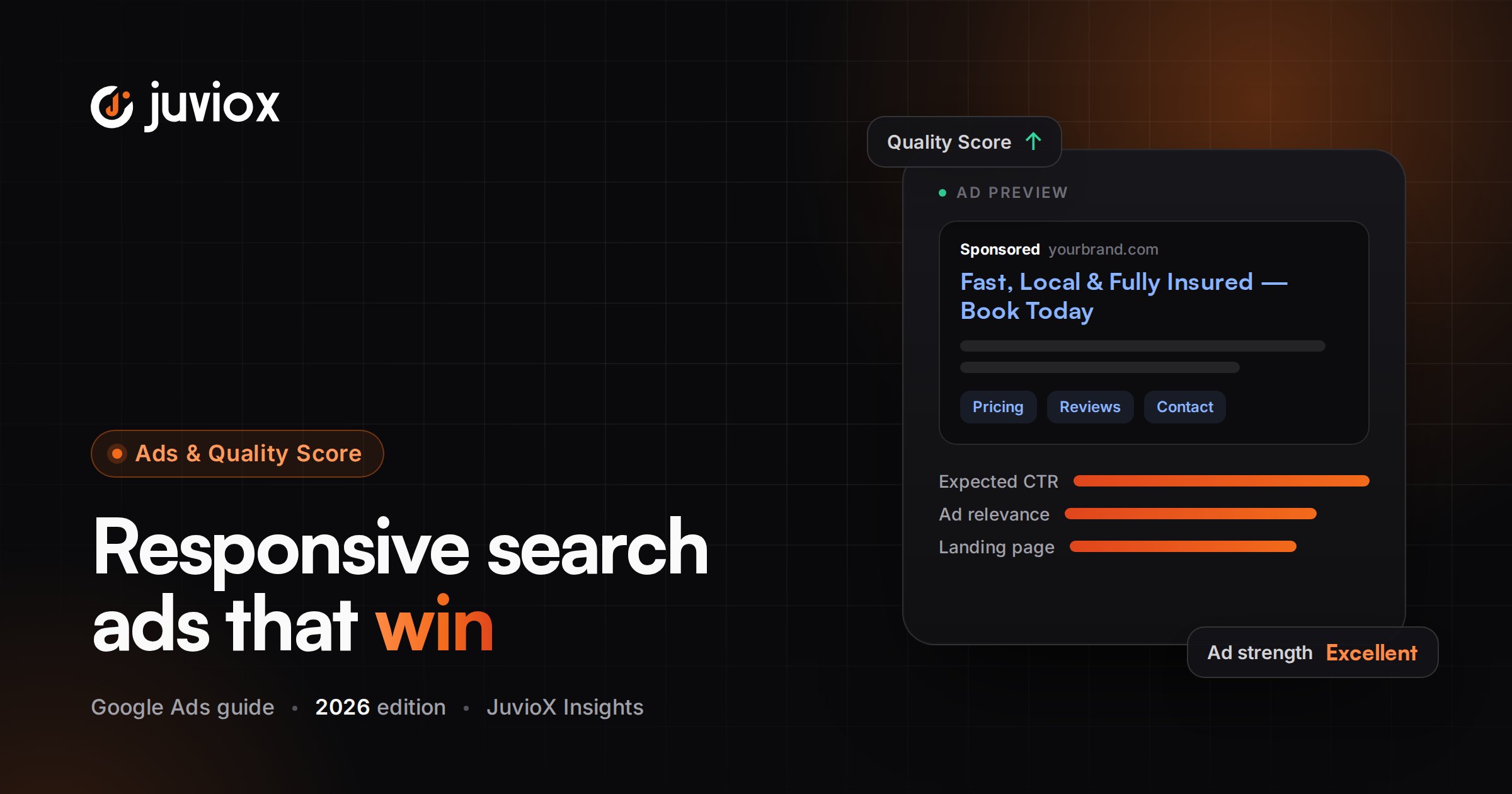
Ad Strength evaluates how well the RSA creative follows Google’s asset best practices. Current ratings include Incomplete, Poor, Average, Good and Excellent.
Google says Ad Strength looks at factors such as asset-keyword relevance, headline combinations/diversity and sitelink sufficiency. It is intended as creation/editing feedback.
| Ad Strength Can Help With | Ad Strength Does Not Tell You |
|---|---|
| Asset variety and relevance | Whether the campaign is profitable |
| Whether more useful headlines/descriptions are needed | Qualified lead quality |
| Creative setup opportunities | Actual customer acquisition cost |
| Sitelink/asset sufficiency | Whether a specific ad will win an auction |
| Best-practice feedback | Ad Rank or Quality Score calculation |
IMPORTANT
Google explicitly says Ad Strength does not determine ad eligibility and is not used to calculate Ad Rank, Quality Score or auction wins. Improve it when the recommendation makes the creative better – not at the expense of truthful, conversion-focused messaging.
Should You Pin RSA Headlines or Descriptions?
By default, RSA assets can appear in different positions. Pinning forces a headline or description to a specified position and reduces the combinations Google can test.
Google generally recommends pinning sparingly because it limits flexibility and can reduce Ad Strength.
| Pinning May Be Appropriate | Avoid Pinning Just Because… |
|---|---|
| A legal disclaimer must always appear | You want Headline 1 to ‘look nicer’ |
| A regulated message must occupy a required position | You are recreating an Expanded Text Ad |
| A brand requirement genuinely demands consistency | You distrust any asset order |
| A controlled messaging test requires it | Ad Strength is not Excellent |
IF YOU MUST PIN
Google recommends giving the system multiple unique alternatives for the same pinned position where possible. A required message can remain controlled without forcing one identical asset into every impression.
What Happens With Headline Positions 1, 2 and 3?
Pinned content in Headline positions 1 or 2, or Description position 1, can be used when a message must consistently appear in those designated slots. Google notes that Headline position 3 and Description position 2 are not guaranteed to show in every ad.
This is particularly important for compliance: do not place mandatory disclosure text only in a position that may not always render.
Responsive Search Ad Example: Local Service Business
| Asset Role | Example |
|---|---|
| Intent | Emergency Electrician Near You |
| Offer | Request Same-Day Service |
| Outcome | Get Power Restored Fast |
| Proof | Licensed & Insured Team |
| Qualifier | Serving Dallas Businesses |
| CTA | Call for Availability |
| Description 1 | Commercial electrical repairs with clear scheduling and experienced local technicians. |
| Description 2 | Request service today. Tell us the issue and we’ll confirm the next available appointment. |
Responsive Search Ad Example: B2B Service
| Asset Role | Example |
|---|---|
| Intent | B2B Google Ads Management |
| Outcome | Improve Qualified Lead Flow |
| Differentiator | Ads + Tracking + CRO |
| Proof | Senior-Led Account Strategy |
| Qualifier | Built for Growth Teams |
| CTA | Request a Google Ads Audit |
| Description 1 | Connect campaign strategy, conversion tracking and landing-page performance in one system. |
| Description 2 | Find wasted spend, measurement gaps and opportunities to improve qualified acquisition. |
Responsive Search Ad Example: Ecommerce
| Asset Role | Example |
|---|---|
| Intent | Shop Premium Running Shoes |
| Offer | Free Shipping Over $75 |
| Benefit | Built for Everyday Miles |
| Proof | 30-Day Easy Returns |
| Category | Men’s & Women’s Styles |
| CTA | Shop New Arrivals |
| Description 1 | Explore lightweight running shoes for training, commuting and everyday comfort. |
| Description 2 | Find your next pair with easy returns and free shipping on qualifying orders. |
EXAMPLES ARE FRAMEWORKS
Adapt the language to the actual offer, proof, geography, policy requirements and landing page. Do not publish generic examples as if they were proven winning copy.
How to Test Responsive Search Ads Correctly
RSAs already test asset combinations automatically, so traditional ‘Ad A vs Ad B’ thinking can be misleading. A useful creative test starts with a business hypothesis.
| Weak Test | Better Test |
|---|---|
| Change 10 headlines and see what happens | Test one messaging theme: price vs expertise vs speed |
| Copy the most-served combination into a static ad | Use combinations as insight, not proof of causal superiority |
| Judge after a few clicks | Use enough volume and conversion delay for the KPI to mature |
| Optimize to CTR only | Evaluate conversion rate, CPL/CPA, qualified leads or value |
| Replace winners constantly | Preserve strong control while introducing deliberate challengers |
- Choose a high-volume/high-value area where learning matters.
- Write the hypothesis before editing: what user belief or objection are you testing?
- Change the relevant message family, not unrelated campaign settings.
- Define the success metric before launch.
- Allow sufficient traffic and conversion delay.
- Check business outcomes, not just asset impressions.
- Keep, refine or reject the hypothesis and document what you learned.
Asset Report vs Combinations Report
| Asset Report | Combinations Report |
|---|---|
| Helps compare individual assets and their status/performance labels | Shows combinations Google has actually assembled and their impressions/views |
| Useful for finding weak/redundant asset candidates | Useful for understanding common message combinations |
| Does not prove an asset caused conversions by itself | Does not prove the most-served combination would win as a static ad |
| Use as one input to creative iteration | Use for qualitative insight and coverage checks |
Google explicitly warns against using the combinations report to create static versions of RSAs, because responsive ads use real-time signals and a static recreation is not guaranteed to perform the same way.
Use Ad Variations for Controlled Message Testing
Google Ads Ad Variations can test a creative change across multiple campaigns or an account – for example, changing a call to action or a value proposition consistently.
This is useful when the hypothesis is broader than one RSA asset and you want a more structured comparison.
TESTING HIERARCHY
RSA asset learning answers ‘which messages does the system use in different contexts?’ A controlled ad variation can better answer ‘what happens when we deliberately change this messaging concept?’ They are related but not identical questions.
RSAs, Search Intent and Quality Score
Ad copy sits between the search intent and the landing page. If the ad group mixes unrelated intent, even excellent copywriting can struggle to stay relevant.
- Use tightly coherent ad-group themes.
- Include important keyword language naturally where it improves relevance.
- Write to the meaning of the search, not just the exact keyword string.
- Keep the ad promise consistent with the landing page.
- Use Search Terms data to discover new objections, language and irrelevant intent.
Our Quality Score and search terms guides cover those topics in full.
Broad Match + Smart Bidding + Responsive Search Ads
Google’s current AI-powered Search guidance connects Broad Match, Smart Bidding and RSAs: broader query eligibility can expose more relevant auctions, Smart Bidding evaluates auction-time value, and the RSA can adapt the message to the search context.
That combination increases the importance of clean conversion data, negative-keyword governance, accurate claims and a strong landing-page experience.
AUTOMATION STACK
More matching flexibility + more bidding automation + more creative flexibility can be powerful only when measurement and business guardrails are equally strong.
Text Customization and AI-Generated Search Copy
Google’s current Search guidance uses the term ‘text customization’ for the feature previously known as Automatically Created Assets. It can generate additional headlines and descriptions to work with advertiser-provided RSA assets.
AI-generated copy should be treated as another optimization input, not permission to stop reviewing brand accuracy, legal claims, offer details and landing-page consistency.
- Review generated assets for factual accuracy.
- Check whether claims are supported by the business/landing page.
- Watch brand tone and regulated-language requirements.
- Use conversion and lead-quality data to judge whether automation is helping.
The JuvioX RSA Optimization Workflow
- Start with search intent and the landing-page promise.
- Map the message architecture: intent, offer, outcome, proof, differentiator, qualifier, CTA.
- Build unique headline/description assets.
- Review Ad Strength recommendations without making the rating the KPI.
- Pin only when there is a real requirement or deliberate test.
- Launch with accurate conversion tracking.
- Review search terms, ad performance, asset details and combinations.
- Evaluate CTR together with conversion rate, CPL/CPA and lead/revenue quality.
- Create a new creative hypothesis based on real friction or opportunity.
- Test deliberately, document learning and repeat.
CREATIVE IS PART OF THE FUNNEL
An RSA can improve traffic quality before the click by making the offer more specific and filtering poor-fit users. The best creative test may reduce CTR while improving qualified conversion economics.
Common RSA Problems and What to Check
| Problem | What to Check |
|---|---|
| Poor Ad Strength | Asset uniqueness, keyword relevance, useful headline count, descriptions, sitelinks |
| High CTR, low conversion rate | Message/landing-page mismatch, overly broad promise, weak qualification |
| Low CTR, strong conversion rate | May be highly selective; assess volume and profitability before changing |
| Low impressions | Eligibility, search demand, bidding/budget, targeting – not just ad copy |
| One message dominates | Is it genuinely useful or are other assets redundant/weak? |
| Pinned RSA underperforms | Pinning may be restricting combinations; verify requirement |
| Good/Excellent Ad Strength but poor CPA | Ad Strength is not a profitability metric; inspect traffic, offer, page and tracking |
| Asset report unclear | Use business hypothesis and broader outcome data rather than overreading labels |
Responsive Search Ads Optimization Checklist
- Search intent for the ad group is coherent
- At least one RSA is active; current Google best-practice quantity reviewed
- 8-10+ useful headlines considered where appropriate
- At least 5 headlines are genuinely unique
- At least 2 descriptions are genuinely different
- Keyword language appears naturally in relevant assets
- Benefits, proof, differentiators and CTA are represented
- Claims are accurate and supportable
- First three headlines can make sense together
- Every asset can make sense in multiple combinations
- Pinning is used only for a documented reason
- Mandatory text is pinned to a position that actually shows reliably
- Ad Strength feedback reviewed but not treated as KPI
- Sitelinks and relevant assets are present
- Search Terms insights feed new copy hypotheses
- Landing page matches the ad promise
- Conversion and lead/revenue quality are measured
- Creative tests have a written hypothesis and success metric
Common Responsive Search Ad Mistakes to Avoid
| Mistake | Why It Hurts | Better Approach |
|---|---|---|
| 15 versions of the same headline | Little real creative diversity | Cover different message roles |
| Keyword stuffing every headline | Repetitive, weak persuasion | Balance relevance with benefits/proof |
| Chasing Excellent Ad Strength at any cost | Rating is not business performance | Protect truthful conversion-focused copy |
| Pinning everything | Removes combination flexibility | Pin only required/strategic messages |
| Treating RSA combinations as A/B winners | Combination frequency is not causal proof | Use structured testing |
| Optimizing only for CTR | Can attract more poor-fit clicks | Use conversion/qualified economics |
| Copying competitor claims | May be inaccurate and undifferentiated | Build from your own offer/proof |
| Changing copy and landing page simultaneously | Harder to isolate learning | Test deliberately |
| Using generic homepage for all ads | Breaks message continuity | Match final URL to intent |
| Ignoring Search Terms | Misses real customer language | Feed query insights into creative |
Final Takeaway: Build a Message System, Not a Headline Collection
A strong Responsive Search Ad does not win because it contains the maximum number of headlines or reaches an Excellent Ad Strength rating. It wins when the asset library gives Google enough accurate, differentiated messaging to match the searcher’s intent while the landing page and conversion tracking complete the experience.
Build each RSA around intent, offer, outcome, proof, qualification and action. Use pinning only when control is genuinely required. Test business hypotheses, not random wording. Then evaluate the result through conversions, qualified leads, customers and value.
GOOGLE ADS CREATIVE + CRO
Turn Search Intent Into Better Conversion Messages
JuvioX connects search intent, RSA creative, landing-page CRO and conversion tracking so ad-copy decisions are measured by qualified business outcomes – not just clicks or an interface rating.
FAQ
Frequently asked questions
What are Responsive Search Ads?
RSAs are Google Search ads built from multiple advertiser-provided headlines and descriptions that Google can assemble into different combinations for different search contexts.
How many headlines can a Responsive Search Ad have?
Google currently allows a minimum of 3 and up to 15 headlines, with up to 30 characters per headline.
How many descriptions can an RSA have?
Google currently requires at least 2 and allows up to 4 descriptions, with up to 90 characters each.
How many RSA headlines should I write?
Google's current setup guidance recommends at least 8-10 headlines, including at least 5 unique headlines. Use enough to create meaningful diversity without filler.
Should I use all 15 RSA headlines?
Not automatically. Use up to 15 when you have genuinely distinct, relevant messages. Redundant filler adds less value than useful diversity.
What is Ad Strength?
It is Google's creative feedback tool for factors such as relevance, diversity and asset sufficiency. It is not used to calculate Ad Rank, Quality Score or auction wins.
Should every RSA have Excellent Ad Strength?
Good/Excellent is a useful setup goal, but actual conversion and business performance remain the KPI. Do not weaken truthful messaging merely to chase the rating.
Should I pin headlines in Google Ads?
Usually only when there is a compliance, brand or deliberate testing reason. Google generally recommends pinning sparingly because it reduces possible combinations.
If I must pin a headline, what should I do?
Where possible, pin multiple unique alternatives to the same required position so Google retains some testing flexibility.
Does Headline 3 always show?
No. Google notes that content pinned to Headline position 3 and Description position 2 is not guaranteed to show in every ad.
How do I test RSA ad copy?
Start with a clear messaging hypothesis, define the business KPI, change the relevant message family, allow sufficient data/conversion delay, then evaluate conversion quality rather than CTR alone.
Can I use the most common RSA combination as a fixed ad?
Google warns that the combinations report should not be used to recreate static ads because RSAs use real-time signals and the static version may not perform the same way.
Are Expanded Text Ads still the model to follow?
No. Expanded Text Ads are legacy. Responsive Search Ads are the modern Search creative format, and forcing an RSA to behave like a fixed ETA through excessive pinning wastes much of its flexibility.
How do Responsive Search Ads affect Quality Score?
Ad Relevance and Expected CTR are Quality Score components, so better intent-aligned creative can improve the underlying experience. The reported Quality Score itself remains a diagnostic, not the RSA objective.
Can Google generate RSA copy automatically?
Google offers text customization and AI-assisted creation features that can generate additional text assets. Advertisers should still review factual accuracy, brand fit, policy/compliance and performance.
7 sources & references
- Google Ads Help - About responsive search ads
- Google Ads Help - About Ad Strength for responsive search ads
- Google Ads Help - Set up your ads for success
- Google Ads Help - Best practices for creating effective responsive search ads
- Google Ads Help - Test and optimize creative messages
- Google Ads Help - About the combinations report for responsive search ads
- Google Ads Help - How to create a relevant ad