On this page
What Is Google Ads Quality Score?
Quality Score is a keyword-level diagnostic score from 1 to 10. Google says a higher score means the ad and landing page are considered more relevant and useful to someone searching for that keyword compared with other advertisers.
It is intended to help you identify where ad quality may need improvement. Google specifically warns that Quality Score is not a key performance indicator and should not be optimized or aggregated like a business performance metric.
JUVIOX NOTE
Treat Quality Score like a diagnostic warning light. If it is weak, investigate the component that is weak. Do not turn the 1-10 number itself into the campaign’s primary optimization goal.
How Is Google Ads Quality Score Calculated?
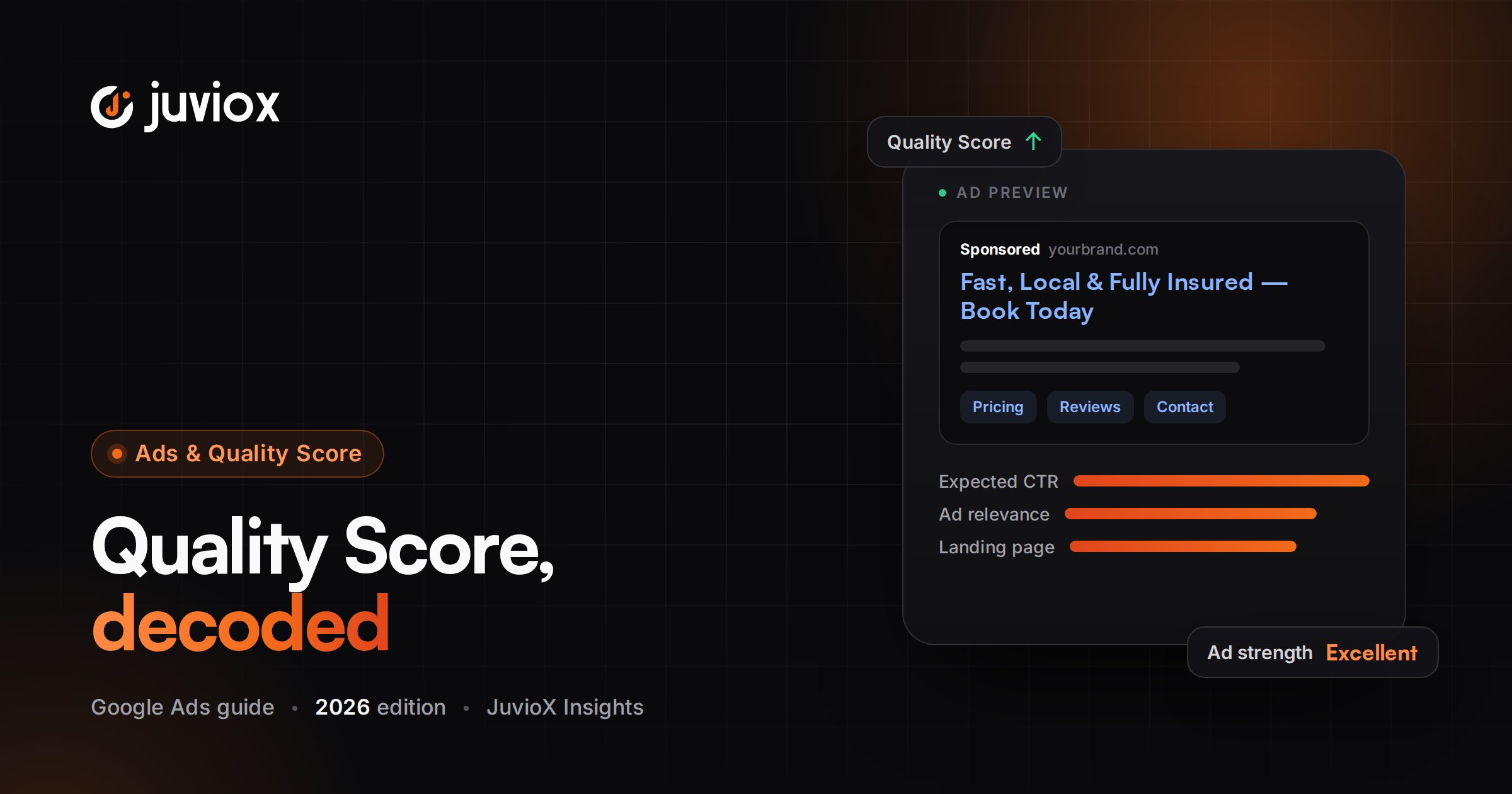
Google calculates the reported Quality Score from the combined performance of three components:
| Component | What It Evaluates | Reported Status |
|---|---|---|
| Expected CTR | How likely the ad is to be clicked when shown | Above average / Average / Below average |
| Ad Relevance | How closely the ad matches the intent behind the user’s search | Above average / Average / Below average |
| Landing Page Experience | How relevant and useful the landing page is after the click | Above average / Average / Below average |
Google says these component evaluations compare your performance with advertisers whose ads showed for the exact same search over the previous 90 days.
ABOUT THE ‘FORMULA’
Google does not publish a simple public formula such as ‘CTR x relevance x landing page = score.’ The 1-10 score is derived from the combined component performance. Avoid third-party formulas that pretend the weighting is officially known.
Component 1: Expected Clickthrough Rate (Expected CTR)
Expected CTR estimates how likely your ad is to receive a click when shown. It is not simply your historical CTR copied into another column. Google normalizes for factors such as ad position and other conditions that affect visibility.
A Below Average rating can indicate that the ad or offer is not compelling enough for the searches represented by the keyword.
- Make the ad’s value proposition clearer.
- Align the ad with the search intent behind the keyword.
- Use specific benefits instead of generic claims.
- Test calls to action that accurately match the next step.
- Avoid improving CTR by attracting clicks from people who are unlikely to convert.
CONVERSION GUARDRAIL
Google itself notes that a more specific ad can sometimes have a lower CTR but a higher conversion rate. Do not sacrifice lead/customer quality merely to improve Expected CTR.
Component 2: Ad Relevance
Ad Relevance evaluates how closely the ad matches the intent behind the user’s search. This is where keyword grouping, ad messaging and search-intent understanding meet.
| Weak Relevance Pattern | Better Approach |
|---|---|
| One ad group mixes unrelated services | Separate themes when the same ad cannot answer the searches well |
| Generic ad copy | Use language and benefits that address the searcher’s actual need |
| Keyword included mechanically but intent ignored | Write to the meaning of the search, not just the keyword string |
| Ad promise differs from landing page | Keep the offer/message consistent through the click |
STRUCTURE NUANCE
Google says account structure itself does not improve quality if the user experience does not change. Splitting an ad group helps only when it lets you create more relevant ads or landing-page experiences.
Component 3: Landing Page Experience
Landing Page Experience evaluates whether the page people reach after the click is relevant, useful and easy to use. The page should fulfill the expectation created by the search and the ad.
- Match the landing-page headline and offer to the search intent.
- Keep the message consistent from keyword/search to ad to page.
- Make important information easy to find.
- Use clear navigation and a clear conversion path.
- Make the experience work well on mobile devices.
- Improve speed and usability where they create friction.
- Provide original, useful information rather than a thin page built only to host a form.
CRO CONNECTION
A stronger landing page can improve both user experience and conversion rate. The goal is not to make a page ‘for Quality Score’; it is to make the page genuinely better for the visitor.
Quality Score vs Auction-Time Ad Quality
This distinction is the most important part of the article.
| Reported Quality Score | Auction-Time Quality |
|---|---|
| 1-10 diagnostic shown at keyword level | Evaluated when the ad competes in an auction |
| Based on Expected CTR, Ad Relevance and Landing Page Experience diagnostics | Real-time evaluations of quality contribute to Ad Rank |
| Not an input in the ad auction | Auction-time quality is an Ad Rank factor |
| Useful for finding areas to investigate | Directly relevant to whether/how competitively the ad can serve |
Google’s best-practice documentation explicitly says the real-time evaluations of the ‘big three’ quality components are used in the ad auction, while the reported 1-10 Quality Score itself is not.
QUICK RULE
Do not optimize the number. Improve the underlying ad experience that the number is helping you diagnose.
Does Quality Score Affect Ad Rank and CPC?
The precise answer is more nuanced than the common statement ‘higher Quality Score lowers CPC.’
The reported 1-10 Quality Score does not enter the auction. However, Google says ad and landing-page quality are among the factors used in Ad Rank, alongside the bid, Ad Rank thresholds, auction context, competitiveness, and expected impact of assets and formats.
Google also explains that higher-quality ads can face lower minimum Ad Rank thresholds/minimum bids in relevant situations. Better auction-time quality can therefore improve competitiveness and cost efficiency, but there is no official fixed table saying a Quality Score of 10 always receives a specific CPC discount.
| Claim | Accurate? | Why |
|---|---|---|
| A 10/10 score guarantees cheap CPC | No | Auction cost depends on multiple auction-time factors |
| Quality Score itself is an Ad Rank input | No | Google calls the 1-10 score diagnostic |
| Ad and landing-page quality matter in the auction | Yes | Auction-time quality contributes to Ad Rank |
| Improving relevance/experience can improve performance | Yes | Better quality can improve competitiveness and user outcomes |
AVOID THE OLD QS-CPC CHART
Do not publish unsupported multipliers such as ‘QS 10 = 50% CPC discount’ unless a current independent study is clearly labeled as third-party research. It is not Google’s published auction formula.
What Is a Good Google Ads Quality Score?
There is no universal Quality Score target that every profitable keyword must reach. A score above the comparison baseline can be encouraging, but business performance still matters more.
Use the score comparatively and diagnostically. A high-value keyword with Quality Score 5 and profitable customer acquisition can be more important than a 10/10 keyword that generates low-value traffic.
BUSINESS-FIRST RULE
Optimize for qualified conversions, revenue and profit. Use Quality Score to locate friction that may be preventing those outcomes.
How to Check Quality Score in Google Ads
- Open Google Ads and go to Campaigns > Keywords / Search keywords.
- Open the Columns control for the keyword table.
- Choose Modify columns.
- Open the Quality score section.
- Add Quality Score, Landing Page Exp., Exp. CTR and Ad Relevance.
- Apply the columns.
- For trend analysis, also add the historical versions of those columns.
Google also allows the historical Quality Score/component columns to be segmented by day so you can see how the diagnostics changed over the reporting period.
Use Historical Quality Score to Diagnose Changes
Historical columns are useful when you changed ads, landing pages or keyword organization and want to see whether the quality diagnostics improved afterward.
| Current Column | Historical Column |
|---|---|
| Quality Score | Quality Score (hist.) |
| Landing Page Exp. | Landing Page Exper. (hist.) |
| Ad Relevance | Ad Relevance (hist.) |
| Exp. CTR | Exp. CTR (hist.) |
DO NOT OVERREAD DAILY NOISE
Use historical Quality Score as supporting evidence. Pair it with CTR, conversion rate, CPA/CPL, revenue/value and search-term quality so you know whether the user experience and business outcome actually improved.
How to Improve Expected CTR
- Review the search intent behind the keyword and real search terms.
- Make the offer more specific and useful to that intent.
- Strengthen the primary headline/value proposition.
- Use verified differentiators – price, availability, expertise, guarantee or other proof where applicable.
- Test calls to action that accurately describe the next step.
- Use relevant ad assets to give searchers more useful information.
- Measure whether CTR gains also improve conversion quality.
EXPECTED CTR PROBLEM
If the ad is relevant but not compelling, improve the offer/message. If the keyword is attracting the wrong intent, rewriting the ad alone may not solve the real problem.
How to Improve Ad Relevance
- Inspect the actual search terms behind the keyword.
- Separate genuinely different intents that require different messages.
- Group keywords by shared user need, not by tiny spelling variations.
- Write responsive search ad assets that clearly answer that need.
- Keep important service/product terminology naturally present in the message.
- Align the final URL and landing-page promise with the ad.
- Use negative keywords when irrelevant demand is the actual source of mismatch.
This is where the JuvioX Campaign Structure, Keyword Research, Match Types, Negative Keywords and Search Terms guides should be internally linked rather than repeated.
How to Improve Landing Page Experience
- Confirm the page immediately answers the searched need.
- Match the ad’s promise, offer and CTA on the page.
- Make trust evidence easy to find.
- Reduce unnecessary navigation/form friction.
- Ensure the mobile experience is usable.
- Improve page speed when it affects real visitor experience.
- Keep content original, useful and transparent.
- Send users to the most relevant page instead of defaulting every click to the homepage.
LANDING PAGE DIAGNOSTIC
A Below Average landing-page rating is a reason to inspect relevance and usability. It is not proof that one technical metric alone – such as PageSpeed score – is the entire cause.
The JuvioX Low Quality Score Diagnostic Framework
| Component Below Average | First Questions | Likely Workstream |
|---|---|---|
| Expected CTR | Is the offer compelling? Is the search intent correct? | Ad copy, offer, query quality |
| Ad Relevance | Does one ad answer the keyword/search intent? | Intent grouping, ads, search terms |
| Landing Page Experience | Does the page fulfill the search/ad promise? | Landing page, CRO, UX, speed |
| Multiple components | Is the entire keyword -> ad -> page chain misaligned? | Rebuild the intent path end-to-end |
Then check business performance. If the keyword is profitable, prioritize improvements that preserve that profitability. If it is unprofitable, determine whether quality is the bottleneck or whether the issue is CPC, competition, conversion rate, lead quality, offer or economics.
Quality Score and Campaign Structure
Quality Score is not awarded at campaign or ad-group level. Google explicitly says there is no campaign-level, ad-group-level or account-level Quality Score.
Moving the same keywords and ads into a different campaign does not improve ad quality by itself. Structure matters only when the change improves what the user sees – for example, a more relevant ad or landing page.
AVOID SKAG NOSTALGIA
Do not split every keyword into its own ad group just to chase Quality Score. Modern account structure should create meaningful relevance boundaries without unnecessary fragmentation.
Quality Score With Broad Match and Modern Matching
Google notes that a broad-match keyword can receive a Quality Score based on a corresponding exact-match keyword’s impressions in certain circumstances. This is another reason not to interpret the number as a literal grade for every broad-match query the keyword can reach.
For modern matching, search-term quality, Smart Bidding, negative keywords and conversion data should be evaluated alongside the diagnostic components.
Quality Score vs Ad Strength
Quality Score and Ad Strength are different diagnostics.
| Quality Score | Ad Strength |
|---|---|
| Keyword-level 1-10 diagnostic | Responsive-ad creative diagnostic |
| Expected CTR + Ad Relevance + Landing Page Experience | Evaluates relevance, quality and diversity of ad assets/copy |
| Used to diagnose keyword/ad/page experience | Used to improve responsive ad asset coverage/quality |
| Not an auction input | Not a substitute for conversion performance |
A campaign can have a strong Ad Strength rating and still have Quality Score or business-performance problems, and vice versa. Use each diagnostic for its intended job.
What Does and Does Not Matter for Ad Quality
| Factor | Google Guidance |
|---|---|
| User device | Matters – mobile/user experience can affect quality |
| Relevance to user intent | Matters – central to ad quality |
| Related keyword/ad/page performance for new keywords | Can matter initially |
| Campaign/ad-group naming or structure alone | Does not matter if user experience is unchanged |
| Running ads on other networks | Does not change Search ad quality on Google.com |
| Buying a higher ad position | Does not improve Expected CTR rating just because position is higher |
| Reported conversions | Do not directly affect ad quality |
IMPORTANT
You do not need to bid for a higher position simply to improve Quality Score. Google says Expected CTR is normalized for ad position and other visibility factors.
Common Quality Score Problems and What to Check
| Problem | What to Check First |
|---|---|
| Low Expected CTR | Search intent, offer strength, ad specificity, assets |
| Low Ad Relevance | Mixed intents, generic copy, keyword-to-ad mismatch |
| Low Landing Page Experience | Message match, usefulness, mobile UX, navigation, speed |
| Quality Score fell after changes | Historical component columns + what actually changed |
| Good QS but poor CPL/CPA | Conversion rate, lead quality, CPC, economics, tracking |
| Low QS but profitable keyword | Component opportunity vs risk of disrupting profitable traffic |
| QS unavailable / ‘-‘ | Keyword eligibility/history/context; do not force a diagnosis without data |
| High CPC despite good QS | Competition, bid strategy, auction context, Ad Rank and commercial intent |
Google Ads Quality Score Optimization Checklist
- Quality Score and all three component columns visible
- Historical Quality Score columns available for trend analysis
- High-spend/high-value keywords prioritized first
- Expected CTR issues separated from intent-quality issues
- Ad Relevance reviewed against real search terms
- Landing pages mapped to the correct search intent
- Mobile landing-page experience tested
- Negative keywords used where irrelevant queries cause mismatch
- CTR changes evaluated with conversion quality
- Quality Score reviewed alongside CPC, conversion rate and CPL/CPA
- No unsupported Quality Score-to-CPC multiplier used in reporting
- Profitable keywords not paused solely because the score is low
- Account structure changed only when it improves relevance/control
- Optimization documented before/after using historical component data
Common Google Ads Quality Score Mistakes to Avoid
| Mistake | Why It Is Wrong | Better Approach |
|---|---|---|
| Optimizing for 10/10 | QS is diagnostic, not the business KPI | Optimize profitable user experience |
| Looking only at the number | The number hides which component is weak | Inspect all three components |
| Assuming QS directly sets CPC | The 1-10 score is not an auction input | Understand auction-time quality + Ad Rank |
| Rewriting ads when intent is wrong | Copy cannot fix irrelevant demand | Fix keywords/search terms/negatives |
| Ignoring the landing page | Ad quality continues after the click | Improve message match and UX |
| Splitting every keyword into a new ad group | Structure alone does not improve quality | Split only for meaningful relevance |
| Bidding higher to improve Expected CTR | Expected CTR is normalized for position | Bid to business performance |
| Pausing a profitable keyword because QS is low | Can destroy valuable demand | Diagnose before acting |
| Using old fixed QS-to-CPC formulas | Not Google’s published auction model | Use current official guidance |
Final Takeaway: Diagnose the Experience, Not the Number
Quality Score is most useful when it tells you where the keyword-to-ad-to-landing-page experience is weak. Expected CTR can expose an unconvincing message. Ad Relevance can expose an intent mismatch. Landing Page Experience can expose a weak post-click experience.
The 1-10 number is not the auction and it is not the business outcome. Use it alongside search terms, CPC, conversion rate, CPL/CPA, qualified leads, revenue and profit. Improve what the user experiences, and let Quality Score serve its proper role: diagnosis.
GOOGLE ADS + CRO
Improve the Entire Search-to-Conversion Experience
JuvioX connects keyword strategy, search intent, ad relevance, landing-page CRO and conversion tracking so quality improvements support measurable business growth – not just a higher diagnostic score.
FAQ
Frequently asked questions
What is Google Ads Quality Score?
It is a 1-10 keyword-level diagnostic that compares the expected quality of your ad and landing-page experience with other advertisers.
What are the three Quality Score factors?
Expected clickthrough rate, Ad Relevance and Landing Page Experience.
Is Quality Score used directly in the Google Ads auction?
No. Google explicitly says the reported 1-10 Quality Score is not an auction input. Real-time ad-quality evaluations do contribute to Ad Rank.
Does a higher Quality Score lower CPC?
Better auction-time ad quality can improve competitiveness and cost efficiency, but there is no official fixed CPC discount tied mechanically to the 1-10 score.
What is a good Quality Score?
There is no universal target that matters more than profitable business performance. Use the score comparatively and diagnose Average/Below Average components.
How do I check Quality Score?
On the Search keywords page, modify columns and add Quality Score plus Landing Page Exp., Exp. CTR and Ad Relevance. Historical versions are also available.
How is Quality Score calculated?
Google combines the performance of Expected CTR, Ad Relevance and Landing Page Experience. Google does not publish a simple public weighting formula.
How do I improve Expected CTR?
Improve intent alignment, offer clarity, specificity, benefits, calls to action and useful assets while monitoring conversion quality.
How do I improve Ad Relevance?
Group genuinely related intent, write ads that address that intent, inspect search terms and use relevant landing pages.
How do I improve Landing Page Experience?
Make the page relevant and useful, match the ad promise, improve usability/mobile experience, reduce friction and provide a clear conversion path.
Should I pause keywords with low Quality Score?
Not automatically. First inspect the components, search terms, conversions and economics. A low score is a reason to investigate, not an automatic pause rule.
Does campaign structure affect Quality Score?
Structure alone does not. Google says moving the same ads and keywords does not improve quality. Structure matters when it changes the user experience through more relevant ads/pages.
Is Quality Score the same as Ad Strength?
No. Quality Score is a keyword-level diagnostic involving Expected CTR, Ad Relevance and Landing Page Experience. Ad Strength evaluates responsive-ad creative relevance, quality and diversity.
Can a broad-match keyword have Quality Score without impressions?
Google says it can in certain cases when a corresponding exact-match keyword has impressions for the exact search in the last 90 days.
7 sources & references
- Google Ads Help - About Quality Score for Search campaigns
- Google Ads Help - 5 ways to use Quality Score to improve performance
- Google Ads Help - Using Quality Score to guide optimizations
- Google Ads Help - What matters (and what doesn't) for ads quality
- Google Ads Help - How the Google Ads auction works
- Google Ads Help - About ad quality
- Google Ads Help - Connect ad quality to better performance