On this page
What Is Google Ads Smart Bidding?
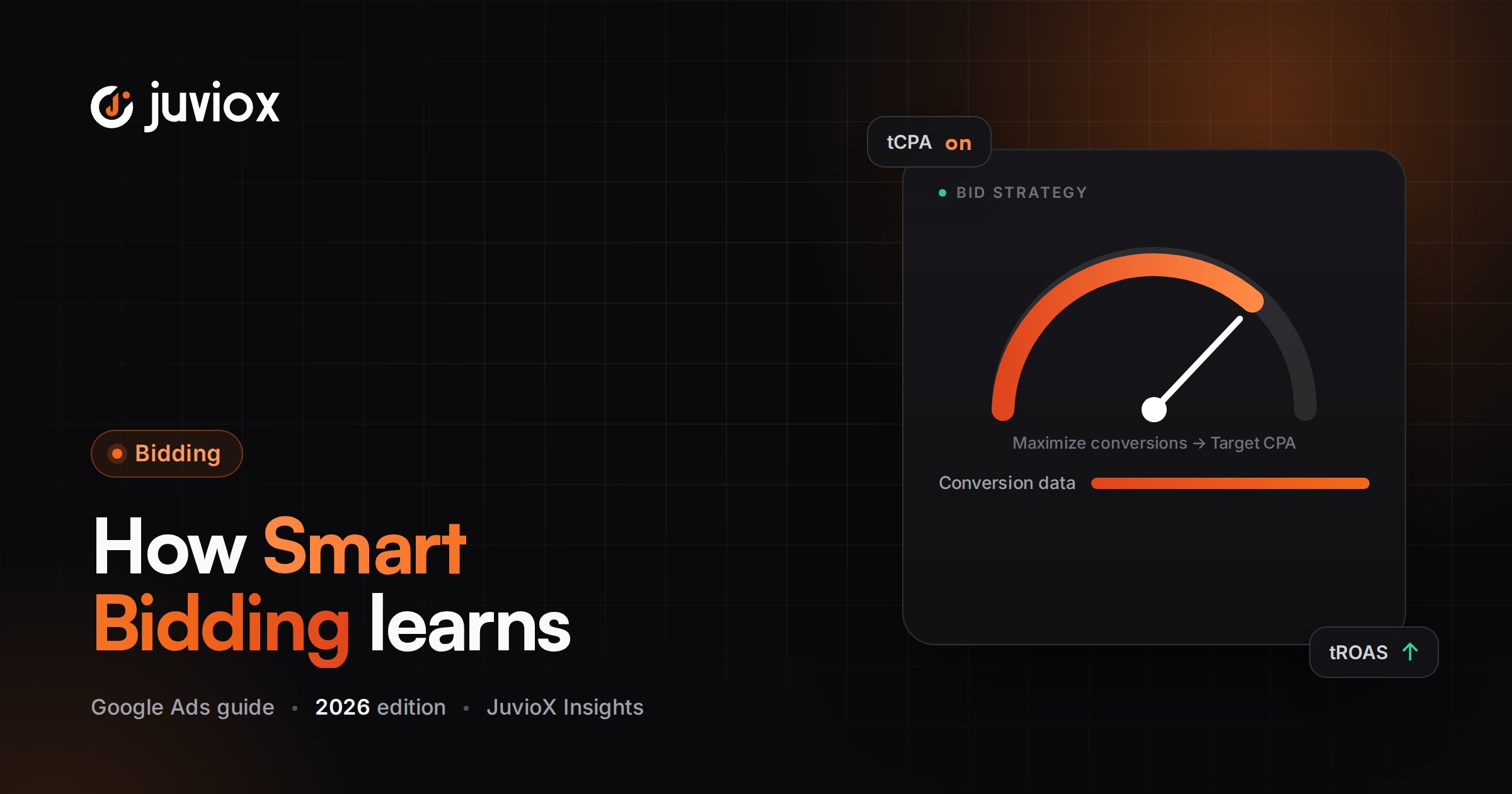
Google defines Smart Bidding as automated bid strategies that use Google AI to optimize for conversions or conversion value in ad auctions. The defining feature is auction-time bidding: the system evaluates each eligible auction and sets a bid based on its predicted value to your objective.
| Smart Bidding Strategy | Primary Optimization Goal |
|---|---|
| Maximize Conversions | Generate the most conversions within budget |
| Target CPA | Generate conversions while pursuing an average CPA target |
| Maximize Conversion Value | Generate the most reported conversion value within budget |
| Target ROAS | Generate conversion value while pursuing a ROAS target |
NOT EVERY AUTOMATED STRATEGY IS SMART BIDDING
Maximize Clicks and Target Impression Share automate bids, but they optimize traffic or visibility rather than conversions/conversion value. Smart Bidding is the conversion-focused subset of automated bidding.
How Auction-Time Bidding Works
Manual bidding starts from a bid you set. Smart Bidding instead predicts the probability or value of a conversion for the specific auction and adjusts the bid accordingly.
Google says Smart Bidding uses auction-time signals and can account for combinations of context that are difficult to reproduce with manual bid adjustments. The practical result is not one ‘smart bid’ for a keyword – it is potentially millions of unique bid decisions across auctions.
| Auction Context | Why It Can Matter |
|---|---|
| Search query / intent | Different searches can carry different conversion likelihood |
| Device | Mobile and desktop behavior can differ |
| Location | Geographic context can change likelihood/value |
| Time of day | Demand and conversion behavior can vary by time |
| Audience / remarketing context | Prior relationship with the business can matter |
| Browser / operating system / language | Contextual combinations can affect predicted performance |
KEY POINT
Smart Bidding is not simply raising bids on ‘good keywords’ and lowering them on ‘bad keywords.’ It models conversion likelihood at the auction level using more context than a static keyword bid can represent.
Query-Level Modeling Helps With Sparse Keyword Data
One reason Smart Bidding can work beyond the performance history of an individual keyword is Google’s query-level modeling. Google says the system can use search-query conversion data across the account to help with data scarcity for low-volume or newer keywords.
This matters because modern matching is increasingly meaning-based. The bidder does not need every keyword variation to accumulate a large isolated dataset before it can use broader contextual evidence.
JUVIOX INTERPRETATION
The unit of optimization is increasingly the auction and its context, not the keyword row in isolation. That makes conversion-goal quality and search-intent governance more important, not less.
The Smart Bidding Feedback Loop
A useful way to understand Smart Bidding is as a closed feedback system:
| Stage | What Happens |
|---|---|
| 1. Auction | A user creates an eligible ad opportunity |
| 2. Prediction | Google estimates conversion probability/value using available context |
| 3. Bid | The strategy sets an auction-time bid aligned to its objective/target |
| 4. Outcome | The user clicks, converts, does not convert, or converts later |
| 5. Measurement | Google Ads receives conversion/value data |
| 6. Learning | The system updates its models using new evidence |
| 7. Next auction | New predictions incorporate the evolving data |
THE WEAK-LINK RULE
If measurement at Stage 5 is wrong, the feedback loop can optimize efficiently toward the wrong outcome. Better AI cannot rescue a conversion goal that misrepresents business value.
What Conversion Data Does Smart Bidding Learn From?
The most important distinction is between data Google can observe and the conversion goals the campaign is instructed to optimize.
- Primary conversion actions included in the campaign’s conversion goals influence bidding.
- Conversion value becomes critical for Maximize Conversion Value and Target ROAS.
- Conversion delay affects when outcomes are fully visible.
- Imported/offline outcomes can extend measurement beyond the website when implemented correctly.
- Historical/query-level data can help initial modeling, even when a specific campaign has little history.
Google explicitly recommends measuring conversion actions that are valuable to the business and including the appropriate actions in the Conversions and Conversion value columns.
How Much Conversion Data Does Smart Bidding Need?
There is no single universal ‘you need exactly 30 conversions’ rule for all Smart Bidding. Google’s current documentation says Smart Bidding can use query-level data beyond the individual bid strategy when little or no conversion data is available, and some strategies can be started without a fixed minimum history.
However, more relevant conversion data generally gives the system stronger evidence and can speed calibration. The quality, recency and business relevance of the data matter alongside raw volume.
| Weak Question | Better Question |
|---|---|
| Do I have 30 conversions? | Do I have enough trustworthy outcomes for this objective and conversion cycle? |
| Can Smart Bidding run? | Can I evaluate it responsibly with my current volume and delay? |
| How do I get more signals? | Which signals represent real business value rather than easy micro-conversions? |
AVOID THE CONVERSION-COUNT MYTH
Do not invent a universal threshold and treat it as Google’s requirement. Strategy-specific eligibility and best practices can change. Use current Google documentation and your actual conversion cycle when deciding readiness.
Learning Status vs Smart Bidding’s Continuous Learning
A campaign can stop displaying the visible ‘Learning’ status while Smart Bidding continues to learn. Google explicitly says its algorithms continue learning even when the bidding status no longer says Learning.
The visible status means the strategy is calibrating after a change toward a new objective or setup. It is not an on/off indicator for machine learning.
IMPORTANT DISTINCTION
Learning status = a temporary calibration state shown in the interface. Continuous learning = the ongoing model updates Smart Bidding performs as new auction and conversion data arrives.
What Can Trigger ‘Bid Strategy Learning’?
| Reason Google Shows | Typical Meaning |
|---|---|
| New strategy | The bid strategy was recently created or reactivated |
| Setting change | A bid-strategy setting changed and Google is recalibrating |
| Composition change | Campaigns, ad groups or keywords were added to or removed from the strategy |
| Ad group target change | Can trigger Learning in some Shopping cases |
Changes to conversion goals/actions can also require the bidder to adapt to a new optimization signal, even when the interface behavior does not look identical in every campaign type.
How Long Does the Google Ads Learning Period Take?
Google says calibration can take up to about three weeks or one to two conversion cycles, although it may be faster when more conversion data is available.
The duration is primarily affected by three things: conversion volume, the length of the conversion cycle, and the bid strategy. Manual CPC does not have a Smart Bidding learning period.
| Factor | Why It Changes Learning |
|---|---|
| Conversion volume | More outcomes can provide evidence faster |
| Conversion cycle | Long delays mean Google must wait longer to observe outcomes |
| Bid strategy | Different objectives require different calibration |
| Historical data | Relevant previous data can help initial calibration |
DO NOT USE A FIXED 7-DAY RULE
A business where most conversions occur in 24 hours and a business where sales close 21 days after the click should not evaluate Smart Bidding on the same timetable.
Conversion Delay: Why Recent Performance Can Be Incomplete
Conversion delay is the time between the ad interaction and the recorded conversion. If customers typically convert several days after clicking, the newest days in your report are incomplete by definition.
Google’s bidding algorithms account for conversion delays using adaptive historical weighting, but human analysts still need to avoid judging recent CPA/ROAS before delayed conversions have had time to arrive.
EXAMPLE
If the typical conversion delay is seven days, comparing the last seven days’ apparent CPA against a mature 30-day period can create a false performance alarm. Exclude or separately interpret the incomplete window.
Does Changing a CPA or ROAS Target Reset Learning?
This topic is often oversimplified. Google’s current ‘How our bidding algorithms learn’ guidance says changing a CPA or ROAS target does not itself trigger a Learning status or erase what Smart Bidding has already learned. The bidder reacts to the new target immediately.
A large target change can still create performance volatility because the campaign may enter a materially different set of auctions. Google recommends evaluating the effect after enough conversion cycles for outcomes to mature.
PRACTICAL RULE
Do not tell clients that every target adjustment ‘resets the algorithm.’ Instead, distinguish between a visible Learning-state trigger, continuous model adaptation, and normal volatility caused by a materially different bidding constraint.
Data Quality: The Most Important Smart Bidding Input
Smart Bidding can be technically sophisticated and still optimize badly if the conversion setup rewards low-value behavior.
| Data Problem | What the Bidder Learns | Business Risk |
|---|---|---|
| Every button click is Primary | Button clicks are valuable outcomes | Spend shifts toward easy micro-actions |
| Duplicate conversion tags | One action appears multiple times | Conversion rate/value is inflated |
| Spam forms count as leads | Spam is treated as success | Bidding seeks similar low-quality traffic |
| Wrong purchase value | Revenue signal is distorted | Value bidding makes poor trade-offs |
| Missing offline qualification | All form leads look equal | Cheap low-quality leads can dominate |
| Tracking breaks on key pages | Real outcomes disappear | Bidder sees an incomplete funnel |
JUVIOX PRINCIPLE
Smart Bidding is a data-quality multiplier. Clean signals can make automation more useful; dirty signals can let automation scale the wrong behavior faster.
Primary vs Secondary Conversions Matter
A campaign’s primary conversion goals are the outcomes used for bidding. Secondary conversions can remain visible for observation without necessarily steering the strategy.
- Keep true business outcomes Primary when they should drive bidding.
- Use diagnostic or micro-conversions as Secondary when they are useful for analysis but too weak to optimize toward.
- Audit account-default vs campaign-specific conversion goals before blaming the bid strategy.
- Check whether a recent conversion-goal change altered the optimization objective.
Smart Bidding for Lead Generation: Raw Lead vs Qualified Lead
Lead generation is where data quality becomes especially important. A form submission tells Google that a person completed the form. It does not tell Google whether the person was a real prospect, in the service area, had budget, became an opportunity or purchased.
| Optimization Signal | Business Proximity |
|---|---|
| Button click | Very weak |
| Form submit | Raw lead |
| Qualified lead | Closer to sales value |
| Sales opportunity | Strong downstream signal |
| Customer / revenue / value | Closest to business outcome |
Where the CRM and tracking architecture allow it, importing qualified/offline outcomes or meaningful values can help reporting and bidding move closer to the sales reality.
QUALITY OVER CHEAP CPL
If Smart Bidding is rewarded for every form equally, it may find more of the easiest forms. If the business cares about qualified opportunities, measurement should eventually communicate that distinction.
Value-Based Smart Bidding Needs Meaningful Values
Maximize Conversion Value and Target ROAS rely on conversion values. Ecommerce often has natural transaction revenue, but lead generation may require carefully designed values based on qualified stages, expected value or another defensible business model.
- Use real transaction-specific revenue where available.
- Avoid arbitrary values that create a false precision.
- If lead values are modeled, document the logic and update it as close rates/economics change.
- Watch revenue and profit economics separately when high revenue does not equal high margin.
Broad Match + Smart Bidding: Why Google Connects Them
Broad Match can use additional contextual signals to reach searches beyond tighter keyword matching. Smart Bidding can then use auction-time context to decide how aggressively to bid on those opportunities.
That combination can expand demand efficiently when measurement is strong, but it also increases the importance of search-term governance, negative keywords, conversion quality and landing-page relevance.
GUARDRAIL
Do not use ‘Broad + Smart Bidding’ as a substitute for strategy. Expansion works best when the account can accurately distinguish valuable conversions from irrelevant traffic and low-quality leads.
Budget and Targets Can Limit Smart Bidding
A campaign can have excellent tracking and still underdeliver if the economic constraints leave too little room to participate in auctions.
| Constraint | Possible Effect |
|---|---|
| Target CPA too low | Traffic and conversion volume can fall |
| Target ROAS too high | Eligible value/volume can shrink |
| Budget too low | Campaign may be Limited by budget |
| Narrow targeting | Not enough eligible demand |
| Low-volume keywords | Insufficient traffic opportunities |
| Disapproved assets / billing issues | Delivery can stop regardless of bidding quality |
Diagnose these separately. Smart Bidding cannot bid into auctions the campaign is not eligible to enter.
Why ‘Bid Strategy Learning – No Impressions’ Happens
Learning itself is not usually the only explanation for zero impressions.
- Check campaign, ad and asset approval/status.
- Check billing/account holds.
- Check dates, locations, audiences and other eligibility settings.
- Check whether keywords/search themes have enough demand.
- Check budget and whether the target is excessively restrictive.
- Check conversion-goal configuration after a recent change.
- Review bid-strategy status details for the reason Learning is shown.
- Avoid assuming the solution is simply ‘wait longer’ if the campaign is not eligible to serve.
How to Evaluate Smart Bidding Performance Correctly
Evaluate the strategy against the objective it was asked to achieve, over a window that accounts for conversion delay.
| Strategy | Core Evaluation |
|---|---|
| Maximize Conversions | Conversion volume + actual CPA + business quality |
| Target CPA | Conversion volume + actual CPA vs target + quality |
| Maximize Conversion Value | Total value + actual ROAS + profitability context |
| Target ROAS | Total value + actual ROAS vs target + profitability context |
- Use the bid strategy report for status, targets, simulators and conversion-delay context.
- Exclude incomplete recent days when conversions have not matured.
- Compare qualified outcomes, not only Google Ads conversion count.
- Look for tracking or traffic-quality changes before concluding the algorithm failed.
- Use experiments when a controlled bidding test is practical.
How to Make Smart Bidding Changes Without Losing the Signal
- Confirm tracking before changing bidding.
- Write down the business hypothesis for the change.
- Use mature data that accounts for conversion delay.
- Change the constraint/objective deliberately, not reactively.
- Avoid bundling a bidding change with many unrelated structural changes unless required.
- Monitor the bid strategy report and business-quality metrics.
- Allow one to two conversion cycles for major performance interpretation when appropriate.
- If the result is poor, diagnose traffic, conversion rate, data quality, target and budget separately.
A USEFUL NUANCE
Google says Smart Bidding reacts immediately to target changes and that a target change itself does not erase prior learning. The reason to avoid constant reactive changes is analytical discipline and auction volatility – not a myth that every edit wipes the algorithm’s memory.
Common Smart Bidding Mistakes
| Mistake | Why It Fails | Better Approach |
|---|---|---|
| Treating Smart Bidding as set-and-forget | Data/market conditions keep changing | Monitor inputs and business outcomes |
| Using weak primary conversions | System optimizes easy actions | Use meaningful primary goals |
| Believing in a universal 30-conversion rule | Readiness depends on strategy/data/cycle | Use current eligibility + data quality |
| Calling every fluctuation ‘learning’ | Many factors move performance | Check status, delay, demand and tracking |
| Assuming every target change resets learning | Not consistent with current Google guidance | Separate target reaction from Learning status |
| Ignoring conversion delay | Recent CPA/ROAS looks worse than mature data | Evaluate complete conversion cycles |
| Optimizing raw lead CPL only | Cheap leads can be low quality | Measure qualification/opportunities/customers |
| Using Broad Match without query governance | Expansion can include weak demand | Review search terms/negatives |
| Tightening targets to force efficiency | Can restrict auctions/volume | Use realistic economic targets |
| Changing conversion goals casually | Changes what the bidder optimizes | Plan and validate goal migrations |
Smart Bidding Optimization Checklist
- Primary conversion goals represent real business outcomes
- Secondary micro-conversions do not accidentally drive bidding
- Conversion tags are deduplicated and recording correctly
- Revenue/values are accurate where value bidding is used
- CRM qualification is connected where feasible
- Conversion delay is known
- Evaluation window excludes immature recent data
- Bid strategy status and Learning reason reviewed
- Targets are realistic relative to mature performance
- Budget and targeting are not unnecessarily restrictive
- Search terms and negative keywords are governed
- Broad Match expansion has measurement safeguards
- Major changes are documented
- Qualified CPL / opportunity / CAC / revenue are reviewed alongside platform conversions
Final Takeaway: Smart Bidding Is Only as Smart as the Goal You Give It
Smart Bidding’s advantage is auction-time optimization at a scale manual bidding cannot reproduce. But the algorithm does not know your business in the way your sales team does. It knows the outcomes and values your measurement system reports.
The strongest Smart Bidding setup therefore combines clean primary conversions, enough relevant data to evaluate performance, realistic CPA/ROAS constraints, conversion-delay awareness, search-intent control and downstream quality signals. When those pieces work together, bidding automation becomes part of a measurable growth system rather than a black box.
TRACKING + GOOGLE ADS
Give Smart Bidding Better Business Signals
JuvioX connects Google Ads strategy with accurate conversion tracking, qualified lead data, CRM outcomes and revenue measurement so automation learns from outcomes that matter.
FAQ
Frequently asked questions
What is Google Ads Smart Bidding?
Smart Bidding is Google's set of AI-powered automated bid strategies that optimize for conversions or conversion value at auction time.
Which strategies are Smart Bidding?
Maximize Conversions, Target CPA, Maximize Conversion Value and Target ROAS are Smart Bidding strategies.
Is Smart Bidding the same as automated bidding?
No. Smart Bidding is the conversion/value-focused subset of automated bidding. Maximize Clicks and Target Impression Share are automated strategies but are not Smart Bidding.
What is auction-time bidding?
It means Google can calculate a bid for each eligible auction using the context and predicted likelihood/value of a conversion.
How long is the Google Ads learning period?
Google says calibration can take up to about three weeks or one to two conversion cycles, and it can be faster when more relevant conversion data is available.
Does Smart Bidding stop learning after the Learning status disappears?
No. Google says its algorithms continue learning even when the interface no longer shows Learning.
What triggers bid strategy Learning?
Google lists a new/reactivated strategy, certain setting changes, and composition changes such as adding/removing campaigns, ad groups or keywords. Some Shopping target changes can also trigger it.
Does changing Target CPA reset learning?
Google's current learning guidance says a target change does not itself trigger Learning status or erase what the system has learned, although a large change can cause volatility by changing the auctions entered.
How many conversions do I need for Smart Bidding?
There is no single universal conversion-count requirement across every Smart Bidding situation. More relevant data can speed calibration, but strategy eligibility, conversion quality and conversion cycle matter.
Can Smart Bidding work with little conversion data?
Google says it can use query-level data beyond the individual bid strategy to build initial conversion-rate models when little or no conversion data is available.
Why is my campaign Learning but getting no impressions?
Check eligibility, approvals, billing, demand, targeting, budget and restrictive CPA/ROAS targets. Learning status alone does not prove waiting is the solution.
Does Smart Bidding use search queries?
Google says it uses query-level conversion modeling across the account to help address sparse data for low-volume/new keywords.
Is Smart Bidding good for lead generation?
It can be, but the conversion signal should represent meaningful lead quality. Raw form submissions alone can be a weak business signal.
What is the biggest Smart Bidding mistake?
Optimizing toward inaccurate or low-value conversion data. The system can become very efficient at producing an outcome the business did not actually want.
8 sources & references
- Google Ads Help - About Smart Bidding
- Google Ads Help - How Google Ads calculates bids
- Google Ads Help - How our bidding algorithms learn
- Google Ads Help - Setting Smarter Search Bids
- Google Ads Help - Duration of the learning period
- Google Ads Help - Evaluate automated bid strategy performance
- Google Ads Help - Tips on measuring Smart Bidding performance
- Google Ads Help - About conversion measurement