On this page
What Is a Google Ads Landing Page?
A Google Ads landing page is the webpage a person reaches after clicking an ad. In most cases it is the page specified by the ad’s Final URL, although modern Google Ads features can dynamically select another relevant page from the same domain when URL expansion is enabled.
The landing page is where paid traffic becomes a business outcome – or leaves without one.
DO NOT THINK OF IT AS A DESIGN ASSET
For Google Ads, the landing page is part of the advertising system. Its job is to preserve intent and convert the right traffic, not simply look impressive.
The Google Ads Landing-Page Performance Chain
| Stage | Core Question |
|---|---|
| Search intent | What is the user actually trying to accomplish? |
| Keyword / targeting | Why was this user eligible to see the ad? |
| Ad promise | What did the ad tell the user they would get? |
| Landing page | Does the page immediately continue that promise? |
| Conversion action | Is the next step clear and appropriate? |
| Qualification | Is the conversion valuable to the business? |
| Measurement | Can Ads/GA4/CRM verify the outcome? |
| Optimization | Do CRO and bidding learn from the right business signal? |
JUVIOX RULE
Do not optimize the page in isolation. A page can convert well for the wrong audience. Judge it as part of Keyword/Query -> Ad -> Page -> Qualified Outcome.
Landing Page vs Homepage for Google Ads
| Dedicated Landing Page | Homepage |
|---|---|
| Focused on one intent/offer | Supports many audiences and navigation paths |
| Message can mirror specific ad group/campaign | Usually broad brand positioning |
| CTA can be singular and explicit | Multiple competing actions are common |
| Easier to test for one campaign objective | Changes affect wider website |
| Often stronger for high-intent paid traffic | Can work when the search is brand/general-company intent |
A homepage is not automatically bad. If the user’s query is broad branded intent and the homepage answers it well, it can be appropriate. But sending a specific ’emergency commercial electrician’ query to a generic company homepage usually creates unnecessary interpretation work.
SPECIFICITY SHOULD FOLLOW INTENT
Use the most relevant page that fully answers the query and ad promise. Do not create hundreds of thin pages simply to repeat a keyword.
What Makes a Good Google Ads Landing Page?
- Immediate relevance to the query and ad
- Clear value proposition
- One obvious primary action
- Strong message continuity
- Useful, specific information
- Trust and proof appropriate to the decision
- Fast and reliable mobile experience
- Low unnecessary friction
- Transparent pricing/eligibility/process where useful
- Accurate tracking and confirmation state
- No destination-policy problems
- A conversion that represents genuine business value
Google describes landing page experience in terms including relevance and usefulness of information, ease of navigation, links on the page and whether the experience matches the expectations created by the ad.
Message Match: Continue the Promise After the Click
Message match is the continuity between what the user searched, what the ad promised and what the landing page shows.
| Weak Match | Strong Match |
|---|---|
| Ad: Emergency AC Repair | Page: General HVAC Services | Ad: Emergency AC Repair | Page: 24/7 Emergency AC Repair |
| Ad: Free SaaS Demo | Page: Generic product homepage | Ad: Free SaaS Demo | Page: Demo page with booking CTA |
| Ad: 20% Off Running Shoes | Page: Full shoe catalog | Ad: 20% Off Running Shoes | Page: Eligible running-shoe promotion |
USE NATURAL CONSISTENCY
You do not need to copy the exact keyword into every heading. The user should simply recognize, within seconds, that they reached the right place.
Search Intent and Landing Page Relevance
Landing-page relevance begins before the page is designed. Classify the intent being purchased.
| Intent | Better Destination |
|---|---|
| Hire / book now | Service-specific conversion page |
| Request quote | Quote-focused page with qualification |
| Product/category purchase | Relevant category/product page |
| Compare solutions | Comparison or solution page |
| Brand navigation | Homepage or relevant brand page |
| Support / existing customer | Usually exclude from acquisition campaign unless intentional |
| Research / informational | Educational page only if the campaign deliberately targets upper-funnel intent |
Search terms and CRM outcomes should inform page strategy. If a landing page attracts the wrong customer type, the issue may be targeting or message positioning rather than layout.
Landing Page Experience and Google Ads Quality Score
Landing Page Experience is one of the three reported components used to calculate the keyword-level 1-10 Quality Score, alongside Expected CTR and Ad Relevance.
Google reports the component as Above Average, Average or Below Average relative to other advertisers for the same search context.
IMPORTANT
Quality Score is a diagnostic tool and is not itself an input in the ad auction. Do not redesign a profitable landing page just to chase a 10/10 score. Use Landing Page Experience to investigate user-experience problems, then validate changes with conversion and business metrics.
What Does Google Consider in Landing Page Experience?
- How relevant the page is to what the user searched and clicked
- How useful the information is
- Whether the page meets the expectations created by the ad
- Ease and intuitiveness of navigation
- Device/mobile experience
- Overall user experience after the click
Auction-time ad quality is evaluated in context, while the visible Quality Score is a diagnostic summary. A page improvement should therefore focus on the real user experience rather than manipulating a displayed score.
How to Diagnose Below Average Landing Page Experience
1. Confirm the search terms are actually relevant to the page.
2. Compare the ad promise with the page headline, offer and CTA.
3. Check whether the page answers the user’s likely questions quickly.
4. Review mobile layout, readability, tap targets and form usability.
5. Test load speed and technical stability.
6. Check whether intrusive overlays, cookie UI or navigation block the main task.
7. Compare conversion rate and qualified-conversion rate by landing page.
8. Review whether the page is too generic for the ad group’s intent.
9. Check policy/destination errors separately from Quality Score.
10. Make one evidence-based improvement and measure the result.
DO NOT ASSUME SPEED IS THE ONLY CAUSE
A fast page can still be Below Average if it is irrelevant or unhelpful. A relevant page can still lose conversions if it is slow or difficult to use.
A High-Converting Google Ads Landing Page Structure
| Section | Purpose |
|---|---|
| 1. Intent-matched hero | Confirm the visitor is in the right place |
| 2. Primary CTA / form | Make the next step obvious |
| 3. Outcome / benefits | Explain why the offer matters |
| 4. Proof | Reviews, results, credentials, logos or case evidence |
| 5. How it works | Reduce uncertainty |
| 6. Offer/service detail | Answer decision-critical questions |
| 7. Qualification | Clarify who it is for / requirements / pricing where useful |
| 8. Objection handling | FAQ, guarantees, process, risk reduction |
| 9. Repeated CTA | Capture users after sufficient information |
| 10. Trust/legal footer | Provide business transparency and necessary policies |
THERE IS NO UNIVERSAL PAGE LENGTH
High-ticket B2B may require substantial proof and explanation. A simple local emergency service may convert with a shorter page. Use decision complexity, not a generic word count.
Above the Fold: What Must Be Clear Immediately?
- What the business is offering
- Who the offer is for
- Why this page matches the ad/search
- What the primary benefit is
- What the visitor should do next
- Why the business is credible enough to continue
Avoid opening with internal brand language that requires interpretation. The first screen should reduce uncertainty, not create it.
Offer, Proof and Trust
Paid traffic is expensive because you are purchasing attention before trust is established. The page should provide evidence appropriate to the risk of the decision.
- Verified reviews/testimonials
- Relevant case studies with real data
- Certifications/accreditations where legitimate
- Client/customer logos with permission
- Clear company identity and contact information
- Pricing or minimums where strategically useful
- Guarantees only when real and clearly defined
- Security/payment signals for ecommerce
- Transparent process and expectations
PROOF MUST BE REAL
Do not manufacture testimonials, client logos, review counts, case-study numbers or ‘trusted by’ claims for CRO.
Forms and Calls to Action
The CTA should match the ad promise and the visitor’s stage. ‘Learn More’ is often weaker than a specific next step when the search is high intent.
| Intent | CTA Example |
|---|---|
| Local service | Get Estimate / Call Now |
| B2B service | Book Strategy Call / Request Proposal |
| SaaS | Start Trial / Book Demo |
| Ecommerce | Add to Cart / Buy Now |
| High-ticket application | Check Eligibility / Apply |
| Lead magnet | Download Guide |
Form fields should have a purpose. More fields can reduce completion rate but improve qualification; fewer fields can increase volume but may increase sales workload.
MEASURE QUALITY, NOT JUST FORM CVR
A form change that raises conversion rate from 6% to 9% but doubles unqualified leads may be a business regression.
Landing Page CRO vs Lead Quality
| CRO Metric | Quality Counter-Metric |
|---|---|
| Form conversion rate | Qualification rate |
| Cost per lead | Cost per qualified lead |
| CTA clicks | Completed valid leads |
| Checkout conversion rate | Revenue / profit |
| Booked calls | Show rate / opportunity rate |
| Page CVR | Customer acquisition cost |
This is especially important for Google Ads lead generation. Conversion-rate optimization should remove unnecessary friction while preserving enough qualification to protect sales efficiency.
Mobile Landing Page Experience
Google explicitly considers device context in ad quality and recommends making information easy to find and navigation intuitive on mobile.
- Use responsive layouts rather than shrinking desktop design.
- Keep the primary CTA visible without covering content.
- Use readable type and comfortable line lengths.
- Make phone/email/form fields easy to complete.
- Avoid oversized popups and sticky elements that block content.
- Test actual devices and browsers, not only a desktop responsive preview.
- Keep tap targets usable and prevent layout shifts around the CTA.
Landing Page Speed
Speed is part of the post-click experience and can materially affect conversion behavior, especially on mobile. Google provides a Landing pages report for reviewing ad destinations and mobile performance.
- Compress and appropriately size hero images.
- Use modern image formats where practical.
- Avoid unnecessary third-party scripts.
- Delay non-critical scripts where technically safe.
- Use caching/CDN/server optimization appropriately.
- Reduce render-blocking resources.
- Avoid heavy animation that delays the primary content/CTA.
- Test real mobile network conditions.
- Monitor Core Web Vitals, but connect technical metrics to conversion behavior.
DO NOT OPTIMIZE SPEED IN ISOLATION
A 95 performance score does not make an irrelevant page convert. Prioritize relevance, usability, stability and speed together.
Navigation: Remove Distraction or Build Trust?
The old CRO rule ‘landing pages must have no navigation’ is too absolute.
| Minimal Navigation Helps When | Normal Navigation Helps When |
|---|---|
| One high-intent offer/CTA | Users need company validation before a high-trust decision |
| Short transactional funnel | Complex B2B research requires supporting information |
| Campaign has a dedicated conversion page | Brand/navigation intent is broad |
| Extra links mainly create leakage | Policies, contact, credentials or product context reduce risk |
OPTIMIZE FOR DECISION CLARITY
Remove links that distract from the task, not links merely because they are links. Google also describes ease of navigation as part of landing page experience.
Google Ads Landing Page Requirements & Destination Policies
A high-converting page still cannot run if the destination violates Google Ads policies.
- The destination must work and be accessible.
- The final URL/display URL domain must comply with domain-consistency requirements.
- Avoid destination mismatch and inappropriate cross-domain redirects.
- The page should provide a functional, useful and navigable experience.
- Do not use deceptive redirects or misleading destinations.
- Check mobile accessibility and browser compatibility.
- Ensure the advertised product/service is actually available on the destination.
POLICY AND QUALITY SCORE ARE SEPARATE
A destination can be policy-compliant but convert poorly. It can also be relevant but disapproved because of a destination-policy problem. Diagnose the correct layer.
Dynamic Landing Pages and Dynamic Keyword Insertion
Dynamic landing pages can personalize headlines or content using campaign/query context, but dynamic text is not a substitute for meaningful relevance.
- Keep the core page useful even if dynamic content fails.
- Do not insert awkward or unsafe query text directly into visible content.
- Preserve grammatical and brand quality.
- Do not create misleading claims from dynamic variables.
- Test URLs, parameters, canonical behavior and analytics tracking.
- Use dynamic content to reinforce a real intent match, not manufacture one.
Performance Max Landing Pages & Final URL Expansion
Performance Max Final URL expansion is currently turned on by default. When enabled, Google can replace the submitted Final URL with another relevant page from the same domain based on the user’s intent.
Google also supports URL exclusions and page feeds to guide which pages can be used.
| Control | Effect |
|---|---|
| Final URL expansion ON | Google can select another relevant same-domain landing page |
| URL exclusions | Prevent traffic from going to specified non-commercial/unwanted pages |
| Page feed + expansion ON | Provides prioritized/known URLs but does not necessarily restrict serving only to them |
| Expansion OFF + page feed/asset URLs | Provides much tighter destination control |
AUDIT THE WHOLE DOMAIN
If Final URL expansion is on, your blog, careers, support, privacy or outdated service pages can become relevant to URL-control decisions. Exclude pages that should not receive acquisition traffic.
AI Max for Search: Final URL Expansion Changes the Landing-Page Conversation
AI Max for Search also includes Final URL expansion. Google currently says the feature is enabled by default when advertisers opt into AI Max and can send traffic to query-relevant pages themed to the ad group.
This means landing-page architecture increasingly affects both conversion performance and Google’s ability to match traffic with the right destination.
2026 IMPLICATION
A well-structured website with clear service/product pages is becoming part of paid-search targeting infrastructure. CRO, SEO information architecture and Google Ads URL controls are increasingly connected.
Google Shopping Landing Pages
Shopping traffic usually expects a product-specific destination. The landing page should accurately represent the item in the ad/feed.
- Product title/content should match the advertised product.
- Price and availability should be consistent with feed/site data.
- Images should accurately represent the product.
- Shipping, returns and key purchase information should be easy to find.
- Mobile product/checkout UX should be reliable.
- Avoid sending a specific product ad to a generic category/homepage unless the campaign format explicitly supports that experience.
How to Measure Google Ads Landing Page Performance
| Metric | What It Tells You |
|---|---|
| Conversion rate | How often paid visits complete the chosen action |
| Qualified conversion rate | How often visits become qualified outcomes |
| Cost per conversion | Media efficiency at the selected conversion stage |
| Cost per qualified lead/customer | Business-quality acquisition efficiency |
| Revenue / conversion value | Economic output |
| Bounce/engagement behavior | Diagnostic context, not final success metric |
| Landing Page Experience | Google Ads Quality Score diagnostic |
| Mobile usability/speed | Technical/UX health |
| Form completion/drop-off | Friction location |
| CRM close rate | Whether landing-page conversions become customers |
USE ONE MEASUREMENT HIERARCHY
Traffic metric -> page conversion -> qualified conversion -> opportunity/customer -> revenue/profit. Do not declare a landing-page winner from CTR or form CVR alone.
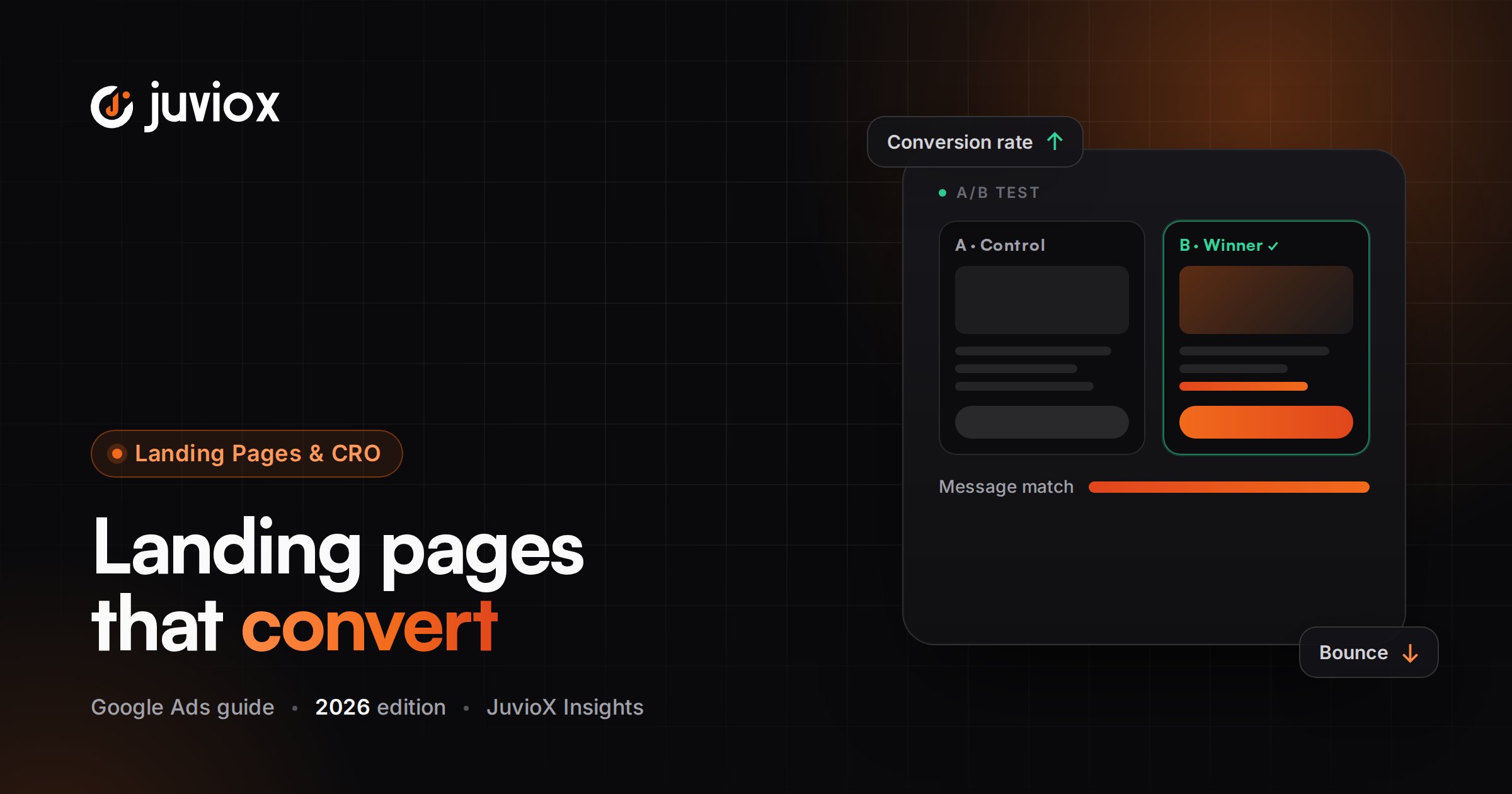
A Better Landing Page CRO Testing Framework
1. Define the business problem, not merely ‘increase CVR.’
2. Choose the segment: campaign, intent, device, location or audience.
3. Write a hypothesis tied to user behavior.
4. Change one meaningful concept or a coherent message family.
5. Keep tracking and conversion definitions stable.
6. Run long enough for useful traffic and conversion maturity.
7. Evaluate both conversion rate and qualified/customer outcomes.
8. Check whether the change affected CPC/Quality diagnostics indirectly through relevance.
9. Document the result and learning.
10. Roll out winners cautiously and continue monitoring.
EXAMPLE HYPOTHESIS
Not ‘make button orange.’ Better: ‘High-intent visitors hesitate because pricing expectations are unclear; adding a starting-price qualifier above the form will reduce raw leads but improve qualified-lead rate and cost per qualified lead.’
Landing Page Examples by Business Model
| Business | Strong Page Direction |
|---|---|
| Local service | Service + area + urgency + trust + phone/form + availability |
| B2B agency/service | Problem + outcome + proof + process + qualification + consultation CTA |
| SaaS | Use case + product proof + integrations/security + demo/trial CTA |
| Ecommerce | Product/category match + price + reviews + shipping/returns + purchase CTA |
| High-ticket professional service | Eligibility + authority + process + case evidence + consultation/application |
These are frameworks, not guaranteed templates. The right structure depends on intent, risk, buying cycle and traffic source.
Google Ads Landing Page Audit Checklist
- Search intent mapped to page
- Ad promise matches hero
- Primary CTA matches ad CTA
- Offer is immediately clear
- Page targets one coherent intent
- Benefits/outcomes are specific
- Proof is real and relevant
- Qualification is intentional
- Form fields have a business purpose
- Mobile form tested
- Page speed tested
- No intrusive UX blocking CTA
- Navigation supports rather than distracts
- Destination URL/domain works correctly
- No unintended redirects
- Conversion tag fires only on success
- Value/transaction ID correct where relevant
- GA4/Ads tracking validated
- Qualified/customer outcome available where possible
- Landing Page Experience reviewed
- Search terms reviewed against destination
- Performance Max URL expansion audited
- AI Max Search URL expansion audited if enabled
- Non-commercial URLs excluded where necessary
- CRO hypothesis backlog maintained
Common Google Ads Landing Page Mistakes
| Mistake | Why It Hurts | Better Approach |
|---|---|---|
| Sending every ad to homepage | Breaks intent specificity | Use the most relevant destination |
| Repeating keyword everywhere | Creates awkward copy without true usefulness | Match meaning and expectations |
| Optimizing only for Quality Score | Diagnostic becomes the goal | Optimize business performance |
| Optimizing only form CVR | Can increase poor-quality leads | Track qualified/customer outcomes |
| Removing all navigation automatically | Can reduce trust/context | Remove only harmful distraction |
| Adding excessive form friction | Can block good prospects | Use purposeful qualification |
| Ignoring mobile | Post-click experience varies by device | Test real mobile UX |
| Ignoring page speed | Paid clicks reach a slow experience | Improve technical performance |
| Using fake proof | Damages trust and compliance | Use verified evidence only |
| Leaving PMax URL expansion unaudited | Traffic may reach unintended pages | Use exclusions/page feeds/controls |
| Treating CRO as random design tweaks | No learning accumulates | Use hypotheses and measurement |
Final Takeaway: The Landing Page Is Part of the Campaign
Google Ads does not end at the click. The landing page determines whether the intent you paid for becomes a useful customer action.
Build the page around the user’s reason for searching. Continue the ad promise. Make the next step obvious. Provide enough proof and information for the decision. Remove unnecessary friction without removing useful qualification. Make the mobile experience fast and reliable. Then measure beyond raw conversion rate into qualified leads, customers and revenue.
When targeting, ads, landing pages, tracking and CRO operate as one system, paid traffic becomes much easier to diagnose and scale.
WEB DESIGN & CRO + GOOGLE ADS
Turn More Paid Clicks Into Qualified Customers
JuvioX connects Google Ads strategy, landing-page design, conversion tracking and CRO so the post-click experience is optimized around measurable business growth.
FAQ
Frequently asked questions
What is a Google Ads landing page?
It is the webpage a user reaches after clicking an ad, usually the ad's Final URL, although features such as Final URL expansion can select another relevant same-domain page in supported campaigns.
Do I need a separate landing page for Google Ads?
Not always. Use a dedicated page when it provides a clearer intent and conversion experience than the existing site page. A strong service, category or product page can also work.
Can I send Google Ads traffic to my homepage?
Yes when the homepage genuinely matches the user's intent, especially for broad brand/company searches. For specific high-intent queries, a more relevant page is usually preferable.
What is Landing Page Experience in Google Ads?
It is a Quality Score component that evaluates how relevant and useful the landing page experience is for users who click the ad.
Does Landing Page Experience affect Quality Score?
Yes. It is one of the three reported Quality Score components alongside Expected CTR and Ad Relevance.
Does Quality Score directly determine my Google Ads CPC?
The visible 1-10 Quality Score is a diagnostic and is not itself an auction input. Auction-time ad quality does affect eligibility, Ad Rank and cost dynamics.
How do I improve Below Average Landing Page Experience?
Check search-term relevance, message match, usefulness, mobile UX, navigation, speed, page specificity and whether the page meets the expectations created by the ad.
What is message match?
It is the consistency between the user's search intent, the ad's promise and the landing page's headline, offer, content and CTA.
What conversion rate should a Google Ads landing page have?
There is no universal good rate. It varies by industry, offer, intent, device and conversion definition. Compare qualified/customer economics rather than chasing a generic benchmark.
Should a Google Ads landing page have navigation?
It depends. Remove distracting paths, but keep navigation or supporting links when they materially improve trust, comprehension or the decision process.
How important is landing page speed for Google Ads?
Very important for user experience, especially on mobile, but speed is not a substitute for relevance, usability and a strong offer.
What are Google Ads landing page requirements?
The destination must work, comply with Google Ads destination policies, use appropriate domain/redirect behavior and provide a functional, useful user experience.
What is Performance Max Final URL expansion?
It lets Performance Max replace the submitted Final URL with another relevant page from the same domain based on user intent. It is currently on by default and can be managed with URL exclusions and page feeds.
Does AI Max for Search change landing pages?
AI Max can use Final URL expansion to send users to query-relevant pages from the domain. Advertisers should review URL expansion and exclusion controls when opting in.
Should I optimize my landing page for Quality Score or conversions?
Use Quality Score/Landing Page Experience as diagnostics, but optimize for qualified conversions, customers, revenue and profit.
How should I A/B test a Google Ads landing page?
Start with a user/business hypothesis, keep tracking stable, test a meaningful change, allow enough conversion maturity and judge both conversion rate and downstream quality.
12 sources & references
- Google Ads Help - Landing page definition
- Google Ads Help - About Quality Score for Search campaigns
- Google Ads Help - Using Quality Score to improve performance
- Google Ads Help - About ad quality
- Google Ads Help - What matters for ad quality
- Google Ads Help - Optimize your ads and landing pages
- Google Ads Help - Evaluate landing-page performance
- Google Ads Policies - Destination requirements
- Google Ads Help - About Final URL expansion in Performance Max
- Google Ads Help - Improve Performance Max with Final URL expansion
- Google Ads Help - Common AI-based controls for Performance Max
- Google Ads Help - About Final URL expansion in Search / AI Max